
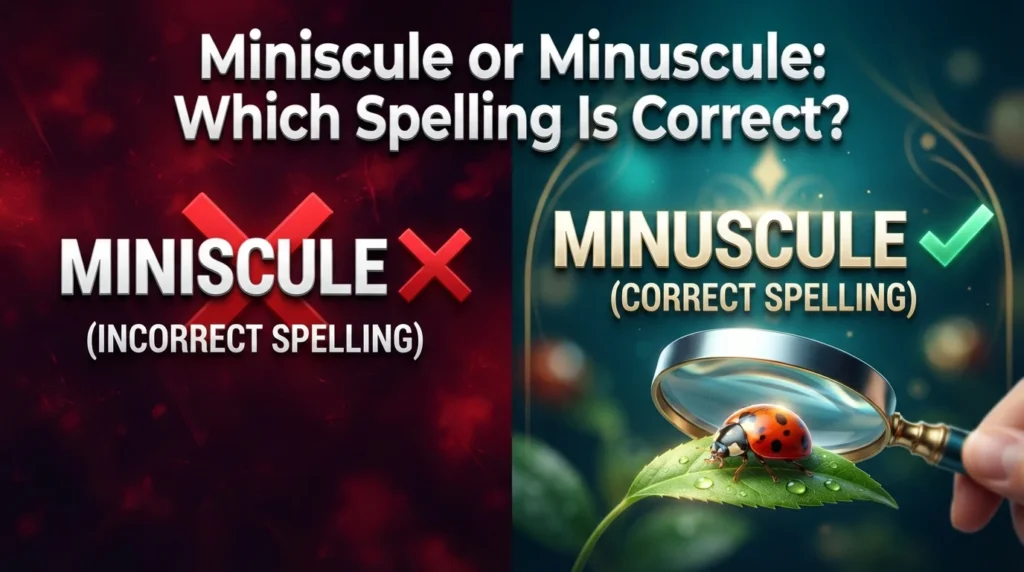

Quick Ans: Minuscule is the correct spelling in standard English. Miniscule is a common misspelling.
| Word Box |
|---|
| Correct spelling: MINUSCULE ✅ |
If you have ever wondered whether to write miniscule or minuscule, you are definitely not alone. These two spellings are often confused because they look and sound almost the same. Still, only one of them is accepted as the correct form in standard English.
The correct word is minuscule. It means extremely small, tiny, or very unimportant compared to something larger. The spelling miniscule appears often in writing, but it is generally considered wrong in formal English.
This article explains the difference between miniscule or minuscule, shows you which one is correct, gives simple examples, and helps you remember the spelling forever.
Miniscule vs. Minuscule: Which One Is Correct?
The correct spelling is minuscule.
It is the standard English word used to describe something very small in size, amount, or importance.
The spelling miniscule is usually a mistake. Many people assume that because the word sounds like “mini,” it should be written with mini-. But that is not how the word is spelled.
Here is the simple comparison:
| Word | Correct? | Meaning |
| Minuscule | ✅ Yes | Extremely small; tiny |
| Miniscule | ❌ No | Common spelling mistake |
Why Is It Minuscule and Not Miniscule?
The reason is historical. The word minuscule comes from a Latin root connected with smallness. It does not come from the word mini.
That is why the spelling starts with minus- rather than mini-.
Many English speakers hear the word and naturally think of “mini,” so they write miniscule. That mistake is very common, but the standard spelling remains minuscule.
A helpful way to remember it is this:
small = minuscule
mini = not the spelling
So when you are writing in essays, blogs, emails, or professional documents, use minuscule.
What Does Minuscule Mean?
The word minuscule has a few closely related meanings, all centered around the idea of smallness.
1. Very Small in Size
This is the most common meaning.
For example:
- The insect was minuscule.
- We found a minuscule crack in the wall.
- The house had a minuscule kitchen.
2. Very Small in Amount
It can also describe a quantity that is tiny or insignificant.
For example:
- The company made a minuscule profit.
- There was only a minuscule amount of sugar left.
- The change in price was minuscule.
3. Unimportant or Trivial
Sometimes the word is used figuratively to show that something is very minor.
For example:
- The issue seemed minuscule compared to the bigger problem.
- Their disagreement was minuscule in the grand scheme of things.
- The difference between the two results was minuscule.
Examples of Minuscule in Sentences
Here are many examples that show how minuscule is used correctly:
- The handwriting was so minuscule that I could barely read it.
- A minuscule amount of dust covered the shelf.
- The difference between the two options was minuscule.
- She noticed a minuscule tear in her dress.
- The amount of water left in the bottle was minuscule.
- He paid a minuscule fee for the service.
- That detail may seem minuscule, but it matters.
- The child held a minuscule toy in his hand.
- The chances of success were minuscule.
- A minuscule error can sometimes cause a big problem.
Common Mistake: Miniscule
Because the pronunciation sounds similar to the word mini, many writers mistakenly write miniscule.
For example:
❌ The difference was miniscule.
✅ The difference was minuscule.
❌ She found a miniscule piece of paper.
✅ She found a minuscule piece of paper.
❌ The amount was miniscule.
✅ The amount was minuscule.
This is a spelling error that even advanced English users make. Still, if you want polished and correct writing, minuscule is the word you should choose.
Easy Way to Remember the Correct Spelling
A simple memory trick is to connect the word to smallness, not to mini.
Think:
minuscule = miniature + small
Even though that is not the word’s actual origin, it helps many learners remember the correct spelling because the word refers to something tiny.
You can also remember this short rule:
MINUSCULE has “us” in the middle, not “i.”
That tiny difference can save you from a spelling mistake.
Another useful memory line is:
Mini looks right, but minuscule is correct.
Minuscule in Different Contexts
The word minuscule works in many different contexts. It is useful in academic writing, business writing, daily conversation, and descriptive language.
In Everyday English
- The room was minuscule.
- The amount of coffee left was minuscule.
- Their apartment was minuscule but cozy.
In Business or Work Writing
- The error had a minuscule effect on the final report.
- The cost difference was minuscule.
- We saw only a minuscule improvement this quarter.
In Academic or Formal Writing
- The sample size was minuscule.
- The change in results was minuscule.
- The impact of the adjustment was minuscule.
In Descriptive Writing
- A minuscule sparkle appeared in the distance.
- The artist painted a minuscule dot of white.
- A minuscule insect crawled across the page.
Why People Get Confused
There are a few reasons why miniscule and minuscule are so often mixed up.
First, the word is not used as often in casual speech as some simpler words like small or tiny. That makes it harder to remember the exact spelling.
Second, many people assume that English spelling follows pronunciation more closely than it actually does. Since minuscule sounds a little like mini, the mistaken spelling feels natural.
Third, auto-correct and quick typing can reinforce the wrong version if someone has seen it written incorrectly many times before.
That is why it helps to slow down and remember the correct form: minuscule.
Synonyms for Minuscule
If you want to vary your writing, you can use other words with similar meanings.
Some common synonyms are:
- tiny
- tiny little
- microscopic
- minute
- small
- little
- negligible
- insignificant
For example:
- The mistake was minuscule.
- The mistake was tiny.
- The mistake was negligible.
Even though these words are similar, minuscule often sounds more formal and precise.
Minuscule vs. Mini: Are They Related?
People often think minuscule and mini must be connected because both suggest something small.
In meaning, they are similar. But in spelling, minuscule is not built from mini. That is why replacing the beginning with mini creates the incorrect spelling miniscule.
So while the meaning feels similar, the correct form is still:
minuscule
not
miniscule
More Correct Examples
Here are some more examples to help make the spelling familiar:
- The price increase was minuscule.
- The gap between the two scores was minuscule.
- They noticed a minuscule flaw in the design.
- The difference in weight was minuscule.
- He wrote the note in minuscule handwriting.
- There was a minuscule chance of rain.
- Her role in the project was minuscule.
- The stain was minuscule, so no one noticed it.
- The food portions looked minuscule.
- A minuscule amount of ink spilled on the page.
Quick Comparison
| Feature | Minuscule | Miniscule |
| Standard spelling | ✅ Yes | ❌ No |
| Means extremely small | ✅ Yes | ❌ Usually no |
| Used in formal writing | ✅ Yes | ❌ Avoid |
| Common mistake | No | Yes |
Frequently Asked Questions
Is miniscule or minuscule correct?
Minuscule is correct.
Is miniscule a real word?
In standard English, miniscule is generally treated as a misspelling of minuscule.
What does minuscule mean?
It means very small, tiny, or insignificant.
How do you spell the word for tiny?
The correct spelling is minuscule.
What is an easy trick to remember it?
Remember that the correct word is related to smallness, not mini. The spelling is minuscule.
Conclusion
When deciding between miniscule or minuscule, the correct spelling is minuscule. It is the standard English word for something very small, tiny, or unimportant. The spelling miniscule is a common mistake, but it should be avoided in formal and professional writing.
If you want clear, correct, and polished English, always choose minuscule.