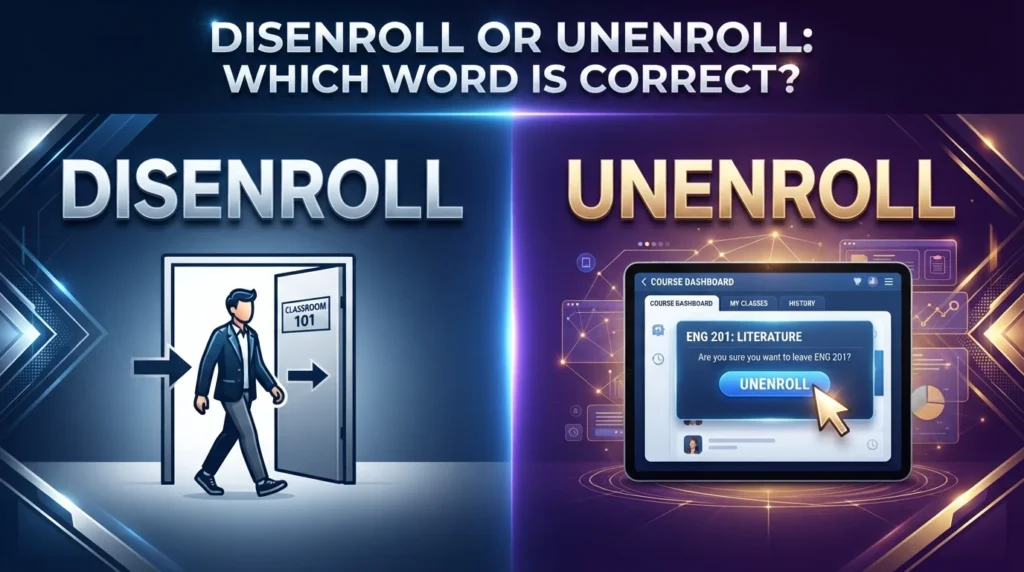

Quick Ans: Unenroll is the more common and standard spelling in modern English, especially in American usage. Disenroll is also a real word, but it is much less common and usually appears in more formal, institutional, or regional contexts.
| Quick Word Box |
|---|
| Common choice: unenroll |
| Less common choice: disenroll |
| Best everyday use: unenroll |
| Main idea: remove someone from enrollment |
If you are wondering whether to write disenroll or unenroll, you are dealing with a pair of words that look similar but are not used in exactly the same way. Both words can appear in English, but they are not equally common, and the safer choice in most everyday writing is usually unenroll.
This article explains the difference between disenroll and unenroll, shows how each word is used, and gives clear examples so you can choose the right one with confidence. It also includes a comparison chart, practical sentence examples, common mistakes, FAQs, and a final conclusion to make the difference easy to remember.
Disenroll vs. Unenroll: What Is the Difference?
At a basic level, both words relate to ending enrollment.
- Unenroll means to remove someone from an enrollment system, class, service, or program.
- Disenroll also means to remove someone from enrollment, but it is less common and often sounds more administrative or formal.
In modern everyday English, especially in American writing, unenroll is usually the word people expect to see. It is the more natural choice for school, online courses, subscriptions, memberships, and general use.
In simple terms:
- Unenroll = the most common, natural choice
- Disenroll = correct in some contexts, but less common
Which Word Should You Use?
If you are writing for a blog, school, email, website, support page, or general communication, unenroll is usually the better choice.
For example:
- You can unenroll from the course anytime.
- Click here to unenroll from notifications.
- The student requested to unenroll from the program.
The word disenroll can also be used, especially in official or institutional language, but it is not the default choice for most casual or general writing.
For example:
- The patient was disenrolled from the insurance plan.
- The organization may disenroll members who do not meet the requirements.
Why Is Unenroll More Common?
The prefix un often means “reverse” or “remove.” That makes unenroll feel very direct and easy to understand.
The prefix oftenmple:
enroll → unenroll
This is why many English speakers prefer it. It follows a pattern that looks familiar and clear.
The prefix dis can also indicate removal or reversal, which is why disenroll exists. However, it is used less often in everyday speech and writing.
So, while both words are understandable, unenroll is generally the easier and more widely accepted choice in everyday contexts.
What Does Disenroll Mean?
Disenroll means to remove someone from a list, program, membership, or enrollment.
It is often used in official, administrative, or policy-related writing.
Examples:
- The agency may disenroll a person who no longer qualifies.
- The member was disenrolled from the plan after missing payments.
- The school will disenroll students who fail to complete registration.
In these examples, disenroll gives a formal tone. It is not wrong, but it sounds more official than unenroll.
What Does Unenroll Mean?
Unenroll means to stop being enrolled in something or to remove someone from an enrollment status.
This is the more common word in education, online platforms, subscriptions, training programs, and everyday communication.
Examples:
- I want to unenroll from the class.
- You can unenroll from the email list at any time.
- She decided to unenroll from the workshop.
- The app lets users unenroll from notifications easily.
Because unenroll is more familiar and more flexible, it is often preferred in modern English.
Disenroll or Unenroll in Sentences
Here are some clear examples that show how both words work.
Using Unenroll
- Please unenroll from the course before the deadline.
- I forgot how to unenroll from that program.
- Students can unenroll online in just a few steps.
- He decided to unenroll after the first week.
- You may unenroll from automatic renewal anytime.
Using Disenroll
- The office may disenroll members who do not submit documents.
- The patient was disenrolled from the health plan.
- The system will disenroll inactive users after 30 days.
- She was disenrolled due to eligibility changes.
These examples show that both words can be used, but unenroll is the cleaner choice for general communication.
Which One Sounds More Natural?
For most people, unenroll sounds more natural.
That is especially true in the following situations:
- School classes
- Online learning platforms
- Subscription cancellations
- Email lists
- Training programs
- Membership settings
- App notifications
If you are writing a message to students, users, customers, or readers, unenroll will usually feel more direct and friendly.
Disenroll, on the other hand, feels more bureaucratic. It may appear in documents, policies, government materials, healthcare language, or official systems.
Common Mistakes With Disenroll and Unenroll
One common mistake is assuming that both words are fully interchangeable in every situation. While they are close in meaning, style and usage matter.
Another mistake is using the less familiar word simply because it sounds more formal, even when the context is casual.
For example:
❌ You can disenroll from our newsletter anytime.
✅ You can unenroll from our newsletter anytime.
That second version sounds more natural and user-friendly.
Another example:
❌ I need to disenroll from the class.
✅ I need to unenroll from the class.
Again, unenroll is usually the better choice in ordinary writing.
Easy Way to Remember the Difference
A simple memory trick is this:
- Unenroll is the word you will probably use most often.
- Disenroll is the more formal or official-sounding version.
Think of it this way:
enroll → unenroll
This is the pattern most people recognize immediately.
If you are writing for general readers, unenroll is usually the safest option.
Comparison Table: Disenroll vs. Unenroll
| Feature | Disenroll | Unenroll |
| Basic meaning | Remove from enrollment | Remove from enrollment |
| Common in everyday English | Less common | More common |
| Tone | Formal, official | Clear, natural, everyday |
| Best for school/work/email | Sometimes | Usually yes |
| Best overall choice | Context-dependent | Most situations |
When to Use Disenroll
You may choose disenroll when the context is more official or administrative.
For example:
- insurance plans
- government systems
- eligibility rules
- institutional policies
- formal notices
In those situations, disenroll may fit the tone better.
Example:
- The participant may be disenrolled if eligibility requirements change.
This sounds like policy language, which is why disenroll can be acceptable in formal settings.
When to Use Unenroll
Use unenroll when you want simple, clear, everyday English.
It is usually the best choice for:
- class registration pages
- learning apps
- newsletters
- online courses
- membership settings
- customer support instructions
Example:
- Tap here to unenroll from the course.
This is short, clear, and easy to understand.
Disenroll or Unenroll: Which Is Better for Writing?
For most writers, unenroll is better.
Why?
Because it is:
- more common
- easier to understand
- more natural in everyday speech
- better for general audiences
Disenroll is not wrong, but it is less familiar. That means readers may pause for a moment, especially if they are not used to formal administrative language.
So, when in doubt, choose unenroll.
Frequently Asked Questions
Is disenroll or unenroll correct?
Both can be correct depending on context, but unenroll is usually the more common and natural choice.
Is unenroll a real word?
Yes. Unenroll is a real and widely used word in modern English.
Is disenroll a real word?
Yes, disenroll is also a real word, but it is less common and more formal.
Which one should I use in casual writing?
Use unenroll.
Which one should I use in official writing?
Either may work depending on the organization, but disenroll is sometimes preferred in formal policy or administrative language.
Are disenroll and unenroll the same?
They are very close in meaning, but unenroll is usually the better choice for general writing, while disenroll sounds more formal.
Final Verdict
If you are choosing between disenroll or unenroll, the safest and most natural choice in most situations is unenroll. It is easier to read, more commonly used, and better suited to everyday English.
Disenroll is also a valid word, but it is less common and more formal. That makes it better for certain official or administrative contexts.
So the simple rule is:
Use unenroll for general writing.
Use disenroll only when the formal context calls for it.
| Final Word Box |
| Best everyday word: unenroll |
| Formal alternative: disenroll |
| Remember: choose the word that fits the tone |
Conclusion
The difference between disenroll and unenroll is mostly about usage and tone. Both words refer to removing someone from enrollment, but unenroll is the more common and natural word in modern English. If you are writing for students, customers, readers, or general audiences, unenroll is usually the best choice. Disenroll can still be used in formal or official settings, but it is less familiar and less common. When you want your writing to sound clear, simple, and correct, unenroll is the word to trust.