
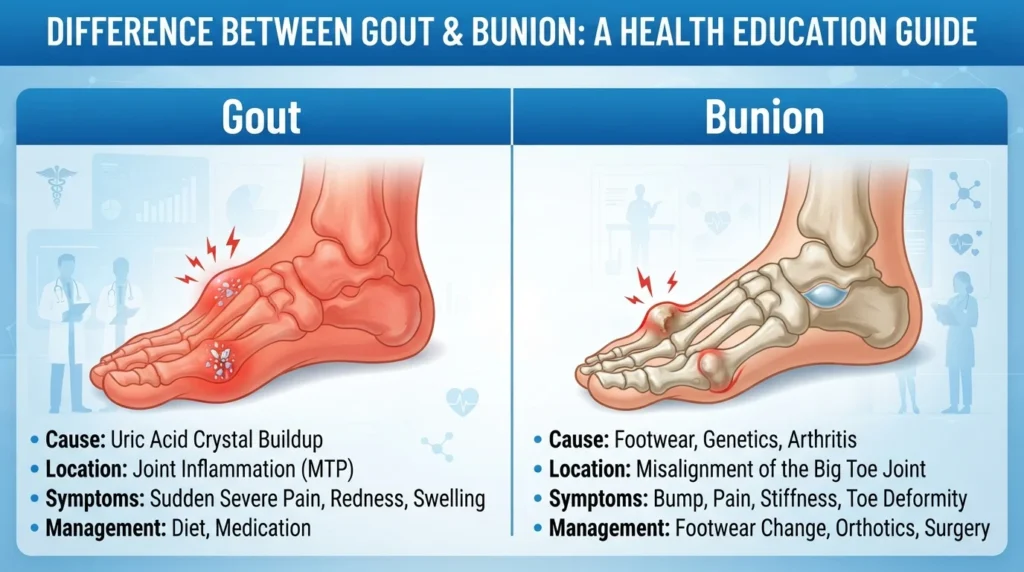

Quick Ans: Gout and bunion are not the same condition. Although both can cause pain around the big toe, gout is a type of inflammatory arthritis caused by a buildup of uric acid crystals in the joints, while a bunion is a bony bump that forms at the base of the big toe due to changes in foot structure. Knowing the difference is important because each condition has different causes, symptoms, and treatments.
Many people confuse gout or bunion because both often affect the big toe and can make walking painful. However, they are completely different medical conditions. One is caused by inflammation inside the joint, while the other develops because of changes in the bones and alignment of the foot.
Understanding the differences between gout and bunions can help you recognize symptoms early and seek the right treatment.
Gout or Bunion: What’s the Difference?
What Is Gout?
Gout is a form of inflammatory arthritis.
It occurs when excess uric acid in the blood forms sharp crystals inside a joint, leading to sudden attacks of severe pain, swelling, redness, and warmth.
The condition most commonly affects the joint at the base of the big toe, although it can also affect the ankles, knees, wrists, and elbows.
Examples:
- He woke up with severe gout pain in his big toe.
- The doctor diagnosed her with gout after blood tests.
- Medication helped reduce the inflammation caused by gout.
What Is a Bunion?
A bunion is a bony bump that develops on the joint at the base of the big toe.
It forms gradually as the big toe pushes toward the second toe, causing the joint to stick outward.
Unlike gout, a bunion is a structural foot problem rather than a type of arthritis.
Examples:
- She bought wider shoes because of her bunion.
- The surgeon recommended treatment for the painful bunion.
- Wearing tight shoes can make a bunion worse.
| Condition | Type | Correct Meaning |
|---|---|---|
| Gout | Medical Condition | A form of inflammatory arthritis caused by uric acid crystals |
| Bunion | Foot Deformity | A bony bump that forms at the base of the big toe |
Quick Recap
- Gout is a type of arthritis.
- Bunion is a structural foot deformity.
- Both can affect the big toe but have different causes and treatments.
- They are not interchangeable.
Is Gout or Bunion a Grammar, Vocabulary, or Medical Usage Issue?
Grammar
No.
This is not a grammar issue.
Vocabulary
Yes.
The confusion comes from using two different medical terms incorrectly.
Medical Usage
Yes.
Using gout when you mean bunion, or vice versa, can create misunderstandings because they describe different conditions.
Are Gout and Bunion Interchangeable?
No.
Although both conditions may affect the same area of the foot, they cannot replace one another.
Medical Writing
Doctors use gout only when referring to inflammatory arthritis caused by uric acid.
They use bunion only when referring to the bony deformity of the big toe joint.
Everyday Conversation
Many people mistakenly call any painful big toe a bunion or gout without knowing the actual cause.
A proper medical diagnosis is important.
Understanding Gout
Meaning
Gout is a painful form of arthritis caused by uric acid crystals collecting inside a joint.
It often develops suddenly and may last several days.
Workplace Example
He missed work because a severe gout attack made walking impossible.
Medical Example
The physician prescribed medication to reduce inflammation caused by gout.
Everyday Example
His big toe became swollen overnight due to gout.
Usage Recap
Use gout when referring to:
- Uric acid crystal buildup
- Inflammatory arthritis
- Sudden joint pain
- Swollen and red joints
Understanding Bunion
Meaning
A bunion is a permanent bony bump that forms on the joint at the base of the big toe.
It usually develops slowly over many years.
Medical Example
The podiatrist examined the patient’s bunion and recommended supportive footwear.
Lifestyle Example
Wearing narrow shoes may worsen a bunion over time.
Everyday Example
She found it difficult to wear heels because of her bunion.
Usage Recap
Use bunion when referring to:
- A bony bump
- Foot alignment problems
- Structural deformity
- Long-term foot changes
Why Do People Confuse Gout and Bunions?
Both conditions commonly affect the big toe.
However, their causes are completely different.
Gout develops because of inflammation caused by uric acid crystals.
Bunions develop because the bones in the foot gradually shift out of alignment.
Since both may cause pain, redness, and difficulty walking, people often assume they are the same condition.
Symptoms: Gout vs. Bunion
Gout Symptoms
- Sudden severe pain
- Swelling
- Redness
- Warmth around the joint
- Pain often starts overnight
Bunion Symptoms
- Visible bump near the big toe
- Toe leaning toward the second toe
- Difficulty wearing tight shoes
- Long-term discomfort
- Gradual progression
When You Should Not Confuse Gout and Bunions
Common Situations to Avoid
Do not call every painful toe gout.
Do not describe every bump on the foot as gout.
Do not assume every swollen toe is a bunion.
Always seek medical advice if symptoms are severe or persistent.
Common Mistakes and Decision Rules
Common Mistakes
| Correct Sentence | Incorrect Sentence | Explanation |
|---|---|---|
| He has gout in his toe. | He has a bunion attack. | Bunions do not cause sudden attacks like gout. |
| She has a bunion on her foot. | She has gout growing on her foot. | Gout does not create a permanent bony bump. |
| Gout is a type of arthritis. | A bunion is arthritis. | A bunion is a structural deformity, not arthritis. |
| The doctor treated his gout. | The doctor removed his gout surgically. | Surgery is more common for severe bunions than gout. |
Decision Rule
Use gout when referring to inflammation caused by uric acid crystals.
Use bunion when referring to a bony deformity of the big toe joint.
Gout and Bunions in Modern Healthcare
Healthcare professionals diagnose gout through symptoms, blood tests, and sometimes joint fluid analysis.
Bunions are usually diagnosed through a physical examination and X-rays.
Because treatments differ significantly, identifying the correct condition is essential.
Expert Opinion
Medical experts agree that although gout and bunions may affect the same joint, they are entirely different disorders.
Accurate diagnosis ensures patients receive the appropriate treatment and avoid unnecessary complications.
Case Studies
Case Study One
A patient believed he had a bunion because of severe pain near his big toe.
After medical testing, doctors diagnosed gout and treated it successfully with medication.
Case Study Two
A woman thought she had gout because her big toe hurt while walking.
An examination revealed a large bunion, and supportive footwear helped relieve her symptoms.
Error Prevention Checklist
Always Use Gout When
- Referring to inflammatory arthritis
- Discussing uric acid crystals
- Describing sudden joint attacks
- Talking about swollen, hot joints
Always Use Bunion When
- Referring to a bony bump
- Discussing foot deformities
- Talking about toe alignment
- Describing structural changes in the foot
Related Medical Word Confusions You Should Master
- Sprain or Strain
- Arthritis or Arthralgia
- Fracture or Break
- Corn or Callus
- Tendon or Ligament
- Bruise or Hematoma
- Acute or Chronic
- Infection or Inflammation
- Osteoporosis or Osteoarthritis
- Sciatica or Herniated Disc
Frequently Asked Questions
Is gout the same as a bunion?
No.
They are completely different medical conditions.
Can gout cause a bunion?
No.
Gout does not cause bunions, although both may affect the same toe.
Which is more painful, gout or a bunion?
A gout attack is usually much more painful because it causes sudden inflammation.
Can you have both gout and a bunion?
Yes.
A person can have both conditions at the same time.
Does a bunion always require surgery?
No.
Many bunions can be managed with proper footwear, orthotics, and other non-surgical treatments.
Is gout permanent?
Gout is a chronic condition, but attacks can often be controlled with medication and lifestyle changes.
Conclusion
When comparing gout or bunion, remember that they are entirely different conditions. Gout is a painful form of inflammatory arthritis caused by uric acid crystal buildup, while a bunion is a structural deformity that creates a bony bump at the base of the big toe. Although both may affect the same joint, they have different causes, symptoms, and treatments. Understanding the distinction can help you seek the right medical care and avoid confusion.