
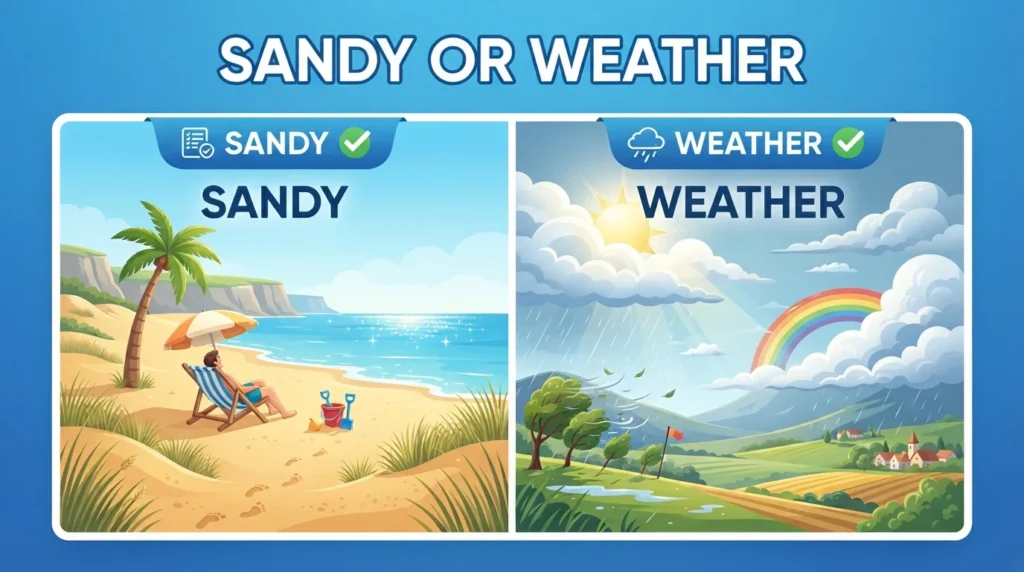

Quick Ans: Sandy and weather are completely different words and cannot be used interchangeably. Sandy describes something covered with or consisting of sand, while weather refers to atmospheric conditions such as sunshine, rain, wind, snow, or temperature. If you’re talking about climate or conditions outside, use weather. If you’re describing beaches, deserts, or anything containing sand, use sandy.
English has many words that sound unrelated yet still confuse learners because they appear in similar contexts. One such example is sandy or weather. While these words have entirely different meanings, some writers accidentally use one in place of the other, especially when describing outdoor environments.
Understanding the difference between sandy and weather will help you write more clearly and avoid confusing your readers.
This guide explains the meaning of each word, how to use them correctly, common mistakes, and practical examples.
Sandy or Weather: What’s the Difference?
What Does Sandy Mean?
Sandy is an adjective.
It describes something that contains, resembles, or is covered with sand.
Examples:
- The beach has sandy shores.
- We walked across the sandy desert.
- His shoes became sandy after the hike.
What Does Weather Mean?
Weather is a noun.
It refers to the condition of the atmosphere at a particular time and place, including temperature, wind, rain, sunshine, humidity, and storms.
Examples:
- The weather is beautiful today.
- Heavy weather delayed the flight.
- Check the weather forecast before traveling.
| Word | Part of Speech | Correct Usage | Meaning |
|---|---|---|---|
| Sandy | Adjective | ✅ Yes | Covered with or made of sand |
| Weather | Noun | ✅ Yes | Atmospheric conditions |
Quick Recap
- Sandy describes places or objects that contain sand.
- Weather describes atmospheric conditions.
- They have completely different meanings.
- They cannot replace each other in a sentence.
Is Sandy or Weather a Grammar, Vocabulary, or Usage Issue?
Grammar
No.
This is not a grammar issue because both words belong to different parts of speech.
Vocabulary
Yes.
Choosing between sandy and weather depends entirely on their meanings.
Usage
Yes.
Using one instead of the other changes the meaning of a sentence and creates confusion.
Are Sandy and Weather Interchangeable?
No.
Although both words are often used when talking about the outdoors, they describe different things.
Formal Writing
Use sandy when describing terrain or surfaces.
Use weather when discussing climate or atmospheric conditions.
Casual Writing
The same rule applies in everyday conversations, text messages, and social media posts.
Understanding Sandy
Meaning
Sandy means covered with, consisting of, or resembling sand.
It is commonly used to describe beaches, deserts, soil, roads, and clothing.
Workplace Example
The construction crew worked on sandy ground before laying the foundation.
Academic Example
The geography teacher explained how sandy soil drains water quickly.
Literature Example
The novel described a long walk across sandy dunes.
Everyday Example
The children returned home with sandy feet after playing at the beach.
Usage Recap
Use sandy when referring to:
- Beaches
- Deserts
- Soil
- Roads
- Shoes or clothes covered with sand
Understanding Weather
Meaning
Weather refers to the condition of the atmosphere over a short period of time.
It includes:
- Rain
- Sunshine
- Wind
- Snow
- Temperature
- Humidity
- Storms
Workplace Example
Employees were allowed to work from home because of severe weather.
Academic Example
Students studied how weather patterns affect agriculture.
News Example
The weather forecast predicted heavy rainfall throughout the weekend.
Everyday Example
The weather is perfect for a picnic today.
Usage Recap
Use weather when talking about:
- Forecasts
- Climate conditions
- Rain
- Snow
- Wind
- Sunshine
- Temperature
Why Do People Confuse Sandy and Weather?
The confusion usually happens because both words are often used in outdoor or travel-related conversations.
For example:
- A sandy beach
- Sunny weather
Although they may appear in the same sentence, they describe different things.
A beach can be sandy, while the day’s weather can be sunny, rainy, or windy.
When You Should Not Use Sandy or Weather
Common Situations to Avoid
Do not write:
❌ The sandy forecast looks good.
❌ Today’s sandy is beautiful.
❌ The beach has warm weather on the ground.
Always write:
✅ The weather forecast looks good.
✅ Today’s weather is beautiful.
✅ The beach has sandy shores.
Common Mistakes and Decision Rules
Common Mistakes
| Correct Sentence | Incorrect Sentence | Explanation |
|---|---|---|
| The beach is sandy. | The beach is weather. | Sandy describes the beach. |
| The weather is warm today. | The sandy is warm today. | Weather refers to atmospheric conditions. |
| We walked across sandy dunes. | We walked across weather dunes. | Sandy modifies dunes. |
| Check the weather forecast. | Check the sandy forecast. | Forecast relates to weather. |
Decision Rule
If you are talking about:
- Sand or beaches → Sandy
- Rain, wind, temperature, or climate → Weather
Sandy and Weather in Everyday English
Both words are common in daily conversations but serve different purposes.
Travel writers often describe sandy beaches and pleasant weather together.
Using the correct word helps readers clearly understand whether you’re describing the land or the atmosphere.
Expert Opinion
English dictionaries classify sandy as an adjective and weather as a noun.
Because they belong to different grammatical categories and have unrelated meanings, they should never be substituted for one another.
Case Studies
Case Study One
A travel blogger wrote, “The island has beautiful weather beaches.”
After editing the sentence to “The island has beautiful sandy beaches,” the description became accurate and natural.
Case Study Two
A student wrote, “Today’s sandy is cloudy.”
The teacher corrected it to “Today’s weather is cloudy,” explaining that weather describes atmospheric conditions.
Error Prevention Checklist
Always Use Sandy When
- Describing beaches
- Talking about deserts
- Referring to sand-covered surfaces
- Describing sandy soil
- Talking about dunes
Always Use Weather When
- Discussing forecasts
- Talking about rain or snow
- Describing temperature
- Referring to storms
- Explaining climate conditions
Related Word Confusions You Should Master
- Weather or Whether
- Desert or Dessert
- Beach or Shore
- Sand or Soil
- Affect or Effect
- Accept or Except
- Than or Then
- Principal or Principle
- Complement or Compliment
- Stationary or Stationery
Frequently Asked Questions
Is sandy or weather correct?
Both are correct, but they have different meanings and are used in different contexts.
What does sandy mean?
It means covered with or consisting of sand.
What does weather mean?
Weather refers to atmospheric conditions such as rain, wind, sunshine, and temperature.
Can sandy replace weather?
No.
They have completely different meanings.
Is weather a noun?
Yes.
Weather is a noun that describes atmospheric conditions.
Is sandy an adjective?
Yes.
It describes something that contains or is covered with sand.
Conclusion
When comparing sandy or weather, remember that these words are not synonyms and cannot be used interchangeably. Sandy describes something that contains or is covered with sand, while weather refers to atmospheric conditions like rain, sunshine, wind, or temperature. Using the correct word ensures your writing is accurate, natural, and easy to understand.