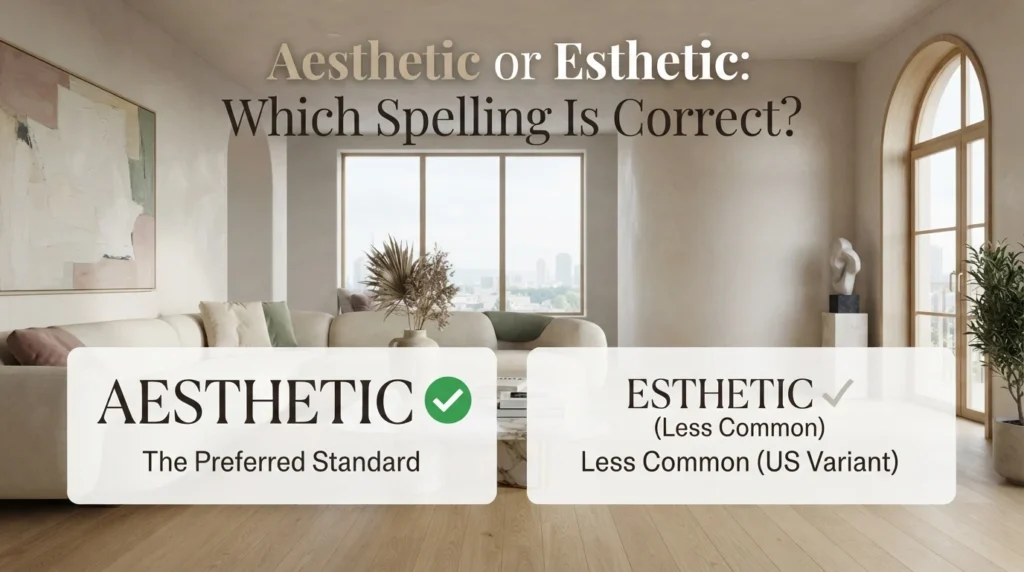

Quick Ans: Both aesthetic and esthetic are correct spellings. However, aesthetic is the preferred and far more common spelling in modern English worldwide, while esthetic is a simplified American variant that appears much less frequently.
If you’ve ever searched for aesthetic or esthetic, you’re probably wondering which spelling you should use. The two words look almost identical and even have the same pronunciation, making them one of the most commonly confused spelling pairs in English.
The good news is that both words are correct. The difference isn’t in their meaning it’s mainly in spelling preference and regional usage. Today, aesthetic is the standard spelling used in books, newspapers, universities, blogs, business writing, and most online content. Esthetic, on the other hand, is a less common American spelling that you’ll occasionally encounter in dictionaries, academic texts, or older publications.
In this complete guide, you’ll learn the difference between aesthetic and esthetic, discover which spelling is more common, understand their meanings, explore grammar rules, compare British and American English, and see plenty of real-life examples so you’ll never confuse these words again.
Aesthetic vs. Esthetic: Which One Is Correct?
The answer is simple:
- ✅ Aesthetic The preferred and most widely used spelling.
- ✅ Esthetic Also correct but much less common.
Although both spellings are accepted by major dictionaries, aesthetic is the version you’ll see in the overwhelming majority of modern writing.
Whether you’re writing a blog post, essay, email, website content, academic paper, or social media caption, aesthetic is usually the safest choice.
| Word | Correct? | Usage |
| Aesthetic | ✅ Yes | Standard spelling used worldwide |
| Esthetic | ✅ Yes | Less common American variant |
What Does Aesthetic Mean?
The word aesthetic relates to beauty, appearance, artistic taste, or the appreciation of art and design.
It can function as both an adjective and a noun.
As an adjective, it describes something visually pleasing or connected with beauty.
As a noun, it refers to a person’s artistic principles or sense of beauty.
Examples as an Adjective
- She loves minimalist aesthetic designs.
- The room has a modern aesthetic.
- Their website has a clean aesthetic appearance.
- His photography follows a vintage aesthetic style.
Examples as a Noun
- Her personal aesthetic is inspired by nature.
- The artist developed a unique aesthetic over many years.
- Fashion trends often influence people’s aesthetic.
What Does Esthetic Mean?
Esthetic means exactly the same thing as aesthetic.
There is no difference in definition.
The only distinction is spelling preference.
For example:
- The building has an esthetic appeal.
- Her esthetic sense is impressive.
These sentences are grammatically correct.
However, many editors would still replace esthetic with aesthetic because it is the more common spelling.
Why Are There Two Spellings?
The difference exists because English has evolved over centuries.
The original word comes from the Greek word aisthētikos, meaning related to perception or sensation.
Later, the word entered English through Latin and French, becoming aesthetic.
In American English, some publishers preferred dropping the opening “a”, creating the simplified spelling esthetic.
Over time, however, aesthetic became the dominant spelling almost everywhere.
Today, you’ll find aesthetic far more often than esthetic in books, newspapers, websites, and academic writing.
Which Spelling Is More Common?
Without question, aesthetic.
Search engines, universities, dictionaries, magazines, and professional editors overwhelmingly recommend aesthetic.
You’ll commonly see it in:
- Interior design
- Fashion
- Graphic design
- Photography
- Architecture
- Literature
- Beauty industry
- Social media
- Marketing
- Education
Although esthetic is still accepted, it appears much less frequently.
If you want your writing to look natural and professional, choose aesthetic.
British English vs. American English
Many people believe esthetic is the American spelling while aesthetic is the British spelling.
This isn’t completely true.
Both British and American dictionaries recognize aesthetic.
In fact, most Americans also write aesthetic.
The spelling esthetic exists mainly as an alternative American variant but is relatively uncommon.
British English
✅ Aesthetic
American English
✅ Aesthetic (most common)
✅ Esthetic (accepted but less common)
Aesthetic as an Adjective
Most people use aesthetic as an adjective.
It describes something attractive or related to beauty.
Examples:
- The office has an elegant aesthetic design.
- Her home has a Scandinavian aesthetic.
- We wanted an aesthetic website.
- The painting has remarkable aesthetic value.
- Their café offers a cozy aesthetic atmosphere.
Aesthetic as a Noun
As a noun, aesthetic refers to a person’s artistic style or appreciation of beauty.
Examples:
- His aesthetic is modern and simple.
- She changed her entire aesthetic after college.
- Every designer develops their own aesthetic.
- The brand has a recognizable aesthetic.
Common Mistakes
Many learners make these mistakes.
Mistake #1: Thinking Esthetic Is Wrong
❌ Esthetic is incorrect.
This is false.
Both spellings are correct.
Mistake #2: Using Esthetic Everywhere
Although correct, esthetic is much less common.
Professional writing usually favors aesthetic.
Mistake #3: Mixing Spellings
Avoid switching between the two spellings in the same article.
Choose one style and stay consistent.
For most writers, that choice should be aesthetic.
Easy Trick to Remember the Difference
A simple memory trick is this:
Think of Art.
Both Art and Aesthetic begin with the letter A.
Since aesthetic is closely connected with art and beauty, remembering the letter A makes choosing the correct spelling much easier.
Remember:
Art → Aesthetic ✅
Not:
Art → Esthetic
This trick helps many learners remember the preferred spelling instantly.
Examples of Aesthetic in Sentences
Here are some examples of the correct usage.
- The café has a beautiful aesthetic.
- She prefers a minimalist aesthetic.
- His Instagram page has a consistent aesthetic.
- The hotel combines luxury with a natural aesthetic.
- Our designer created an elegant aesthetic for the website.
- The painting has great aesthetic value.
- Modern homes often follow a Scandinavian aesthetic.
- Their clothing brand focuses on a vintage aesthetic.
- The room’s aesthetic makes it feel peaceful.
- Good lighting improves the overall aesthetic of a photograph.
Aesthetic vs. Esthetic: Quick Comparison
| Feature | Aesthetic | Esthetic |
| Correct spelling | ✅ Yes | ✅ Yes |
| Most common spelling | ✅ Yes | ❌ No |
| Preferred in professional writing | ✅ Yes | ❌ Rarely |
| British English | ✅ Standard | Rare |
| American English | ✅ Most common | Less common |
| Meaning | Beauty or artistic appearance | Same meaning |
Remember: If you’re unsure whether to use aesthetic or esthetic, choose aesthetic. It’s the spelling readers expect to see.
Frequently Asked Questions
Is aesthetic or esthetic correct?
Both spellings are correct, but aesthetic is much more common and widely preferred.
Which spelling should I use?
For almost all writing situations, use aesthetic.
Is esthetic wrong?
No.
It is an accepted alternative spelling, mainly found in American English.
Why is aesthetic more popular?
Because it has become the standard spelling used by publishers, universities, businesses, dictionaries, and websites around the world.
Do they have different meanings?
No.
They have exactly the same meaning.
The difference is only in spelling preference.
Which spelling is better for SEO and blogging?
Aesthetic is generally the better choice because it is searched and recognized far more often by readers.
Conclusion
When choosing between aesthetic or esthetic, remember that both spellings are correct, but aesthetic is the clear winner in modern English. It is the preferred spelling in professional writing, education, publishing, marketing, and everyday communication. Unless you’re following a specific style guide that prefers esthetic, you should confidently use aesthetics. It is more familiar to readers, more common online,and the best choice for blogs, websites, assignments, and business documents.