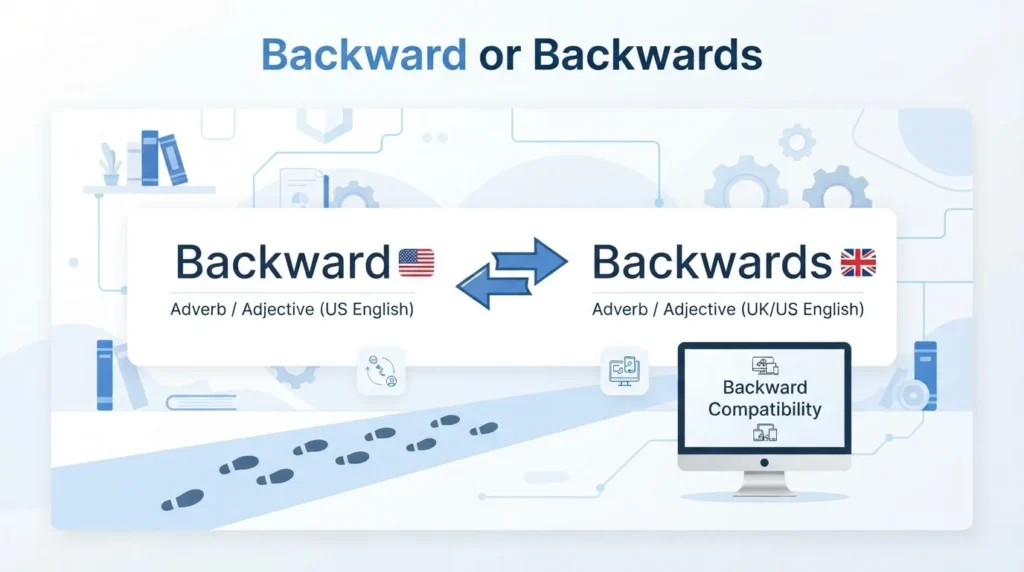

Quick Ans: Both backward and backwards are correct, but their usage depends on the variety of English you are using. Backward is more common in American English, while backwards is preferred in British English. In most situations, both words have the same meaning and can be used interchangeably.
English has many words that differ slightly between American and British English, and backward or backwards is a common example. Many writers wonder whether adding the “s” changes the meaning or whether one spelling is grammatically incorrect.
Fortunately, the answer is simple.
This guide explains the difference between backward and backwards, when to use each one, common mistakes to avoid, and examples from everyday English.
Backward or Backwards: What’s the Difference?
What Does Backward Mean?
Backward can function as an adjective or an adverb.
It commonly means:
- Toward the back.
- In the reverse direction.
- Behind the normal level of progress or development.
Examples:
- Take one backward step.
- The car rolled backward.
- The country remained economically backward.
What Does Backwards Mean?
Backwards is primarily an adverb.
It has the same meaning as backward when describing movement in the reverse direction.
It is especially common in British English.
Examples:
- He walked backwards without looking.
- Please move backwards a little.
- The clock seemed to run backwards.
| Word | Part of Speech | Correct Word | Common Usage |
|---|---|---|---|
| Backward | Adjective / Adverb | ✅ Yes | Preferred in American English |
| Backwards | Adverb | ✅ Yes | Preferred in British English |
Quick Recap
- Both backward and backwards are correct.
- Backward is more common in American English.
- Backwards is more common in British English.
- The meaning is usually the same.
Is Backward or Backwards a Grammar, Vocabulary, or Usage Issue?
Grammar
No.
Both forms are grammatically correct.
Vocabulary
Yes.
The difference mainly depends on regional vocabulary preferences.
Usage
Yes.
American writers usually prefer backward, while British writers often choose backwards.
Are Backward and Backwards Interchangeable?
In most situations, yes.
Both words describe movement in the reverse direction.
However, if you are writing for a specific audience, it is better to follow that audience’s regional English style.
Formal Writing
For American English:
- backward compatibility
- backward movement
- backward thinking
For British English:
- walk backwards
- look backwards
- move backwards
Casual Writing
Both words sound natural in everyday conversation.
Choose the version that matches your audience.
Understanding Backward
Meaning
Backward means moving toward the rear or being less advanced than expected.
It can describe physical movement, progress, education, technology, or development.
Workplace Example
The software supports backward compatibility with older systems.
Academic Example
Researchers studied why some regions remained economically backward.
Literature Example
The character took a backward glance before leaving.
Everyday Example
The child accidentally stepped backward.
Usage Recap
Use backward when referring to:
- Reverse movement
- Older technology compatibility
- Lack of progress
- American English writing
Understanding Backwards
Meaning
Backwards means moving in the opposite direction or toward the back.
It is the preferred everyday form in British English.
Sports Example
The goalkeeper jumped backwards to stop the ball.
Everyday Example
She walked backwards while talking to her friend.
Technology Example
The animation suddenly started playing backwards.
Usage Recap
Use backwards when:
- Writing in British English.
- Describing reverse movement.
- Referring to something operating in reverse.
Why Do People Get Confused Between Backward and Backwards?
The confusion exists because both words have the same meaning.
Unlike many spelling differences, neither word is incorrect.
The only real difference is regional preference.
American English usually drops the final “s” in words like:
- toward
- forward
- backward
British English often keeps the “s”:
- towards
- forwards
- backwards
Historical Background
Historically, both forms have existed for centuries.
Over time, American English gradually preferred shorter forms such as backward, forward, and toward, while British English continued using backwards, forwards, and towards more frequently.
Today, both spellings remain standard.
When You Should Not Use Backward or Backwards
Common Situations to Avoid
Do not mix American and British spelling styles in the same article.
Avoid writing:
- backward (American style)
- towards (British style)
in the same sentence unless you intentionally mix dialects.
Choose one style and stay consistent throughout your writing.
Common Mistakes and Decision Rules
Common Mistakes
| Correct Sentence | Incorrect Sentence | Explanation |
|---|---|---|
| The car moved backward. | ❌ The car moved backwardly. | “Backwardly” is rarely used and sounds unnatural. |
| She walked backwards. | ❌ She walked backwardsly. | “Backwardsly” is incorrect. |
| The software offers backward compatibility. | ❌ The software offers backwards compatibility. | “Backward compatibility” is the standard technical term. |
| He looked backwards. | ✅ Correct in British English. | Common regional usage. |
Decision Rule
Use backward if:
- You are writing in American English.
- You are referring to backward compatibility.
- You are describing something less developed.
Use backwards if:
- You are writing in British English.
- You are describing reverse movement in everyday language.
Backward and Backwards in Modern Technology
The phrase backward compatibility is the accepted technical term worldwide.
Software companies, hardware manufacturers, and developers almost always use backward compatibility, even in British English documentation.
Because of this, backward is the preferred form in technology writing.
Expert Opinion
Major dictionaries, including Merriam-Webster and the Cambridge Dictionary, recognize both backward and backwards as correct.
The difference is primarily regional rather than grammatical.
Case Studies
Case Study One
An American software company consistently used backward compatibility in its product documentation because it is the industry standard.
Case Study Two
A British travel guide instructed visitors to walk backwards carefully while leaving a narrow pathway.
The wording matched standard British English usage.
Error Prevention Checklist
Always Use Backward When
- Writing in American English.
- Referring to backward compatibility.
- Describing limited progress.
- Following U.S. style guides.
Use Backwards When
- Writing in British English.
- Describing movement in reverse.
- Following UK spelling conventions.
- Writing for British readers.
Related Word Confusions You Should Master
- Forward or Forwards
- Toward or Towards
- Among or Amongst
- While or Whilst
- Grey or Gray
- Traveler or Traveller
- Canceled or Cancelled
- Practice or Practise
- Affect or Effect
- Than or Then
Frequently Asked Questions
Is backward or backwards correct?
Both are correct.
Backward is preferred in American English, while backwards is more common in British English.
Is backward American English?
Yes.
American English generally prefers backward.
Is backwards British English?
Yes.
British English commonly uses backwards.
Which one should I use in technical writing?
Use backward, especially in the phrase backward compatibility.
Do backward and backwards have different meanings?
No.
In most situations, they have the same meaning.
Can I use both in the same article?
It is better to choose one style and remain consistent throughout the article.
Conclusion
When comparing backward or backwards, both words are correct and share the same meaning. The main difference lies in regional English usage. Backward is the preferred choice in American English and is the standard term in technical phrases like backward compatibility, while backwards is more common in British English for describing reverse movement. Choosing the right form depends on your audience, but maintaining consistency throughout your writing is the most important rule.