
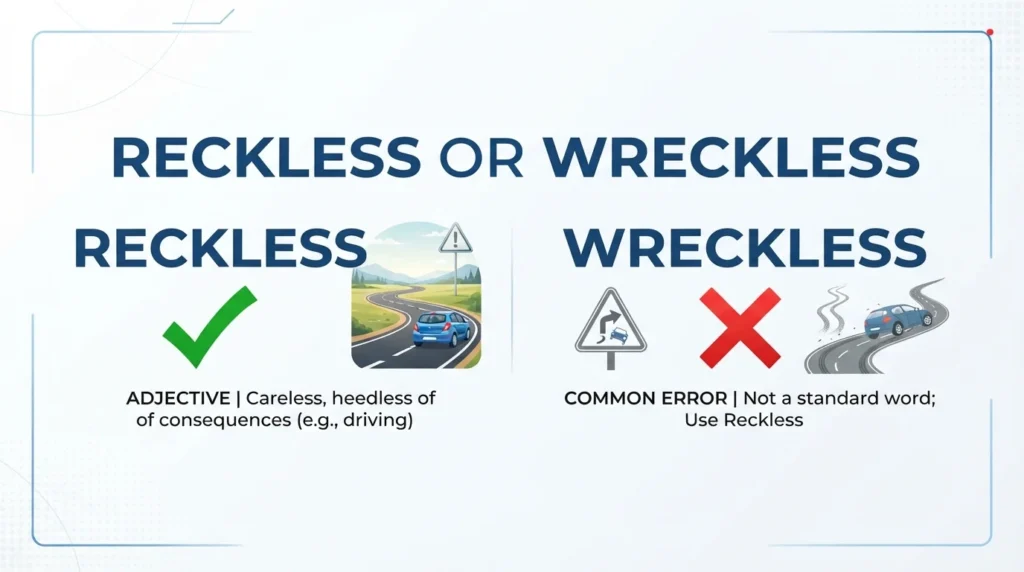

Quick Ans: Reckless is the correct spelling. Wreckless is a common misspelling and is not considered standard English. Although many people think wreckless makes sense because a reckless person often causes wrecks, dictionaries and style guides recognize reckless as the only correct spelling.
English contains many words that are easy to misspell because they sound logical in another form. One such example is reckless or wreckless. Since the word wreck refers to destruction or accidents, many writers mistakenly assume that wreckless should describe someone who causes wrecks.
However, English spelling follows historical language development rather than modern logic.
This guide explains the difference between reckless and wreckless, why the confusion exists, and how to use the correct spelling in every situation.
Reckless or Wreckless: What’s the Difference?
What Does Reckless Mean?
Reckless is an adjective.
It describes someone who acts without thinking about the possible consequences or dangers of their actions.
A reckless person often ignores safety, rules, or the feelings of others.
Examples:
- He made a reckless decision.
- Reckless driving can cause serious accidents.
- The investor made several reckless financial choices.
What Does Wreckless Mean?
Wreckless is not a standard English word.
Although some people use it informally or humorously, it is considered a spelling mistake in professional, academic, and everyday writing.
| Word | Part of Speech | Correct Word | Meaning |
|---|---|---|---|
| Reckless | Adjective | ✅ Yes | Acting without care or considering danger |
| Wreckless | Misspelling | ❌ No | Incorrect spelling of reckless |
Quick Recap
- Reckless is the correct spelling.
- Wreckless is a misspelling.
- Always use reckless in formal and informal writing.
Is Reckless or Wreckless a Grammar, Vocabulary, or Usage Issue?
Grammar
No.
This is not a grammar issue.
Vocabulary
Yes.
It is a vocabulary and spelling issue.
Usage
Yes.
Using wreckless instead of reckless is considered incorrect in standard English.
Are Reckless and Wreckless Interchangeable?
No.
Only reckless is recognized as a correct English word.
Formal Writing
Always write reckless in:
- Academic essays
- Business reports
- News articles
- Professional communication
Casual Writing
Even in text messages and social media posts, reckless remains the correct spelling.
Understanding Reckless
Meaning
Reckless describes behavior that is careless, irresponsible, or dangerous because someone does not think about the possible results.
Workplace Example
The manager warned employees against making reckless decisions that could harm the company.
Academic Example
The history teacher discussed how the king’s reckless actions led to conflict.
Literature Example
The novel’s main character was known for his reckless bravery.
Everyday Example
Driving without wearing a seat belt is reckless.
Usage Recap
Use reckless when describing:
- Careless behavior
- Dangerous decisions
- Risky actions
- Irresponsible choices
Understanding Wreckless
Meaning
Wreckless has no official meaning in standard English.
It is simply a misspelling of reckless.
Internet Example
Some social media posts use wreckless, but dictionaries still recognize reckless as the correct spelling.
Writing Example
Grammar-checking software usually marks wreckless as an error.
Usage Recap
Avoid using wreckless in:
- Essays
- Articles
- Emails
- Business documents
- Academic writing
Why Do People Spell It as Wreckless?
Many people associate the word reckless with wreck, especially because reckless driving often causes car wrecks.
As a result, they mistakenly believe wreckless is the correct spelling.
However, the word reckless comes from the older English word reck, meaning “to care” or “to pay attention.”
Adding -less creates the meaning without care.
That is why reckless is historically and grammatically correct.
Historical Background of the Word Reckless
The word reckless comes from Middle English.
It developed from the verb reck, meaning “to care,” “to pay attention,” or “to consider.”
Over time, reckless came to describe someone who acts without care or concern for consequences.
The spelling has remained unchanged for centuries.
When You Should Not Use Wreckless
Common Situations to Avoid
Do not write:
❌ Wreckless driving
❌ Wreckless behavior
❌ Wreckless decisions
❌ Wreckless actions
Always write:
✅ Reckless driving
✅ Reckless behavior
✅ Reckless decisions
✅ Reckless actions
Common Mistakes and Decision Rules
Common Mistakes
| Correct Sentence | Incorrect Sentence | Explanation |
|---|---|---|
| Reckless driving is dangerous. | Wreckless driving is dangerous. | Reckless is the correct spelling. |
| She made a reckless decision. | She made a wreckless decision. | Wreckless is incorrect. |
| His reckless behavior caused problems. | His wreckless behavior caused problems. | Always use reckless. |
| The company avoided reckless spending. | The company avoided wreckless spending. | Reckless is the accepted word. |
Decision Rule
If you mean someone who acts carelessly or without thinking about the consequences, always use reckless.
Never use wreckless in standard English.
Reckless in Modern Writing and Technology
Modern dictionaries, search engines, AI writing assistants, and grammar tools all recognize reckless as the standard spelling.
Most spelling checkers automatically suggest replacing wreckless with reckless.
Using the correct spelling improves clarity and professionalism.
Expert Opinion
Language experts agree that reckless is the only accepted spelling.
The confusion exists because people naturally associate reckless behavior with causing wrecks, but that connection does not affect the word’s historical spelling.
Case Studies
Case Study One
A student repeatedly used wreckless in an English essay.
The teacher corrected every instance to reckless, explaining that wreckless is a spelling error.
Case Study Two
A company published a road safety article using the phrase wreckless driving.
After proofreading, the content was updated to reckless driving, making it grammatically correct and more professional.
Error Prevention Checklist
Always Use Reckless When
- Describing dangerous behavior
- Talking about careless decisions
- Writing professionally
- Creating academic content
- Referring to risky actions
Never Use Wreckless When
- Writing articles
- Sending business emails
- Preparing reports
- Writing essays
- Publishing online content
Related Word Confusions You Should Master
- Careless or Careful
- Affect or Effect
- Accept or Except
- Principal or Principle
- Than or Then
- Complement or Compliment
- Lose or Loose
- Stationary or Stationery
- Imply or Infer
- Discreet or Discrete
Frequently Asked Questions
Is reckless or wreckless correct?
Reckless is the correct spelling.
Is wreckless a real English word?
No.
It is considered a misspelling of reckless.
Why do people write wreckless?
Because they associate reckless behavior with causing wrecks.
What does reckless mean?
It means acting carelessly without considering the risks or consequences.
Can I use wreckless in formal writing?
No.
Always use reckless in professional, academic, and everyday writing.
Is reckless an adjective?
Yes.
It describes a person, action, or behavior that is careless or dangerous.
Conclusion
When comparing reckless or wreckless, only reckless is correct. It is the standard English spelling used to describe someone who acts without thinking about the possible consequences of their actions. Although wreckless may seem logical because reckless behavior often causes wrecks, it is considered a spelling mistake by dictionaries and grammar experts. Remember this simple rule: whenever you describe careless or dangerous behavior, always write reckless.