
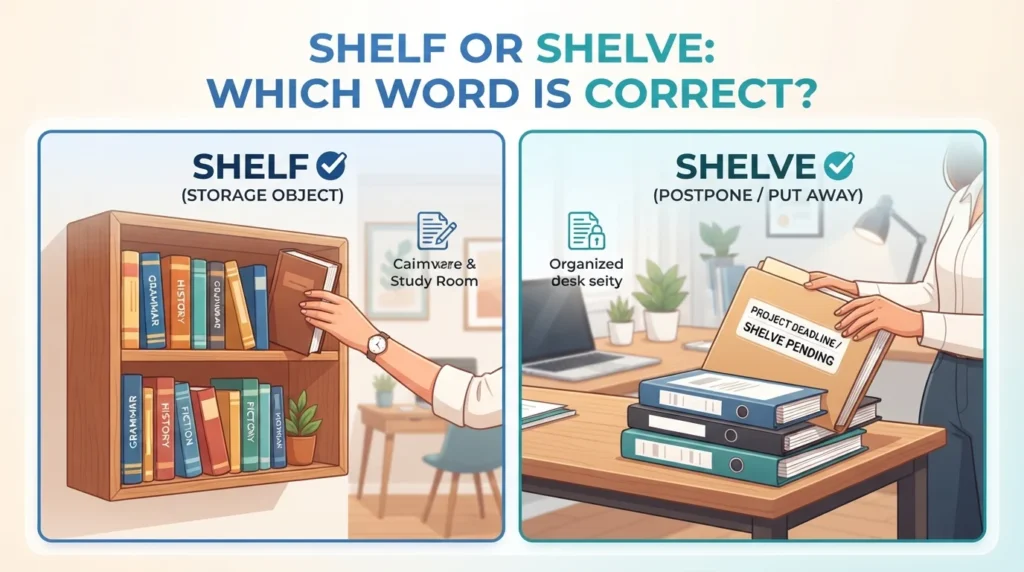

Quick Ans: These two words look and sound very similar, which is why many English learners get confused between them. Although they are related, they have completely different meanings and are used in different situations.
The correct choice depends on whether you are talking about a physical object used for storing things or an action of placing something aside or postponing a plan.
In this detailed guide, we will explain the difference between shelf and shelve, their meanings, grammar rules, examples, common mistakes, and easy ways to remember which word to use.
Shelf vs. Shelve: Which One Is Correct?
Both shelf and shelve are correct English words, but they are not interchangeable.
A shelf is a noun. It refers to a flat surface attached to a wall, inside a cupboard, or part of a bookcase where things are stored.
A shelve is a verb. It means to place something on a shelf or to delay, postpone, or stop a plan or idea.
Word Comparison Box
| Word | Part of Speech | Meaning | Example |
|---|---|---|---|
| Shelf | Noun | A flat surface used for storing items | The books are on the shelf. |
| Shelve | Verb | To put something away or postpone something | They decided to shelve the project. |
What Does Shelf Mean?
The word shelf is a noun that describes a flat, horizontal surface used for holding or displaying objects.
Shelves are commonly found in homes, offices, libraries, stores, and kitchens. People use them to organize books, decorations, food items, and other belongings.
Examples of Shelf in Sentences
- I placed the vase on the top shelf.
- The library has thousands of books on every shelf.
- My favorite books are kept on the wooden shelf.
- She cleaned the kitchen shelf before arranging the dishes.
- The store displays products on a large shelf.
In all these examples, shelf refers to a physical place where something can be stored.
What Does Shelve Mean?
The word shelve is a verb. It has two main meanings.
1. To Put Something on a Shelf
The first meaning of shelve is to place something on a shelf.
For example:
- She shelved the books after reading them.
- He carefully shelved the files in alphabetical order.
Here, shelve means putting something onto a shelf.
2. To Postpone or Delay Something
The second and more common meaning of shelve is to delay a plan, idea, or project.
When someone decides not to continue something for now, they can shelve it.
Examples:
- The company decided to shelve the new product idea.
- They had to shelve their travel plans because of bad weather.
- The government shelved the proposal after discussions.
In these sentences, nobody is physically putting something on a shelf. Instead, the word means delaying or putting something aside.
Why Do People Confuse Shelf and Shelve?
The confusion happens because these words come from the same root and look almost identical.
The main difference is the final letter:
Shelf = Thing (Noun)
Shelve = Action (Verb)
A simple way to understand:
- A shelf is something you can touch.
- To shelve is something you do.
For example:
I put the book on the shelf.
Here, shelf is the object.
I decided to shelve the book idea.
Here, shelve is an action.
Shelf or Shelve: Grammar Difference
Understanding their grammar roles makes the difference much easier.
Shelf as a Noun
A noun names a person, place, thing, or idea.
Examples:
- The picture is on the shelf.
- This shelf is made of wood.
- The upper shelf is difficult to reach.
Shelve as a Verb
A verb describes an action.
Examples:
- Please shelve these documents.
- They will shelve the discussion until next month.
- The team decided to shelve the project.
Singular and Plural Forms
The plural form of shelf is shelves.
This spelling change is important.
Examples:
- One shelf
- Two shelves
- Many shelves
For example:
- The room has five wooden shelves.
- The library contains hundreds of shelves.
The verb form changes differently:
- Shelve
- Shelved
- Shelving
Examples:
- They shelved the plan.
- She is shelving the old files.
Common Mistakes With Shelf and Shelve
Many people use these words incorrectly because they focus only on spelling.
Mistake 1: Using Shelf as a Verb
Incorrect:
❌ I will shelf this project.
Correct:
✅ I will shelve this project.
The action requires the verb shelve.
Mistake 2: Using Shelve for a Physical Object
Incorrect:
❌ The book is on the shelve.
Correct:
✅ The book is on the shelf.
The object where the book sits is a shelf.
Mistake 3: Confusing Shelves and Shelves
Incorrect:
❌ The books are on the book shelve.
Correct:
✅ The books are on the book shelf.
Remember:
Shelf = singular object
Shelves = more than one object
Examples of Shelf in Everyday Life
Here are some common examples:
- The clock is hanging above the shelf.
- I found an old photo on the bottom shelf.
- The supermarket filled every shelf with products.
- The toy was placed on a high shelf.
- She organized her shoes on the shoe shelf.
Examples of Shelve in Everyday Life
Examples of shelve as an action:
- The manager decided to shelve the idea.
- They shelved the meeting until next week.
- The writer shelved the unfinished novel.
- The company may shelve the project temporarily.
- He shelved his personal plans to focus on work.
Easy Trick to Remember Shelf vs Shelve
Use this simple memory trick:
Shelf = Storage Place
A shelf is a place where things stay.
Example:
The book is on the shelf.
Shelve = Something You Do
Shelve is an action.
Example:
They decided to shelve the plan.
Remember:
Shelf is a thing. Shelve is an action.
Shelf or Shelve in Professional Writing
Both words are commonly used in professional English, but choosing the correct one is important.
Businesses often use shelve when discussing delayed projects.
Example:
The company decided to shelve the expansion plan.
Libraries, offices, and stores commonly use shelf.
Example:
The documents are stored on the second shelf.
Using these words correctly makes your writing clearer and more professional.
Frequently Asked Questions
Is shelf or shelve correct?
Both are correct words, but they have different meanings. Shelf is a noun, while shelve is a verb.
What is the plural of shelf?
The plural of shelf is shelves.
Example:
The books are arranged on several shelves.
Does shelve mean to cancel?
Not always. Shelve usually means to postpone or delay something. It does not always mean permanently canceling it.
Can shelve be used for books?
Yes. It can mean placing books on a shelf.
Example:
The librarian shelved the new books.
How can I remember the difference?
Remember:
Shelf = Place
Shelve = Action
Quick Comparison Box
| Word | Meaning | Usage |
| Shelf | A flat storage surface | The book is on the shelf. |
| Shelve | To place away or postpone | They shelved the project. |
Conclusion
Understanding the difference between shelf and shelve is simple once you remember their roles. A shelf is a physical object used for storing things, while shelve is a verb that describes an action, such as putting something on a shelf or postponing an idea.
Whenever you are talking about a place where items are stored, use shelf. When you are describing an action of delaying, organizing, or putting something away, use shelve.
The easiest rule to remember is:
Shelf = Thing
Shelve = Action
Using these words correctly will make your English writing more accurate and professional.