
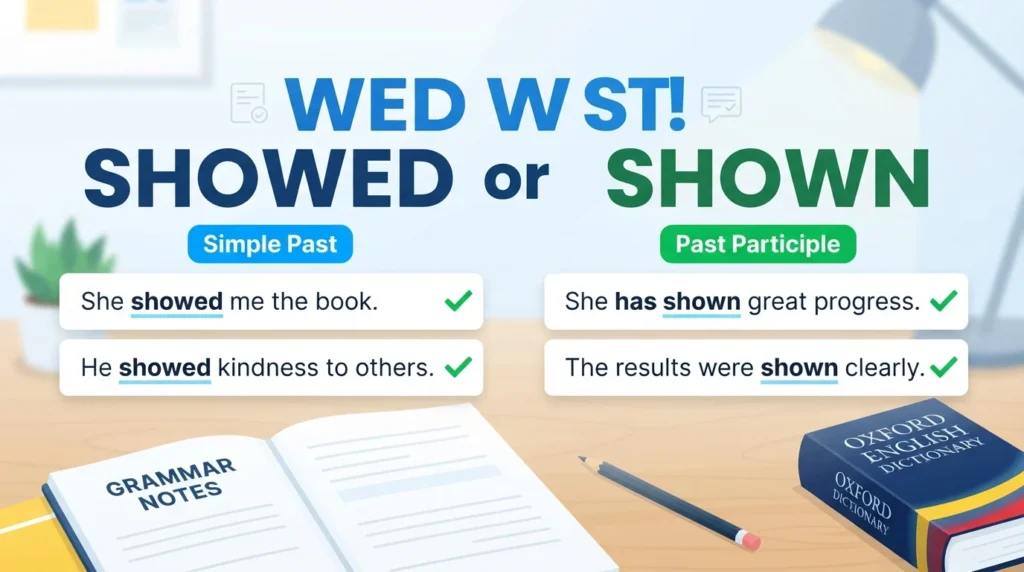

Quick Ans: Both showed and shown are correct, but they are not interchangeable. Showed is the simple past tense of show, while shown is the past participle and is used with helping verbs such as has, have, had, is, was, were, and been. Understanding the difference helps you write grammatically correct English in both formal and everyday situations.
Many English learners confuse showed or shown because both words describe something that happened in the past. However, they serve different grammatical purposes. Using the wrong one can make your sentence sound awkward or grammatically incorrect.
This guide explains the difference between showed and shown, when to use each one, common mistakes, and simple rules to help you choose the correct word every time.
Showed or Shown: What’s the Difference?
What Does Showed Mean?
Showed is the simple past tense of the verb show.
It describes an action that happened and was completed in the past.
Examples:
- She showed me her new phone.
- The teacher showed the students how to solve the problem.
- He showed great kindness during the meeting.
What Does Shown Mean?
Shown is the past participle of show.
It is used with helping verbs such as has, have, had, was, were, is, are, and been.
Examples:
- She has shown remarkable progress.
- The results were shown on the screen.
- They had shown interest before the meeting.
| Word | Verb Form | Correct Word | Usage |
|---|---|---|---|
| Showed | Simple Past | ✅ Yes | Past action completed |
| Shown | Past Participle | ✅ Yes | Used with helping verbs |
Quick Recap
- Showed = Simple past tense.
- Shown = Past participle.
- Showed stands alone.
- Shown usually follows a helping verb.
Is Showed or Shown a Grammar, Vocabulary, or Usage Issue?
Grammar
Yes.
This is primarily a grammar issue involving different verb forms.
Vocabulary
No.
Both words come from the same verb.
Usage
Yes.
Choosing the correct verb form depends on the sentence structure.
Are Showed and Shown Interchangeable?
No.
Although both come from the verb show, they perform different grammatical functions.
Formal Writing
Use the correct verb tense.
Examples:
- The report showed an increase in sales.
- The report has shown consistent growth over time.
Casual Writing
The same grammar rules apply in conversations and social media.
Understanding Showed
Meaning
Showed refers to an action that happened in the past and is complete.
Workplace Example
The manager showed the team the new project timeline.
Academic Example
The experiment showed positive results.
Literature Example
The author showed the character’s emotions through dialogue.
Everyday Example
She showed me her vacation photos.
Usage Recap
Use showed when:
- Describing a completed past action.
- No helping verb is present.
- Writing in the simple past tense.
Understanding Shown
Meaning
Shown is the past participle of show.
It must usually be used with a helping verb.
Business Example
The company has shown significant improvement.
Academic Example
The findings were shown during the presentation.
Technology Example
The error has shown up several times.
Usage Recap
Use shown after helping verbs such as:
- has
- have
- had
- is
- was
- were
- been
Why Do People Confuse Showed and Shown?
Many learners think both words are simply past tense forms because they describe past events.
The real difference is grammatical.
- Showed is the simple past.
- Shown is the past participle.
English has many irregular verbs that follow this same pattern.
For example:
- Write → Wrote → Written
- Break → Broke → Broken
- Show → Showed → Shown
Historical Background of the Verb Show
The verb show has existed in English for centuries.
Over time, showed became the regular simple past form, while shown developed as the standard past participle used in perfect and passive constructions.
Today, both forms remain standard English.
When You Should Not Use Showed or Shown
Common Situations to Avoid
Do not write:
❌ She has showed me the report.
✅ She has shown me the report.
Do not write:
❌ The results were showed yesterday.
✅ The results were shown yesterday.
Do not write:
❌ He shown me his car.
✅ He showed me his car.
Common Mistakes and Decision Rules
Common Mistakes
| Correct Sentence | Incorrect Sentence | Explanation |
|---|---|---|
| She showed me the file. | She shown me the file. | Use showed without a helping verb. |
| He has shown improvement. | He has showed improvement. | Use shown after “has.” |
| The results were shown. | The results were showed. | Passive voice requires shown. |
| They showed us the office. | They shown us the office. | Simple past uses showed. |
Decision Rule
Use showed if there is no helping verb.
Use shown if the sentence includes words like:
- has
- have
- had
- was
- were
- is
- are
- been
Showed and Shown in Modern English
Both showed and shown are widely used in modern English.
Grammar-checking software, dictionaries, and AI writing tools recognize both words but recommend each one only in the correct grammatical context.
Using the right verb form makes your writing more natural and professional.
Expert Opinion
English grammar experts agree that showed is the simple past tense, while shown functions as the past participle.
Mixing the two is one of the most common verb-form mistakes made by English learners.
Case Studies
Case Study One
A student wrote:
“She has showed excellent progress.”
The teacher corrected it to:
“She has shown excellent progress.”
Because shown must follow has.
Case Study Two
An employee wrote:
“The manager shown us the presentation.”
The corrected sentence became:
“The manager showed us the presentation.”
Because no helping verb was present.
Error Prevention Checklist
Always Use Showed When
- Writing in the simple past tense.
- Describing a completed action.
- No helping verb appears in the sentence.
- Narrating past events.
Always Use Shown When
- Using has, have, had.
- Writing passive voice.
- Using been.
- Forming perfect tenses.
Related Grammar Confusions You Should Master
- Seen or Saw
- Began or Begun
- Wrote or Written
- Broke or Broken
- Did or Done
- Spoke or Spoken
- Chose or Chosen
- Went or Gone
- Lay or Lie
- Sat or Set
Frequently Asked Questions
Is showed or shown correct?
Both are correct, but they are used differently.
When should I use showed?
Use showed as the simple past tense.
Example:
She showed me the document.
When should I use shown?
Use shown after helping verbs.
Example:
She has shown great improvement.
Is “has showed” correct?
No.
The correct phrase is has shown.
Can shown be used without a helping verb?
Generally, no.
It normally requires a helping verb.
Is showed an irregular verb?
No.
Showed is the regular past tense, while shown is the irregular past participle.
Conclusion
When comparing showed or shown, both words are correct but serve different grammatical purposes. Showed is the simple past tense and is used without a helping verb, while shown is the past participle and must usually follow verbs such as has, have, had, was, or been. Remember this simple rule: if there is no helping verb, use showed; if there is a helping verb, use shown. Following this rule will help you write clear, accurate, and grammatically correct English.