
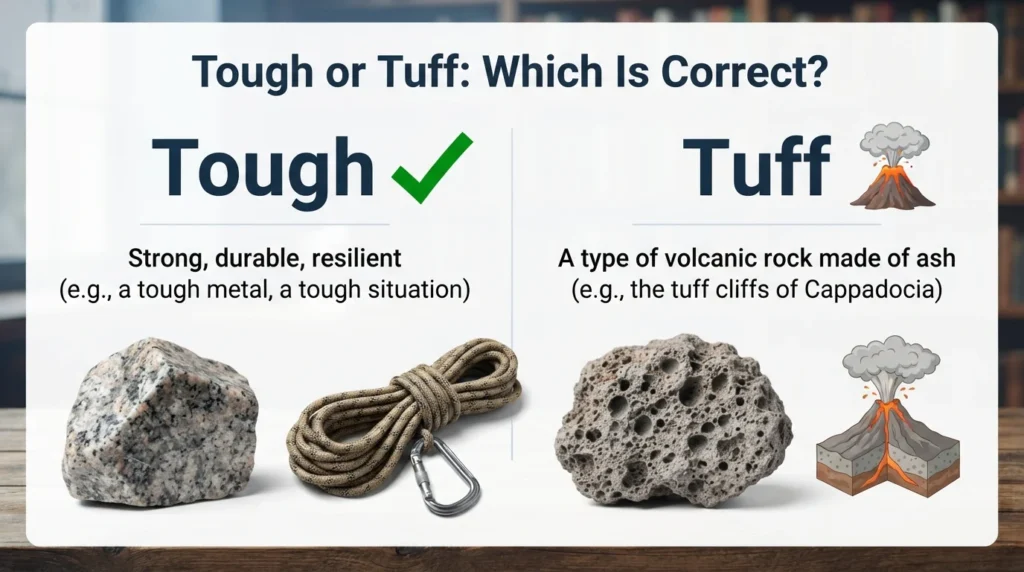

Quick Ans: Tough is the correct standard English spelling. Tuff is generally an informal or nonstandard spelling, although it can sometimes be used intentionally in slang, brand names, usernames, or creative writing. If you are writing formally, use tough.
English has many words that sound similar or look almost identical but have different meanings and uses. Tough or tuff is a common example that can confuse writers because both words are pronounced similarly.
The confusion becomes even greater because tuff is sometimes seen online, in social media posts, music, fashion, and casual communication.
However, the two forms are not interchangeable in standard English.
This guide explains the difference between tough and tuff, their meanings, correct usage, common mistakes, and when you should use each one.
Tough or Tuff: What’s the Difference?
What Does Tough Mean?
Tough is a standard English word.
It can be used as an adjective, noun, or verb depending on the context.
As an adjective, tough can describe something strong, difficult, resilient, or emotionally strong.
Examples:
- This material is tough.
- She had a tough day.
- He is a tough competitor.
- The exam was tough.
What Does Tuff Mean?
Tuff is not normally used as the standard spelling of the adjective tough.
In informal communication, people sometimes use tuff as a slang or stylized version of tough.
However, tuff also has a separate geological meaning. In geology, tuff refers to a type of rock formed from volcanic ash and other volcanic material.
Examples:
- The building was made from tuff.
- The geologist identified the rock as volcanic tuff.
| Word | Part of Speech | Correct Word | Meaning |
|---|---|---|---|
| Tough | Adjective/Noun/Verb | ✅ Yes | Strong, difficult, resilient, or challenging |
| Tuff | Noun | ✅ Contextual | Volcanic rock; also informal slang in some contexts |
| Tuff | Informal spelling | ⚠️ Casual | Stylized version of “tough” in some online contexts |
Quick Recap
- Tough is the standard English spelling.
- Tuff can refer to a type of volcanic rock.
- Tuff may also appear as informal slang or a stylized spelling of tough.
- Use tough in formal and professional writing when you mean difficult, strong, or resilient.
Is Tough or Tuff a Grammar, Vocabulary, or Usage Issue?
Grammar
Partly.
The main issue is not sentence structure but choosing the correct word for the intended meaning.
Vocabulary
Yes.
Tough and tuff can have different meanings depending on context.
Usage
Yes.
Using tuff instead of tough in formal writing can be considered a spelling or word-choice mistake when you mean difficult or strong.
Are Tough and Tuff Interchangeable?
No.
They should not automatically replace one another.
Formal Writing
Use tough when you mean:
- Difficult
- Strong
- Durable
- Resilient
- Emotionally strong
For example:
The company faced a tough financial year.
Do not write:
The company faced a tuff financial year.
Casual Writing
In social media, texting, music, gaming, and other informal contexts, tuff may sometimes be used intentionally as slang or stylistic language.
However, it is still safer to use tough unless you specifically want an informal style.
Understanding Tough
Meaning
Tough has several meanings.
It can describe something that is physically strong or difficult to damage.
Example:
The workers used a tough material for the construction project.
It can also describe something difficult or challenging.
Example:
The final exam was tough.
It can describe someone who is strong and able to deal with difficult situations.
Example:
She is a tough person who never gives up.
Workplace Example
The manager made a tough decision during the company crisis.
Academic Example
The students found the final examination tough.
Literature Example
The novel follows a tough character who survives many difficult situations.
Everyday Example
Today was a tough day at work.
Usage Recap
Use tough when describing something that is:
- Difficult
- Strong
- Durable
- Challenging
- Resilient
Understanding Tuff
Meaning
Tuff has a specific scientific meaning in geology.
It refers to a type of rock formed when volcanic ash and other volcanic particles become compacted and cemented together.
Science Example
The geologist collected a sample of volcanic tuff.
Geography Example
The cliffs contained layers of tuff created by ancient volcanic activity.
Casual Internet Example
Someone might write “That outfit is tuff” online as an informal or stylized way of saying something is impressive, cool, or tough.
Usage Recap
Use tuff when:
- Referring to volcanic rock
- Intentionally using slang
- Writing in a deliberately informal or stylized style
For standard writing, tough is usually the correct choice.
Why Do People Spell Tough as Tuff?
The main reason is pronunciation.
Tough and tuff are pronounced the same way in standard English.
This makes the spelling confusing for learners and casual writers.
Online communication has also increased the use of shortened and stylized spellings.
People may write tuff because it looks closer to the way tough sounds.
However, pronunciation does not determine standard spelling.
When You Should Not Use Tuff
Common Situations to Avoid
Do not write:
❌ It was a tuff exam.
❌ She had a tuff day.
❌ He is a tuff person.
❌ This material is tuff.
For standard English, write:
✅ It was a tough exam.
✅ She had a tough day.
✅ He is a tough person.
✅ This material is tough.
Common Mistakes and Decision Rules
Common Mistakes
| Correct Sentence | Incorrect Sentence | Explanation |
|---|---|---|
| The exam was tough. | The exam was tuff. | Tough is the standard spelling. |
| She had a tough day. | She had a tuff day. | Use tough for difficult situations. |
| He is a tough competitor. | He is a tuff competitor. | Tough is correct here. |
| The rock is volcanic tuff. | The rock is volcanic tough. | Tuff is the geological term. |
Decision Rule
If you mean difficult, strong, challenging, or resilient, use tough.
If you mean volcanic rock, use tuff.
If you are intentionally using internet slang or a stylized spelling, tuff may appear in informal contexts.
Tough in Modern Media and Technology
The word tough is widely used in modern English.
It appears in:
- News articles
- Business writing
- Sports reporting
- Education
- Books
- Advertising
- Professional communication
The spelling tuff is more commonly seen in informal digital communication, social media, music, gaming, and creative expressions.
Expert Opinion
Standard English uses tough for meanings such as difficult, strong, or resilient.
Tuff has an established scientific meaning in geology and can also appear as an informal or stylized spelling.
Therefore, context is important.
Case Studies
Case Study One
A student wrote “The exam was tuff” in a university assignment.
The teacher corrected it to “The exam was tough” because the student was describing difficulty rather than volcanic rock or slang.
Case Study Two
A geology student wrote about volcanic tuff in a research report.
In this case, tuff was correct because the word referred to a specific type of volcanic rock.
Error Prevention Checklist
Always Use Tough When
- Describing something difficult
- Describing a strong material
- Describing a resilient person
- Talking about a challenging experience
- Writing professional or academic content
Use Tuff When
- Referring to volcanic rock
- Discussing geology
- Intentionally using slang
- Writing informal or stylized dialogue
Related Word Confusions You Should Master
- Tough or Tuff
- Though or Thought
- Through or Threw
- Then or Than
- Affect or Effect
- Accept or Except
- Advice or Advise
- Lose or Loose
- Breath or Breathe
- Weather or Whether
Frequently Asked Questions
Is tough or tuff correct?
Tough is the correct standard spelling when you mean difficult, strong, or resilient.
Is tuff a real word?
Yes.
Tuff is a real geological term for a type of volcanic rock. It is also sometimes used informally as slang or a stylized spelling of tough.
Can I use tuff instead of tough?
Only in informal or intentionally stylized contexts.
For formal, academic, or professional writing, use tough.
Is tough pronounced like tuff?
Yes.
In standard English, tough and tuff have the same pronunciation.
What does tough mean?
Tough can mean difficult, strong, durable, challenging, or emotionally resilient depending on the context.
What does tuff mean in geology?
Tuff is a type of volcanic rock formed from compacted volcanic ash and other volcanic material.
Is tuff slang?
It can be.
In online and casual communication, people sometimes use tuff as a stylized or slang spelling of tough.
Conclusion
When comparing tough or tuff, the correct choice depends on the meaning. Tough is the standard English word used for something difficult, strong, durable, or challenging. Tuff is a legitimate geological term for volcanic rock and can also appear as informal internet slang or a stylized spelling of tough. For essays, professional communication, websites, and formal writing, use tough when you mean difficult or strong. Remember the simple rule: difficult or strong = tough; volcanic rock = tuff.