
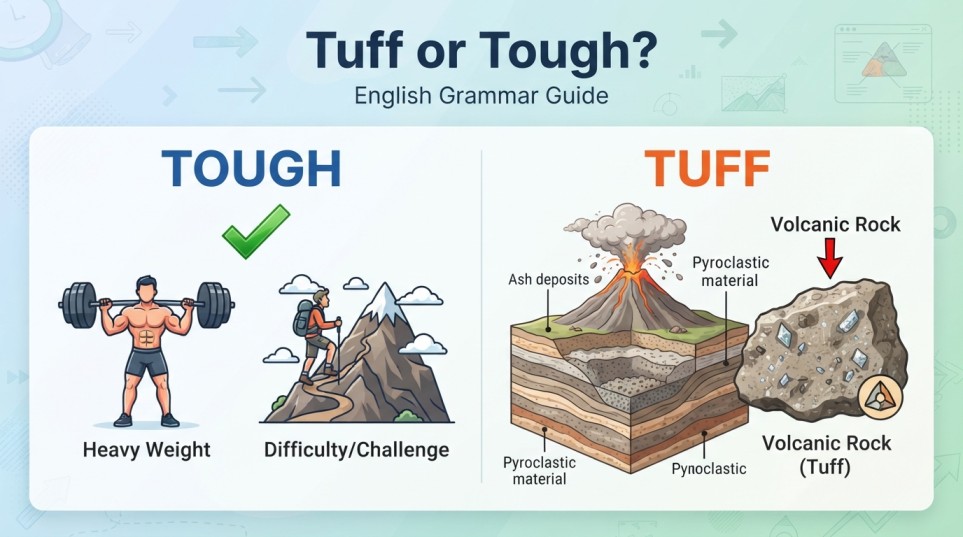

Quick Ans: Tough is the correct and standard English word when you mean something difficult, strong, durable, or emotionally resilient. Tuff is also a real word, but it has a completely different meaning. In geology, tuff refers to a type of rock formed from volcanic ash. Because the two words sound alike, many people mistakenly use tuff when they actually mean tough.
English is full of words that sound similar but have entirely different meanings. One common example is tuff or tough. Since both words are pronounced almost the same way, writers often confuse them in emails, essays, and online posts.
However, these words are not interchangeable.
This guide explains the difference between tuff and tough, their meanings, examples, and how to avoid common mistakes.
Tuff or Tough: What’s the Difference?
What Does Tough Mean?
Tough is usually an adjective.
It describes something that is:
- Difficult to do
- Strong or durable
- Able to handle hardship
- Physically or emotionally resilient
Examples:
- This exam is tough.
- She is mentally tough.
- The material is extremely tough.
What Does Tuff Mean?
Tuff is a noun in geology.
It refers to a type of rock made from volcanic ash that has hardened over time.
Examples:
- The mountain contains layers of volcanic tuff.
- Scientists studied the ancient tuff deposits.
| Word | Part of Speech | Correct Word | Meaning |
|---|---|---|---|
| Tough | Adjective | ✅ Yes | Difficult, strong, or resilient |
| Tuff | Noun | ✅ Yes (Geology) | A rock formed from volcanic ash |
Quick Recap
- Tough means difficult, strong, or durable.
- Tuff is a geological term for volcanic rock.
- The two words sound similar but have completely different meanings.
Is Tuff or Tough a Grammar, Vocabulary, or Usage Issue?
Grammar
No.
This is not a grammar issue.
Vocabulary
Yes.
The confusion comes from choosing the correct word.
Usage
Yes.
Using tuff when you mean tough is a vocabulary mistake.
Are Tuff and Tough Interchangeable?
No.
Although they sound alike, they cannot replace each other because they have different meanings.
Formal Writing
Use tough when discussing:
- Challenges
- Strong materials
- Difficult situations
- Resilient people
Use tuff only when discussing geology or volcanic rock.
Casual Writing
Most people only need the word tough in everyday conversations.
Understanding Tough
Meaning
Tough describes something that is difficult, strong, durable, or capable of enduring hardship.
Workplace Example
The company faced a tough financial year.
Academic Example
The final examination was particularly tough.
Literature Example
The novel tells the story of a tough survivor overcoming adversity.
Everyday Example
This steak is too tough to chew.
Usage Recap
Use tough when referring to:
- Difficult situations
- Strong materials
- Hard experiences
- Resilient people
- Challenging tasks
Understanding Tuff
Meaning
Tuff is a type of rock formed from volcanic ash and debris.
It is an important term in geology and earth science.
Science Example
Researchers found layers of volcanic tuff near the crater.
Geological Example
The canyon walls contain deposits of ancient tuff.
Educational Example
Students learned how tuff forms after volcanic eruptions.
Usage Recap
Use tuff only when discussing:
- Geology
- Volcanoes
- Rock formations
- Earth science
Why Do People Confuse Tuff and Tough?
The confusion exists because both words have nearly identical pronunciations.
Many English learners hear the word tough and mistakenly spell it as tuff because the spelling seems more logical.
However, English spelling often follows historical patterns rather than pronunciation rules.
Historical Background of the Word Tough
The word tough comes from Old English and has been used for centuries to describe strength and difficulty.
The word tuff comes from the Italian word tufo, referring to volcanic rock.
Although the words sound alike, they developed from entirely different origins.
When You Should Not Use Tuff or Tough
Common Situations to Avoid
Do not write:
❌ This exam is tuff.
❌ She is mentally tuff.
❌ He had a tuff childhood.
Always write:
✅ This exam is tough.
✅ She is mentally tough.
✅ He had a tough childhood.
Likewise, do not replace the geological term:
❌ Scientists studied volcanic tough.
Correct:
✅ Scientists studied volcanic tuff.
Common Mistakes and Decision Rules
Common Mistakes
| Correct Sentence | Incorrect Sentence | Explanation |
|---|---|---|
| The interview was tough. | The interview was tuff. | Tough means difficult. |
| She is a tough person. | She is a tuff person. | Tough means resilient. |
| The cliffs contain tuff deposits. | The cliffs contain tough deposits. | Tuff is a type of rock. |
| This leather is tough. | This leather is tuff. | Tough means strong and durable. |
Decision Rule
Ask yourself this question:
Are you talking about something difficult, strong, or resilient?
➡️ Use tough.
Are you talking about volcanic rock?
➡️ Use tuff.
Tough in Modern Media and Technology
The word tough is frequently used in:
- Business writing
- Sports journalism
- Motivational content
- News articles
- Everyday communication
The word tuff is mostly limited to scientific and geological discussions.
Expert Opinion
Language experts classify tuff and tough as homophones—words that sound alike but have different meanings and spellings.
Understanding homophones helps writers avoid common vocabulary mistakes.
Case Studies
Case Study One
A student wrote, “The exam was tuff.”
The teacher corrected the sentence because tough is the proper word for something difficult.
Case Study Two
A geology report used the phrase “volcanic tough.”
The professor changed it to “volcanic tuff” because the report referred to rock formations.
Error Prevention Checklist
Always Use Tough When
- Referring to difficult situations
- Describing strong materials
- Talking about resilience
- Discussing challenging experiences
- Writing everyday English
Always Use Tuff When
- Discussing geology
- Writing about volcanoes
- Describing rock formations
- Studying earth science
Related Word Confusions You Should Master
- Then or Than
- Affect or Effect
- Accept or Except
- Principal or Principle
- Compliment or Complement
- Desert or Dessert
- Stationary or Stationery
- Discreet or Discrete
- Hear or Here
- Farther or Further
Frequently Asked Questions
Is it tuff or tough?
Both are real words, but they have different meanings.
Which is correct for something difficult?
Tough is correct.
Is tuff a real word?
Yes. It is a geological term for volcanic rock.
Is tough an adjective?
Yes. It usually describes something difficult, strong, or resilient.
Why do people spell tough as tuff?
Because both words sound nearly identical when spoken.
Can tuff and tough be used interchangeably?
No. They have entirely different meanings.
What part of speech is tuff?
It is primarily a noun.
Conclusion
When comparing tuff or tough, remember that both words are real, but they belong in completely different contexts. Tough describes something difficult, strong, or resilient and is the word most people need in everyday English. Tuff, on the other hand, is a scientific term for volcanic rock. Whenever you’re writing about challenges, durability, or strength, choose tough. Save tuff for geology and earth science discussions.