
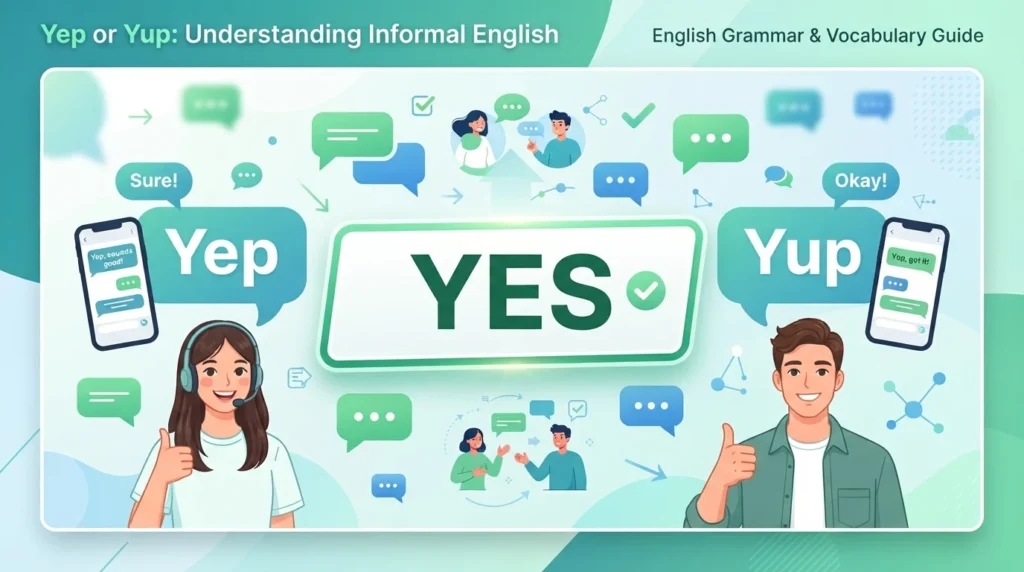

Quick Ans: Both yep and yup are correct informal words used to mean “yes.” Neither is grammatically wrong, but they have slightly different tones. Yep is generally considered a little more neutral and is more common in everyday conversation, while yup often sounds more casual, relaxed, or enthusiastic. Neither word is appropriate in formal or professional writing, where yes is the preferred choice.
English is full of informal expressions that people use in everyday conversations. One common example is yep or yup. Since both words mean the same thing, many learners wonder whether one is more correct than the other.
The good news is that both spellings are accepted in informal English.
However, understanding the slight difference in tone can help you choose the most natural word for different situations.
This guide explains the difference between yep and yup, when to use each one, common mistakes, and examples from everyday English.
Yep or Yup: What’s the Difference?
What Does Yep Mean?
Yep is an informal way of saying “yes.”
It is commonly used in conversations, text messages, and casual speech. Compared to yup, it often sounds slightly more neutral and straightforward.
Examples:
- Yep, I’ll be there at 7.
- Yep, that’s the correct answer.
- Yep, I finished the project yesterday.
What Does Yup Mean?
Yup is also an informal version of “yes.”
It carries the same meaning as yep, but many native speakers use it to sound a bit more relaxed, friendly, or enthusiastic.
Examples:
- Yup, I watched that movie.
- Yup, everything is ready.
- Yup, that’s exactly what I meant.
| Word | Part of Speech | Correct Word | Meaning |
|---|---|---|---|
| Yep | Interjection | ✅ Yes | An informal way of saying “yes” |
| Yup | Interjection | ✅ Yes | Another informal way of saying “yes” |
Quick Recap
- Both yep and yup are correct.
- Both mean “yes.”
- Yep usually sounds a little more neutral.
- Yup often sounds slightly more casual or enthusiastic.
- Use yes instead of either word in formal writing.
Is Yep or Yup a Grammar, Vocabulary, or Usage Issue?
Grammar
No.
This is not a grammar issue.
Vocabulary
Yes.
The choice depends on vocabulary preference and speaking style.
Usage
Yes.
Both words are acceptable in casual communication, but neither is recommended in formal writing.
Are Yep and Yup Interchangeable?
Yes.
In most casual conversations, yep and yup can be used interchangeably because they both simply mean “yes.”
Formal Writing
Avoid both words.
Instead, use:
- Yes
- Certainly
- Absolutely
- Of course
Casual Writing
Both yep and yup work perfectly in:
- Text messages
- Social media
- Friendly conversations
- Informal emails
Understanding Yep
Meaning
Yep is a friendly and informal confirmation.
Many English speakers use it in daily conversations because it sounds polite without being too enthusiastic.
Workplace Example
“Did you send the report?”
“Yep, I emailed it this morning.”
Academic Example
“Did everyone complete the assignment?”
“Yep, we submitted it yesterday.”
Literature Example
The character smiled and replied, “Yep, that’s exactly what happened.”
Everyday Example
“Are you coming with us?”
“Yep!”
Usage Recap
Use yep when:
- Confirming something casually.
- Talking with friends.
- Sending text messages.
- Having relaxed conversations.
Understanding Yup
Meaning
Yup is another informal way of saying “yes.”
Some speakers feel it sounds a little more cheerful or laid-back than yep.
Conversation Example
“Did you enjoy the concert?”
“Yup, it was amazing.”
Social Media Example
Someone comments:
“Yup, I completely agree.”
Everyday Example
“Is this your phone?”
“Yup.”
Usage Recap
Use yup when:
- Speaking casually.
- Chatting with family or friends.
- Replying in online conversations.
- Expressing a relaxed agreement.
Why Do People Use Yep or Yup Instead of Yes?
People often choose yep or yup because they sound more natural in casual speech.
These words help conversations feel friendlier and less formal.
Many native English speakers rarely say yes in everyday conversations with friends.
Instead, they naturally respond with:
- Yep
- Yup
- Yeah
The choice usually depends on personal speaking style rather than grammar.
When You Should Not Use Yep or Yup
Common Situations to Avoid
Avoid using yep or yup in:
- Job applications
- Academic essays
- Business reports
- Legal documents
- Professional emails
- Official presentations
Instead, write yes.
Common Mistakes and Decision Rules
Common Mistakes
| Correct Sentence | Incorrect Sentence | Explanation |
| Yes, I agree with your proposal. | Yep, I agree with your proposal. (Formal email) | Use yes in professional writing. |
| Yep, I’ll call you later. | Yes, I’ll call you later. (Very casual chat) | Both work, but yep sounds more natural casually. |
| Yup, that’s my bag. | Yups, that’s my bag. | Yups is not a standard spelling. |
| Yep and yup both mean yes. | Yep means “no.” | Both words express agreement. |
Decision Rule
Use yep or yup only in informal conversations.
Whenever you’re writing professionally or academically, choose yes instead.
Yep and Yup in Modern Communication
Text messaging, social media, and instant messaging have made yep and yup extremely common.
Voice assistants and AI chatbots also recognize both words as informal confirmations.
Despite their popularity, professional communication still favors the standard word yes.
Expert Opinion
Linguists consider both yep and yup acceptable informal variants of yes.
Neither spelling is more correct than the other.
The choice depends mainly on tone, regional preference, and personal speaking habits.
Case Studies
Case Study One
A customer service representative replied to a client using “Yep!”
Although grammatically acceptable, the manager suggested replacing it with “Yes” to maintain a more professional tone.
Case Study Two
A group of friends in an online chat used both yep and yup throughout the conversation.
Everyone understood the meaning because both words function as informal ways of saying yes.
Error Prevention Checklist
Always Use Yep or Yup When
- Texting friends
- Casual conversations
- Social media replies
- Informal chats
- Friendly online discussions
Never Use Yep or Yup When
- Writing business emails
- Preparing academic assignments
- Creating legal documents
- Writing professional reports
- Communicating with clients formally
Related Word Confusions You Should Master
- Yeah or Yes
- Yep or Yeah
- OK or Okay
- Hi or Hey
- Thanks or Thank You
- Accept or Except
- Affect or Effect
- Then or Than
- Complement or Compliment
- Who’s or Whose
Frequently Asked Questions
Is yep or yup correct?
Both are correct informal words that mean “yes.”
Which is more common, yep or yup?
Both are widely used. Yep is often considered slightly more neutral, while yup may sound more relaxed or enthusiastic.
Can I use yep in formal writing?
No.
Use yes in formal and professional writing.
Is yup a real English word?
Yes.
It is recognized as an informal interjection meaning “yes.”
Do native English speakers use both words?
Yes.
Both yep and yup are common in everyday spoken English.
Which sounds more professional?
Neither.
Use yes whenever professionalism is important.
Conclusion
When comparing yep or yup, both spellings are correct and both simply mean “yes.” The difference lies mainly in tone rather than grammar. Yep often sounds slightly more neutral, while yup can feel a little more relaxed or enthusiastic. In casual conversations, either word works perfectly. However, in professional, academic, or formal writing, yes is always the better choice.