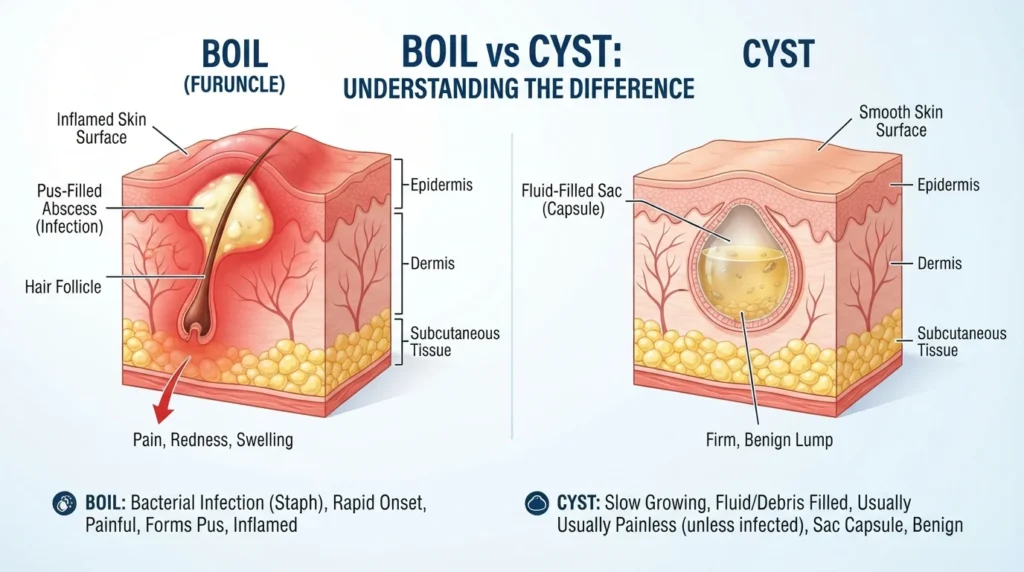

Quick Ans: Boil and cyst are not the same thing, although they can look similar. A boil is a painful skin infection usually caused by bacteria, while a cyst is a closed sac under the skin that may contain fluid, air, or other material. The correct word depends on the type of skin lump you are describing.
Many people use the terms boil and cyst interchangeably because both can appear as bumps under the skin. However, they have different causes, symptoms, and treatments.
Understanding the difference between a boil or cyst can help you describe skin conditions more accurately and know when medical attention may be necessary.
This guide explains the meaning of each term, their differences, common symptoms, and how to tell them apart.
Boil or Cyst: What’s the Difference?
What Does Boil Mean?
A boil is a painful, pus-filled lump that develops when bacteria infect a hair follicle or oil gland.
Boils usually:
- Are red and swollen
- Feel warm and tender
- Fill with pus over time
- May eventually burst and drain
What Does Cyst Mean?
A cyst is a closed pocket of tissue that can contain fluid, pus, air, or other substances.
Cysts usually:
- Grow slowly
- Feel soft or firm
- Are often painless
- May remain under the skin for a long time
| Word | Part of Speech | Correct Meaning | Definition |
|---|---|---|---|
| Boil | Noun | ✅ Yes | A painful bacterial skin infection filled with pus |
| Cyst | Noun | ✅ Yes | A closed sac under the skin containing fluid or other material |
Quick Recap
- A boil is an infection.
- A cyst is a sac beneath the skin.
- Boils are usually painful and red.
- Cysts are often painless and slow-growing.
Is Boil or Cyst a Grammar, Vocabulary, or Usage Issue?
Grammar
No.
This topic is unrelated to grammar.
Vocabulary
Yes.
The confusion comes from choosing the correct medical term.
Usage
Yes.
Using boil when you actually mean cyst, or vice versa, can create misunderstandings when describing symptoms.
Are Boil and Cyst Interchangeable?
No.
Although they can appear similar, they refer to different skin conditions.
Formal Writing
Medical professionals use the terms carefully because they have different meanings and treatment approaches.
Casual Writing
Many people call any skin lump a boil, even when it is actually a cyst.
Understanding Boils
Meaning
A boil is a bacterial skin infection that forms beneath the skin.
It typically starts as a small red bump and gradually becomes larger and more painful.
Medical Example
The doctor diagnosed the painful lump as a boil caused by a bacterial infection.
Workplace Example
He missed work because a large boil required medical treatment.
Everyday Example
The painful boil on her neck became swollen and filled with pus.
Usage Recap
Use boil when referring to:
- Painful infected skin lumps
- Pus-filled bumps
- Bacterial skin infections
- Inflamed hair follicles
Understanding Cysts
Meaning
A cyst is a sac-like structure that develops under the skin and contains fluid, air, or semi-solid material.
Many cysts are harmless and may not cause pain.
Medical Example
The ultrasound confirmed that the lump was a benign cyst.
Academic Example
Medical students learned how to distinguish a cyst from an abscess and a boil.
Everyday Example
She discovered a small cyst on her arm during a routine check.
Usage Recap
Use cyst when referring to:
- Sac-like lumps under the skin
- Non-infected growths
- Fluid-filled pockets
- Slowly developing skin bumps
How Can You Tell the Difference?
Signs of a Boil
- Red and swollen
- Painful to touch
- Filled with pus
- Feels warm
- May drain naturally
Signs of a Cyst
- Usually painless
- Grows slowly
- Round and smooth
- Often moves slightly under the skin
- May remain unchanged for years
What Causes Boils and Cysts?
Causes of Boils
Boils are usually caused by bacteria, especially Staphylococcus aureus.
Risk factors include:
- Poor hygiene
- Weakened immune system
- Skin injuries
- Diabetes
Causes of Cysts
Cysts can develop due to:
- Blocked glands
- Infections
- Injuries
- Genetic conditions
- Chronic inflammation
When You Should Not Use Boil or Cyst Incorrectly
Common Situations to Avoid
Do not call every skin lump a boil.
Do not assume every painless bump is a cyst.
Avoid self-diagnosing serious skin conditions without medical advice.
Remember that different skin problems can appear similar.
Common Mistakes and Decision Rules
Common Mistakes
| Correct Sentence | Incorrect Sentence | Explanation |
|---|---|---|
| The doctor treated the boil with antibiotics. | The doctor treated the cyst with antibiotics. | Many cysts do not require antibiotics. |
| She had a cyst removed surgically. | She had a boil removed surgically. | Cysts are more commonly removed surgically. |
| The boil was painful and filled with pus. | The cyst was painful and filled with pus. | These are typical boil symptoms. |
| The cyst had been present for years. | The boil had been present for years. | Boils are usually short-term infections. |
Decision Rule
If the lump is:
- Red
- Painful
- Filled with pus
It is more likely a boil.
If the lump is:
- Slow-growing
- Usually painless
- Sac-like
It is more likely a cyst.
Boils and Cysts in Modern Healthcare
Doctors often use physical examinations and imaging tests to distinguish between boils and cysts.
Accurate diagnosis is important because the treatment for a boil may differ significantly from the treatment for a cyst.
Some cysts require monitoring, while severe boils may need antibiotics or drainage.
Expert Opinion
Medical experts advise against squeezing either a boil or a cyst at home.
Doing so may increase the risk of infection, scarring, or further complications.
Any rapidly growing, painful, or recurring lump should be examined by a healthcare professional.
Case Studies
Case Study One
A patient believed she had a cyst on her back.
After examination, the doctor determined it was actually a large boil caused by a bacterial infection.
Case Study Two
A man repeatedly treated a painless lump as a boil.
Medical testing later confirmed that the lump was a harmless cyst that required a different treatment approach.
Error Prevention Checklist
Use Boil When
- The lump is painful
- Pus is present
- The skin is red and swollen
- The bump developed quickly
Use Cyst When
- The lump is slow-growing
- It feels like a sac under the skin
- It is usually painless
- The bump has existed for a long time
Related Medical Terms You Should Know
- Boil or Abscess
- Cyst or Tumor
- Rash or Hives
- Wart or Skin Tag
- Pimple or Boil
- Ulcer or Sore
- Infection or Inflammation
- Lump or Growth
Frequently Asked Questions
Is a boil the same as a cyst?
No.
A boil is an infection, while a cyst is a sac beneath the skin.
Can a cyst turn into a boil?
A cyst can become infected and may develop symptoms similar to a boil.
Are boils painful?
Yes.
Boils are usually painful and tender.
Are cysts dangerous?
Most cysts are harmless, although some may require medical treatment.
Should I squeeze a boil or cyst?
No.
Squeezing either one can lead to infection or complications.
Do both conditions require surgery?
No.
Some boils heal on their own, while some cysts may need surgical removal.
Conclusion
When comparing boil or cyst, the two terms describe different medical conditions. A boil is a painful bacterial infection that usually fills with pus, while a cyst is a sac-like lump that often grows slowly and may be painless. Knowing the difference can help you describe symptoms more accurately and understand when professional medical advice may be necessary.