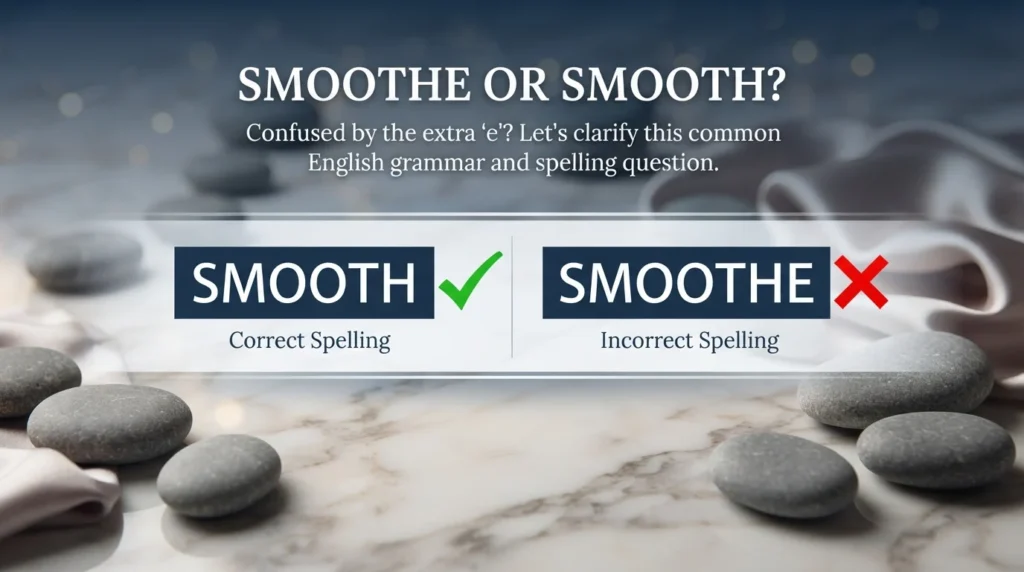

Quick Ans: Smooth is the correct spelling. Smoothe is usually incorrect when used as an adjective meaning even, soft, or not rough. However, smoothe does exist as a rare verb form meaning “to make smooth,” although modern English almost always uses smooth as both the adjective and the verb.
English contains many words that look similar because of extra letters or older spellings. One common example is smoothe or smooth. Many writers add an extra e because words like breathe and bathe end with an e, leading them to believe that smoothe is also correct.
However, in most situations, the correct spelling is simply smooth.
This guide explains the difference between smooth and smoothe, when each can be used, and how to avoid common spelling mistakes.
Smoothe or Smooth: What’s the Difference?
What Does Smooth Mean?
Smooth can be an adjective, verb, or noun.
It generally means:
- Having an even or flat surface.
- Free from difficulties or problems.
- Polite, calm, or sophisticated.
- To make something even or flat.
Examples:
- The table has a smooth surface.
- We had a smooth flight.
- She tried to smooth her hair.
What Does Smoothe Mean?
Smoothe is a rare and outdated verb form.
It means to make smooth, but modern English almost always uses smooth instead.
Most dictionaries consider smoothe uncommon or archaic.
| Word | Part of Speech | Correct Word | Meaning |
|---|---|---|---|
| Smooth | Adjective, Verb, Noun | ✅ Yes | Even, soft, or to make even |
| Smoothe | Rare Verb | ⚠️ Limited Use | An old form meaning to make smooth |
Quick Recap
- Smooth is the standard modern spelling.
- Smoothe is rare and outdated.
- In almost all writing situations, use smooth.
Is Smoothe or Smooth a Grammar, Vocabulary, or Usage Issue?
Grammar
No.
This is not a grammar issue.
Vocabulary
Yes.
The confusion involves choosing the correct spelling and word form.
Usage
Yes.
Modern English overwhelmingly prefers smooth.
Using smoothe in everyday writing may look like a spelling mistake.
Are Smoothe and Smooth Interchangeable?
Not completely.
Although smoothe historically meant “to make smooth,” modern English uses smooth for both meanings.
Formal Writing
Always prefer smooth.
Examples:
- A smooth process
- Smooth skin
- To smooth the fabric
Casual Writing
Use smooth in text messages, emails, and social media posts.
Avoid smoothe, as many readers will assume it is a typo.
Understanding Smooth
Meaning
Smooth describes something that is even, soft, polished, or free from difficulties.
As a verb, it means to make something even or less rough.
Workplace Example
The manager ensured a smooth transition to the new software system.
Academic Example
The scientist described the material as having a smooth texture.
Literature Example
The river flowed over smooth stones.
Everyday Example
She used lotion to keep her skin smooth.
Usage Recap
Use smooth when referring to:
- Flat or even surfaces
- Easy processes
- Polite behavior
- Making something less rough
Understanding Smoothe
Meaning
Smoothe is an old or uncommon verb that means to make smooth.
Today, it is rarely used outside historical texts or certain dictionaries.
Historical Example
Some older writings use smoothe instead of smooth as a verb.
Writing Example
Modern editors usually replace smoothe with smooth.
Usage Recap
Avoid smoothe unless you are discussing historical language or quoting an old text.
Why Do People Write Smoothe Instead of Smooth?
The confusion happens because many English verbs end with an e, including:
- breathe
- bathe
- soothe
As a result, some writers mistakenly assume that smoothe is the correct spelling.
However, modern English standardizes the word as smooth.
Historical Background of the Word Smooth
The word smooth comes from Old English and has existed for centuries.
Earlier forms of English occasionally used smoothe as a verb, but over time the simpler form smooth became the accepted standard.
Today, dictionaries and style guides overwhelmingly prefer smooth.
When You Should Not Use Smoothe
Common Situations to Avoid
Do not write:
❌ The road is smoothe.
❌ She has smoothe skin.
❌ We had a smoothe journey.
❌ Please smoothe your hair.
Always write:
✅ The road is smooth.
✅ She has smooth skin.
✅ We had a smooth journey.
✅ Please smooth your hair.
Common Mistakes and Decision Rules
Common Mistakes
| Correct Sentence | Incorrect Sentence | Explanation |
|---|---|---|
| The surface is smooth. | The surface is smoothe. | Smooth is the correct adjective. |
| We had a smooth trip. | We had a smoothe trip. | Smoothe is not used as an adjective. |
| Please smooth the fabric. | Please smoothe the fabric. | Modern English prefers smooth. |
| Her skin feels smooth. | Her skin feels smoothe. | Smooth is the standard spelling. |
Decision Rule
If you mean:
- Even or soft
- Polished or flat
- Free from difficulties
- To make something even
Use smooth.
Use smoothe only when discussing historical or archaic English.
Smooth in Modern Writing and Technology
Search engines, grammar tools, and AI writing assistants recognize smooth as the standard spelling.
Most spelling checkers flag smoothe as incorrect or suggest replacing it with smooth.
Using the correct spelling improves clarity and professionalism.
Expert Opinion
Modern dictionaries and style guides agree that smooth is the preferred spelling in contemporary English.
Although smoothe has historical roots, it is rarely used today and can confuse readers.
Case Studies
Case Study One
A business website repeatedly used smoothe transition throughout its articles.
Editors corrected every instance to smooth transition to improve professionalism and readability.
Case Study Two
A student wrote smoothe skin in an essay.
The teacher corrected it to smooth skin, explaining that smoothe is not the standard modern spelling.
Error Prevention Checklist
Always Use Smooth When
- Describing surfaces
- Talking about easy processes
- Referring to polished textures
- Using the verb meaning “make even”
- Writing professionally
Avoid Smoothe When
- Writing articles
- Publishing content
- Preparing business documents
- Writing essays
- Describing textures or appearances
Related Word Confusions You Should Master
- Breathe or Breath
- Loose or Lose
- Soothe or Smooth
- Than or Then
- Affect or Effect
- Principal or Principle
- Stationary or Stationery
- Compliment or Complement
- Farther or Further
- Accept or Except
Frequently Asked Questions
Is smooth or smoothe correct?
Smooth is correct in almost every situation.
Is smoothe a real word?
Yes, but it is an old and uncommon verb form.
Why is smooth spelled without an e?
Because modern English standardized the spelling as smooth, even though some older forms used smoothe.
Can I use smoothe in professional writing?
It is generally best to avoid it because most readers will consider it a spelling mistake.
Is smooth a verb?
Yes.
Examples:
- Smooth your hair.
- Smooth the fabric.
- Smooth the rough edges.
Conclusion
When comparing smoothe or smooth, the correct choice in modern English is almost always smooth. The word works as both an adjective and a verb and is widely accepted in professional, academic, and everyday writing. Although smoothe exists as an old verb form, it is now rare and can easily be mistaken for a spelling error. To avoid confusion and write clearly, use smooth in nearly every situation.