
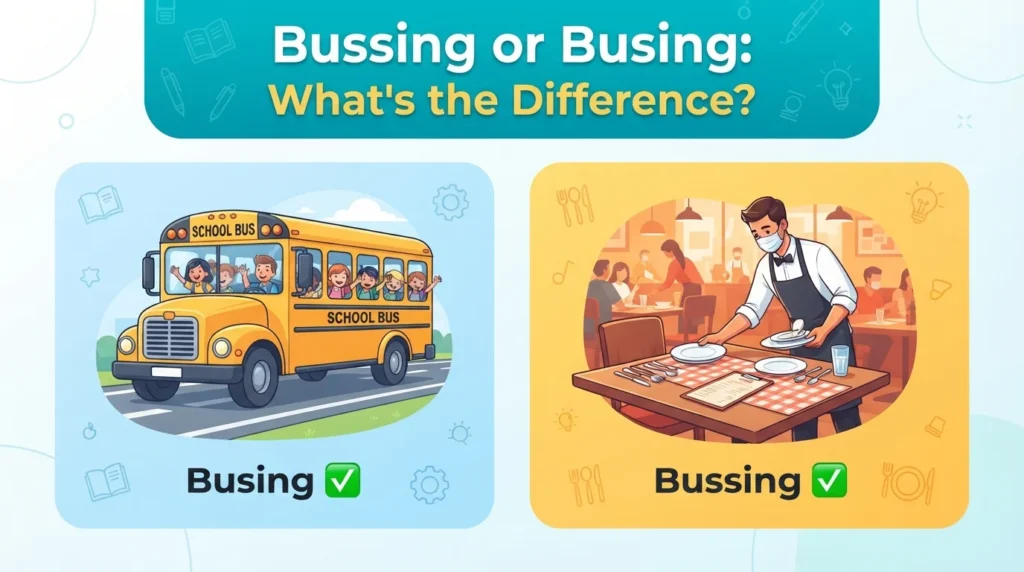

Quick Ans: Both bussing and busing are correct, but they are used in different contexts. Busing is the preferred spelling when referring to transporting people by bus, especially in American English. Bussing is commonly used when referring to clearing tables in restaurants. The intended meaning determines which spelling you should use.
English has many words with multiple accepted spellings depending on their meaning. One common example is bussing or busing. Since both spellings appear in books, newspapers, and online articles, many writers wonder which one is actually correct.
The answer depends on context.
Whether you are writing about school transportation or restaurant work, understanding the difference between bussing and busing will help you avoid confusion and improve your writing.
This guide explains the meaning of each spelling, when to use them, common mistakes, and practical examples.
Bussing or Busing: What’s the Difference?
What Does Busing Mean?
Busing is the present participle of the verb bus when it means transporting people by bus.
It commonly refers to:
- Taking students to school by bus.
- Transporting passengers.
- Organized transportation using buses.
Examples:
- The city is busing students to nearby schools.
- The company is busing employees to the office.
- The government introduced a new busing program.
What Does Bussing Mean?
Bussing is commonly used in the restaurant industry.
It refers to clearing dirty dishes, glasses, and utensils from tables after customers finish eating.
Examples:
- She spent the evening bussing tables.
- The restaurant hired two employees for bussing duties.
- He started his career by bussing tables before becoming a waiter.
| Word | Part of Speech | Correct Word | Meaning |
|---|---|---|---|
| Busing | Verb (Present Participle) | ✅ Yes | Transporting people by bus |
| Bussing | Verb (Present Participle) | ✅ Yes | Clearing tables in a restaurant |
Quick Recap
- Busing refers to transportation by bus.
- Bussing usually refers to clearing restaurant tables.
- Both spellings are correct, but they have different meanings.
Is Bussing or Busing a Grammar, Vocabulary, or Usage Issue?
Grammar
No.
This is not a grammar issue.
Vocabulary
Yes.
The difference depends on the meaning of the word.
Usage
Yes.
Choosing the wrong spelling can change the meaning of your sentence.
Are Bussing and Busing Interchangeable?
No.
Although both spellings are correct, they should not be used interchangeably because they describe different actions.
Formal Writing
Use busing when discussing transportation.
Use bussing when discussing restaurant work.
Casual Writing
The same rule applies in everyday writing and social media posts.
Understanding Busing
Meaning
Busing means transporting people by bus.
It is commonly used in education, public transportation, and employee shuttle services.
Workplace Example
The company is busing workers from the parking lot to the factory.
Academic Example
The school district expanded its busing program for students.
News Example
The city announced additional busing routes during the festival.
Everyday Example
Parents appreciated the school’s free busing service.
Usage Recap
Use busing whenever you are talking about transportation by bus.
Understanding Bussing
Meaning
Bussing means removing used dishes and cleaning tables in restaurants.
It is an important part of restaurant service.
Restaurant Example
She was bussing tables during the dinner rush.
Workplace Example
His first restaurant job involved bussing tables every evening.
Training Example
New employees learn bussing procedures before serving customers.
Everyday Example
The manager thanked everyone for helping with bussing after the event.
Usage Recap
Use bussing only when referring to clearing tables or similar restaurant duties.
Why Do People Confuse Bussing and Busing?
The confusion exists because both words come from the verb bus.
When adding -ing, some writers double the s, while others do not.
Modern dictionaries distinguish the spellings by meaning:
- Busing → transportation.
- Bussing → restaurant table clearing.
This distinction helps readers immediately understand the intended context.
Historical Background
The word bus comes from omnibus, a Latin word meaning “for all.”
Over time, bus became the standard English word for public transportation.
The restaurant term bussing developed later and became common in the hospitality industry to describe clearing tables after customers finish dining.
When You Should Not Use the Wrong Spelling
Common Situations to Avoid
Do not write:
❌ The school is bussing students.
❌ The waiter is busing tables.
Instead write:
✅ The school is busing students.
✅ The waiter is bussing tables.
Common Mistakes and Decision Rules
Common Mistakes
| Correct Sentence | Incorrect Sentence | Explanation |
|---|---|---|
| The city is busing students. | The city is bussing students. | Transportation uses busing. |
| She is bussing tables. | She is busing tables. | Restaurant work uses bussing. |
| The school expanded its busing program. | The school expanded its bussing program. | Transportation context. |
| Bussing tables is hard work. | Busing tables is hard work. | Restaurant context. |
Decision Rule
If you mean transportation by bus, use busing.
If you mean clearing restaurant tables, use bussing.
Bussing and Busing in Modern English
Today, most dictionaries recognize both spellings.
Many newspapers, educational institutions, and transportation agencies prefer busing for transportation.
Restaurants and hospitality professionals commonly use bussing when discussing table service.
Understanding the context is more important than memorizing the spelling.
Expert Opinion
Language experts generally agree that busing is the preferred spelling for transportation.
However, the restaurant industry has widely adopted bussing to distinguish table-clearing duties from transportation.
Using the appropriate spelling makes your writing clearer and more professional.
Case Studies
Case Study One
A school newsletter mistakenly announced that it was bussing students to another campus.
Editors later corrected the spelling to busing because the sentence referred to transportation.
Case Study Two
A restaurant job advertisement listed experience in busing tables.
The hiring manager updated it to bussing tables to match common hospitality industry usage.
Error Prevention Checklist
Always Use Busing When
- Referring to school transportation.
- Discussing bus services.
- Writing about public transportation.
- Describing employee shuttle programs.
- Talking about transporting passengers.
Always Use Bussing When
- Referring to clearing restaurant tables.
- Discussing restaurant duties.
- Writing about food service jobs.
- Describing hospitality work.
- Mentioning table-cleaning responsibilities.
Related Word Confusions You Should Master
- Brought or Bought
- Stationary or Stationery
- Principal or Principle
- Affect or Effect
- Accept or Except
- Than or Then
- Complement or Compliment
- Farther or Further
- Discreet or Discrete
- Filipino or Philipino
Frequently Asked Questions
Is bussing or busing correct?
Both are correct, but they have different meanings.
What does busing mean?
It means transporting people by bus.
What does bussing mean?
It means clearing tables in a restaurant.
Why are there two spellings?
The different spellings help distinguish transportation from restaurant work.
Is bussing tables correct?
Yes. Bussing tables is the standard expression in the restaurant industry.
Is busing students correct?
Yes. Busing students refers to transporting students by bus.
Conclusion
When comparing bussing or busing, both spellings are correct, but they serve different purposes. Busing refers to transporting people by bus, while bussing refers to clearing tables in restaurants. Choosing the correct spelling depends entirely on the context of your sentence. Remember this simple rule: if it’s about transportation, use busing; if it’s about restaurant table service, use bussing.