
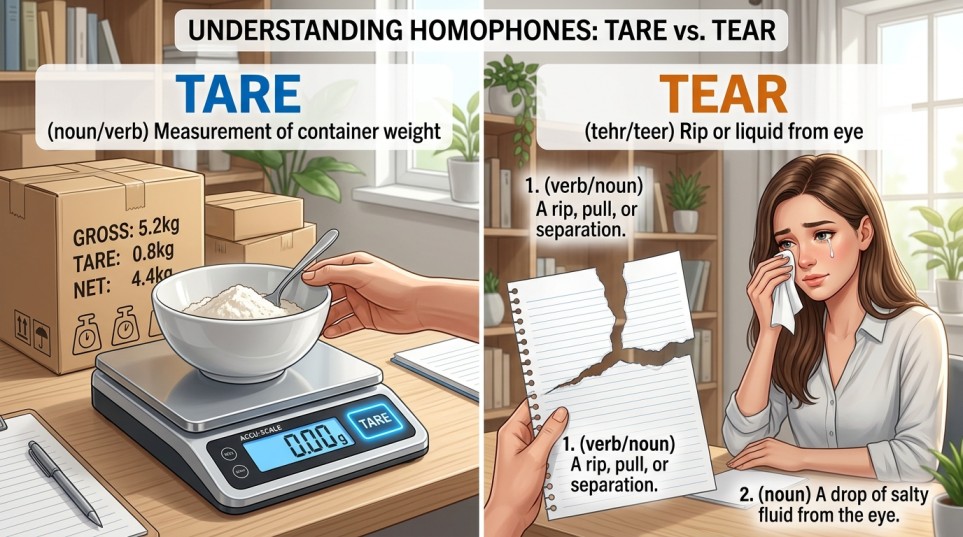

Quick Ans: Tare or tear? These words sound similar in some accents, but they have completely different meanings. Tare usually refers to the weight of a container that is subtracted from the total weight or a type of weed, while tear most commonly means to rip something apart or refers to the drops that come from your eyes. Choosing the correct word depends entirely on the context.
English contains many words that sound alike but have different meanings, making them easy to confuse. One common example is tare or tear. Although these words may appear similar in pronunciation, they are not interchangeable. Using the wrong one can change the meaning of a sentence and create confusion in both spoken and written English.
This confusion often appears in workplaces, classrooms, shipping industries, and everyday conversations. Understanding how each word functions will help you communicate more accurately and avoid common vocabulary mistakes.
Whether you are improving your English, writing professionally, or simply satisfying your curiosity, this guide explains the meaning, pronunciation, usage, and differences between tare and tear with practical examples.
Tare or Tear: What’s the Difference?
What Does Tare Mean?
Tare is primarily a noun and a verb.
As a noun, it refers to the weight of a container or packaging that is deducted from the total weight to determine the net weight of its contents.
As a verb, tare means to set a scale to zero after accounting for the container’s weight.
What Does Tear Mean?
Tear can be a noun or a verb.
As a verb, it means to rip, split, or pull something apart.
As a noun, it commonly refers to a drop of liquid that comes from your eye when you cry. It can also refer to a rip in fabric or paper.
| Word | Part of Speech | Meaning | Common Contexts |
|---|---|---|---|
| tare | Noun and Verb | Container weight deducted from total weight or to reset a scale | Shipping, manufacturing, laboratories, cooking |
| tear | Noun and Verb | To rip something or a drop from the eye | Everyday English, emotions, clothing, paper |
Quick Recap
Tare relates to weighing and measurement.
Tear relates to ripping something or crying.
Although they sound alike in some accents, they have completely different meanings and should never be used interchangeably.
Is Tare or Tear a Grammar, Vocabulary, or Usage Issue?
Grammar
This is not a grammar problem.
Both words are grammatically correct when used in the right context.
Vocabulary
Yes. This is mainly a vocabulary issue because the words have different meanings.
Usage
Choosing between tare and tear depends entirely on what you want to express.
Are They Interchangeable?
No.
Even if they sound similar, they describe different actions and concepts.
Formal Writing
Professional documents should use tare when discussing weights, measurements, shipping, manufacturing, or laboratory work.
Use tear when describing damage, emotions, or physical ripping.
Casual Writing
The same distinction applies in everyday conversations, text messages, and social media posts.
Understanding Tare
Meaning
The most common meaning of tare is the weight of an empty container.
This weight is subtracted from the total weight so only the contents are measured.
Many digital kitchen scales include a tare button that automatically removes the container’s weight.
Workplace Example
The warehouse employee pressed the tare button before weighing the shipment.
Academic Example
Students learned how to tare laboratory scales before measuring chemicals.
Technology Example
Modern digital scales automatically tare the container with a single button.
Cooking Example
Always tare the bowl before adding flour to ensure accurate measurements.
Manufacturing Example
The machine records the tare weight before packaging begins.
Usage Recap
Use tare whenever you discuss weighing containers, calculating net weight, or resetting a scale.
Understanding Tear
Meaning
As a verb, tear means to rip something apart.
As a noun, it often refers to the liquid produced by your eyes when you cry.
Another meaning is a rip or split in material.
Workplace Example
Be careful not to tear the confidential documents.
Academic Example
The student accidentally tore a page from the textbook.
Technology Example
Rough handling can tear internal cables during computer repairs.
Emotional Example
A single tear rolled down her face after hearing the good news.
Clothing Example
There is a small tear in my jacket sleeve.
Usage Recap
Choose tear whenever you refer to ripping, damage, or tears from the eyes.
When You Should Not Use Tare or Tear
Common Situations to Avoid
Do not write tare when talking about crying.
Avoid using tear when discussing shipping weights.
Never press the tear button on a scale because it does not exist.
Do not say a package has a tare in the fabric.
Avoid replacing one word with the other simply because they sound similar.
Do not confuse the technical measurement term with the everyday action of ripping.
Never use tare to describe emotional expressions.
Always consider the surrounding context before choosing either word.
Common Mistakes and Decision Rules
Common Errors
| Correct Sentence | Incorrect Sentence | Explanation |
|---|---|---|
| Please tare the scale first. | Please tear the scale first. | Tare means to reset the scale. |
| She wiped away a tear. | She wiped away a tare. | A tear comes from the eye. |
| The package weight excludes the tare. | The package weight excludes the tear. | Tare refers to container weight. |
| Be careful not to tear the paper. | Be careful not to tare the paper. | Tear means to rip. |
| The laboratory assistant tared the balance. | The laboratory assistant teared the balance. | Tared is the correct verb. |
Decision Rule
If you are talking about weight, containers, or scales, use tare.
If you are talking about ripping something or crying, use tear.
Tare and Tear in Modern Technology and AI Tools
Modern technology uses both words in different contexts.
Digital weighing systems include a tare function that removes container weight before measuring contents.
Artificial intelligence powered warehouse systems automatically calculate tare weight to improve inventory accuracy.
Meanwhile, image recognition software can detect a tear in clothing, packaging, or printed documents during quality inspections.
Because these words belong to different industries, choosing the correct one is essential for clear communication.
Where Do Tare and Tear Come From?
Etymology
Tare comes from the Arabic word tarha, meaning something deducted or rejected. It later entered European languages through trade and commerce before becoming part of English measurement terminology.
Tear, meaning to rip, comes from Old English teran, while the noun referring to liquid from the eye originates from Old English tear. Although they share similar spellings today, their origins are entirely different.
Expert Opinion
Strong vocabulary is not just about knowing more words. It is about choosing the right word for the right situation every time.
Editors often recommend learning commonly confused word pairs because they improve both writing accuracy and reading comprehension.
Case Study One
A food manufacturing company discovered that new employees frequently misunderstood the tare function on digital scales.
After receiving proper training, weighing errors decreased significantly. The company also reduced packaging waste because product weights became more consistent.
Case Study Two
An English language school tested students on commonly confused words.
Many learners mixed up tare and tear because they focused only on pronunciation.
After practicing real life examples, students showed higher vocabulary accuracy in both writing and speaking assessments.
Error Prevention Checklist
Always Use Tare When
- discussing digital scales
- calculating net weight
- measuring ingredients
- weighing shipping containers
- working in laboratories
- using commercial weighing equipment
Never Use Tear When
- referring to container weight
- resetting a scale
- discussing net weight calculations
- operating weighing equipment
- describing measurement procedures
Related Grammar Confusions You Should Master
Improving your vocabulary becomes easier when you learn similar word pairs.
Some useful topics include:
- bear or bare
- brake or break
- affect or effect
- principal or principle
- compliment or complement
- stationery or stationary
- peak or peek
- aisle or isle
- council or counsel
- passed or past
Frequently Asked Questions
Is tare a real English word?
Yes. It is a standard English term used mainly in weighing and measurement.
What does the tare button do?
It subtracts the weight of a container so only the contents are measured.
Can tare mean tear?
No. These words have completely different meanings.
Is tear always pronounced the same way?
No. Tear can have different pronunciations depending on whether it means to rip or the liquid from the eye.
What industries commonly use tare?
Shipping, logistics, laboratories, food production, manufacturing, and retail all use the term regularly.
Can tear be both a noun and a verb?
Yes. It can refer to a drop from the eye or the action of ripping something.
Which word appears on digital kitchen scales?
The correct label is tare.
Why do people confuse tare and tear?
They look and sometimes sound similar, but they represent completely different concepts.
Conclusion
When comparing tare or tear, the difference is easy to remember once you understand their meanings. Tare relates to weighing, measurements, and removing the weight of a container, while tear refers to ripping something or the drops that come from your eyes. Since these words belong to different contexts, they are never interchangeable. Choosing the correct one will make your writing clearer, more professional, and easier for readers to understand.