
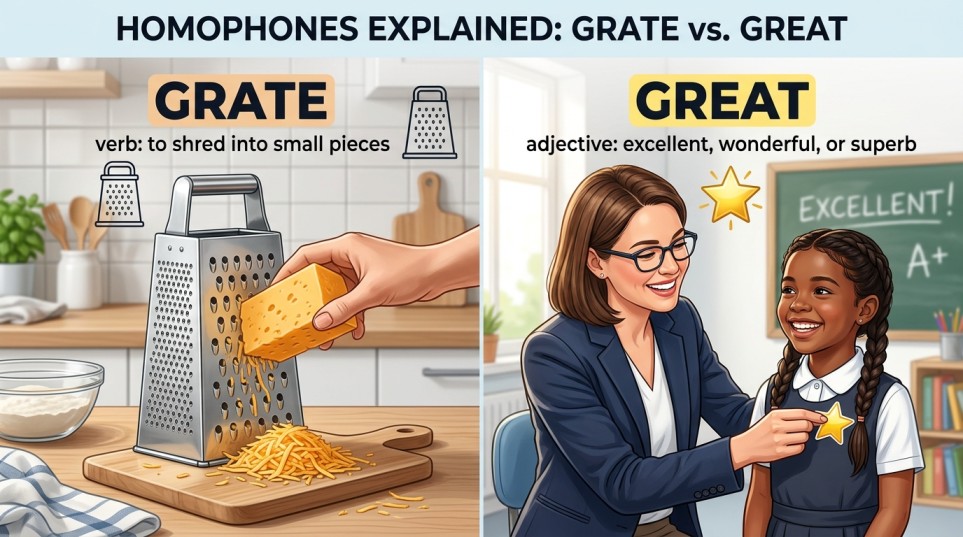

Quick Ans: Grate or great? The correct word depends on your meaning. Grate is usually a verb that means to shred food into small pieces or to irritate someone. Great is an adjective that means excellent, large, important, or impressive. Although they sound alike, they have completely different meanings and should never be used interchangeably.
English is full of words that sound the same but have different meanings, making them easy to confuse. One common example is grate or great. Since both words share the same pronunciation, many writers accidentally choose the wrong one when typing quickly or relying on sound instead of meaning.
The confusion often appears in emails, school assignments, social media posts, and professional writing. Fortunately, understanding the difference is simple once you learn what each word means and how it functions in a sentence.
This guide explains the meanings, grammar, pronunciation, examples, common mistakes, and practical tips to help you use grate and great correctly every time.
Grate or Great: What’s the Difference?
What Does Grate Mean?
Grate is primarily a verb that means to reduce food into small pieces by rubbing it against a rough surface. It can also mean to annoy, irritate, or produce a harsh scraping sound.
As a noun, grate refers to a metal framework or covering, such as a fireplace grate or a drain grate.
What Does Great Mean?
Great is an adjective used to describe something excellent, impressive, important, skilled, large, or remarkable.
It is one of the most common positive adjectives in the English language.
| Word | Part of Speech | Correct Meaning | Example |
|---|---|---|---|
| grate | Verb or noun | To shred food, irritate, or a metal frame | Please grate the cheese. |
| great | Adjective | Excellent, large, impressive, important | She did a great job. |
Quick Recap
Grate usually refers to shredding, scraping, or irritating.
Great describes something positive, impressive, or outstanding.
Although both words sound exactly alike, their meanings are completely different.
Is Grate or Great a Grammar, Vocabulary, or Usage Issue?
Grammar
This is not a grammar problem because both words are grammatically correct.
The challenge lies in selecting the correct word for the intended meaning.
Vocabulary
Yes. This is mainly a vocabulary issue because grate and great have different definitions despite sharing the same pronunciation.
Usage
Correct usage depends entirely on context.
Replacing one with the other changes the meaning of the sentence.
Are They Interchangeable?
No.
These words are homophones, which means they sound the same but have different spellings and meanings.
Using the wrong one creates a noticeable writing mistake.
Formal Writing
Academic papers, reports, and professional emails require careful word choice.
Selecting the correct word improves clarity and credibility.
Casual Writing
Even in everyday conversations or social media posts, using the correct spelling prevents misunderstandings.
Understanding Grate
Meaning
The verb grate usually means to cut food into tiny pieces using a grater.
It can also describe something that causes irritation or creates an unpleasant scraping sound.
Workplace Example
The chef asked the kitchen staff to grate fresh Parmesan cheese before serving the pasta.
Academic Example
The science experiment required students to grate small pieces of wax before mixing the materials.
Technology Example
The constant notification sound began to grate on users after several hours of testing.
Cooking Example
Grate the carrots before adding them to the salad.
Everyday Example
His repetitive complaints started to grate on everyone’s patience.
Additional Example
The metal wheels continued to grate against the concrete floor.
Usage Recap
Use grate when talking about shredding food, producing a scraping sound, or describing something that becomes irritating over time.
Understanding Great
Meaning
Great describes someone or something that is excellent, successful, impressive, important, or unusually large.
It is one of the most frequently used positive adjectives in English.
Workplace Example
Our team achieved great results during the final quarter.
Academic Example
She wrote a great research paper that received the highest grade in the class.
Technology Example
The new software offers great performance and improved security.
Everyday Example
You did a great job on your presentation.
Historical Example
Many historians consider the library one of the greatest achievements of the ancient world.
Personal Example
We had a great time during the family vacation.
Usage Recap
Choose great whenever you want to describe quality, success, excellence, importance, or size.
When You Should Not Use Grate or Great
Common Situations to Avoid
Do not write grate job when praising someone’s work.
Avoid saying great the cheese while giving cooking instructions.
Never write the noise was great on my ears if you mean it was irritating.
Do not replace great with grate simply because they sound alike.
Avoid using grate to describe positive experiences.
Never use great when referring to shredding food.
Always consider the meaning before choosing the spelling.
Proofread carefully when writing homophones.
Common Mistakes and Decision Rules
Common Errors
| Correct Sentence | Incorrect Sentence | Explanation |
|---|---|---|
| Please grate the cheese. | Please great the cheese. | Grate means to shred food. |
| She did a great job. | She did a grate job. | Great means excellent. |
| The sound began to grate on my nerves. | The sound began to great on my nerves. | Grate means to irritate. |
| We had a great vacation. | We had a grate vacation. | Great describes something enjoyable. |
| Grate the chocolate before decorating the cake. | Great the chocolate before decorating the cake. | Cooking requires grate. |
Decision Rule
If you mean to shred, scrape, or irritate, use grate.
If you mean excellent, impressive, important, or enjoyable, use great.
Grate and Great in Modern Technology and AI Tools
Modern grammar checkers and AI writing tools usually recognize the difference between grate and great based on context.
For example, an AI assistant can identify that great performance is correct when reviewing software documentation. Likewise, cooking applications correctly use grate the cheese in recipes.
Despite these advances, AI tools may occasionally miss homophone mistakes if the sentence remains grammatically correct. Reviewing your writing carefully is still the best way to avoid errors.
Where Do Grate and Great Come From?
Etymology
The word grate comes from the Latin word gratare, meaning to scrape.
Its meaning has remained closely connected to rubbing or scraping surfaces.
The word great originates from Old English great, meaning large, powerful, or important.
Over time, its meaning expanded to include excellence, success, and admiration.
Although the words now sound identical, they developed from completely different origins.
Expert Opinion
Strong writing depends on choosing the correct word, not simply the word that sounds right. Understanding homophones improves clarity and prevents common communication mistakes.
Professional editors often recommend checking homophones separately during proofreading because spelling software cannot always detect contextual errors.
Case Study One
A food blog noticed readers frequently searched for great the cheese instead of grate the cheese.
After publishing a short explanation about the difference, the article attracted thousands of additional visitors through search engines and reduced reader confusion in recipe comments.
Case Study Two
A business communication trainer reviewed employee emails and found that several team members accidentally wrote grate work instead of great work.
Following a writing workshop focused on common homophones, spelling accuracy improved significantly, and internal documents required fewer editing corrections.
Error Prevention Checklist
Always Use Grate When
- talking about shredding food
- describing scraping sounds
- referring to irritation
- discussing kitchen preparation
- mentioning a fireplace grate
- describing repetitive annoyance
Never Use Great When
- giving cooking instructions
- referring to shredding cheese
- describing scraping sounds
- talking about irritation
- referring to a metal grate
- explaining food preparation
Related Grammar Confusions You Should Master
Improving your understanding of homophones makes writing much more accurate.
Some helpful topics include:
- there, their, or they’re
- your or you’re
- accept or except
- affect or effect
- than or then
- bear or bare
- brake or break
- compliment or complement
- principal or principle
- peak, peek, or pique
Frequently Asked Questions
Is grate or great correct?
Both are correct, but they have different meanings. The correct choice depends on the sentence.
What does grate mean?
Grate means to shred food, scrape, irritate, or refers to a metal framework.
What does great mean?
Great means excellent, impressive, important, successful, or very good.
Are grate and great pronounced the same?
Yes. They are homophones, meaning they share the same pronunciation but have different spellings and meanings.
Is it grate job or great job?
The correct phrase is great job because you are praising someone’s work.
Is it grate the cheese or great the cheese?
The correct instruction is grate the cheese because the verb means to shred food into small pieces.
Why do people confuse grate and great?
They sound identical when spoken, causing many writers to choose the wrong spelling.
Can grammar checkers detect this mistake?
Many grammar tools identify contextual errors, but some mistakes still require careful proofreading because both words are correctly spelled.
Conclusion
When deciding between grate or great, remember that pronunciation can be misleading. Grate refers to shredding, scraping, or irritating, while great describes excellence, importance, quality, or success. Although the words sound exactly alike, their meanings are entirely different.
Understanding this distinction will help you write more accurately in recipes, academic assignments, professional emails, and everyday conversations. Whenever you are unsure, think about the meaning first rather than the pronunciation, and choosing the correct word becomes much easier.