
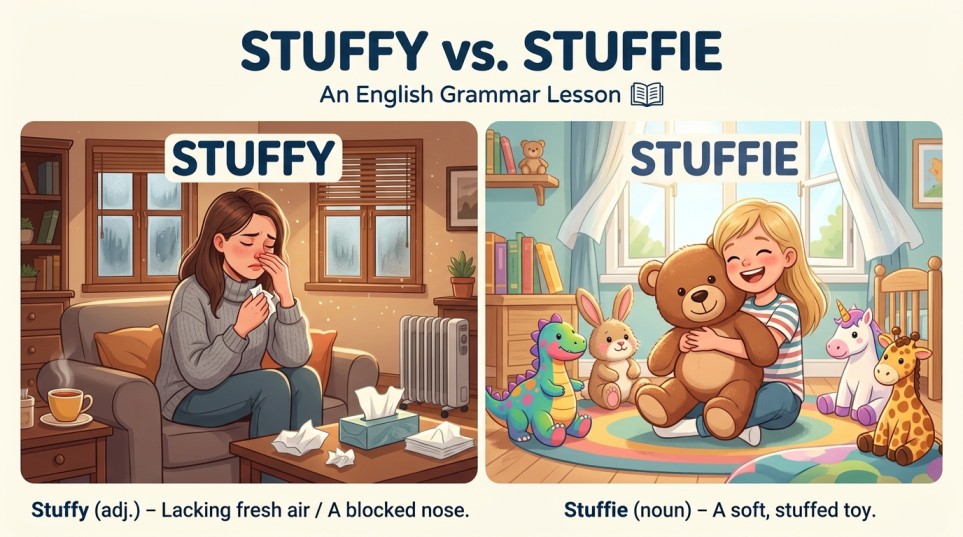

Quick Ans: Stuffy or stuffie? The correct choice depends on what you mean. Stuffy is a standard English adjective that describes something lacking fresh air, overly formal, or affected by a blocked nose. Stuffie is an informal noun, mainly used in North America, that refers to a stuffed animal or plush toy.
English contains many words that look and sound alike but have completely different meanings. One common example is stuffy or stuffie. Although these words differ by only one letter, they belong to different parts of speech and are used in entirely different situations.
Many people become confused because stuffie has become increasingly popular through parenting blogs, social media, and online shopping, while stuffy has been part of standard English for centuries. Understanding the difference helps you communicate more clearly and avoid using the wrong word in conversation or writing.
This guide explains the meaning of each word, when to use them, common mistakes, practical examples, and simple tips for remembering the difference.
Stuffy or Stuffie: What’s the Difference?
What Does Stuffy Mean?
Stuffy is an adjective. It usually describes a room with poor air circulation, a person with a blocked nose, or someone who behaves in an overly formal or rigid manner.
What Does Stuffie Mean?
Stuffie is an informal noun. It refers to a stuffed animal or plush toy, especially one owned by a young child. The term is widely used in Canada and the United States but is considered casual rather than formal English.
| Word | Part of Speech | Correct | Meaning |
|---|---|---|---|
| stuffy | Adjective | ✅ Yes | Lacking fresh air, having a blocked nose, or overly formal |
| stuffie | Informal noun | ✅ Yes | A stuffed animal or plush toy |
Quick Recap
Both stuffy and stuffie are correct English words.
They are not interchangeable because they have different meanings and grammatical roles.
Use stuffy to describe conditions or people. Use stuffie when referring to a plush toy.
Is Stuffy or Stuffie a Grammar, Vocabulary, or Usage Issue?
Grammar
This is not a grammar issue.
Both words are grammatically correct when used in the proper context.
Vocabulary
Yes. This is mainly a vocabulary question because the words have different meanings.
Usage
Choosing the correct word depends entirely on what you want to express.
Are They Interchangeable?
No.
Despite their similar pronunciation, they cannot replace each other.
Formal Writing
Stuffy appears frequently in books, newspapers, academic writing, and professional communication.
Stuffie is generally avoided in formal documents because it is an informal term.
Casual Writing
Both words are common in everyday conversation.
Parents, teachers, and children often use stuffie naturally when talking about favorite plush toys.
Understanding Stuffy
Meaning
The adjective stuffy has several accepted meanings.
It can describe a room that feels hot and lacks ventilation.
The word also describes someone with a blocked nose due to illness.
In another sense, it refers to a person who behaves in a very formal, old fashioned, or serious way.
Workplace Example
The meeting room felt stuffy because the windows remained closed all afternoon.
Academic Example
Students found the lecture hall stuffy after several hours without proper ventilation.
Healthcare Example
I cannot breathe comfortably because my nose feels stuffy today.
Social Example
Many people think the dress code makes the event feel too stuffy.
Additional Examples
The office became stuffy during the afternoon.
His stuffy nose kept him awake all night.
She dislikes stuffy conversations filled with unnecessary formalities.
The old library felt warm and stuffy during summer.
Usage Recap
Use stuffy whenever you describe poor air quality, nasal congestion, or an overly formal attitude.
It works well in both spoken and written English.
Understanding Stuffie
Meaning
A stuffie is a stuffed animal or plush toy.
Children often develop strong emotional attachments to their favorite stuffie because it provides comfort and security.
Although dictionaries recognize the word, it remains informal.
Family Example
My daughter never sleeps without her favorite stuffie.
Preschool Example
Each child brought a favorite stuffie for show and tell.
Shopping Example
The gift shop sells colorful stuffies shaped like different animals.
Everyday Examples
He carries his dinosaur stuffie everywhere.
The teddy bear has been her favorite stuffie for years.
She washed every stuffie before donating them.
Our puppy loves playing with soft stuffies.
Usage Recap
Use stuffie only when referring to a stuffed toy or plush animal.
Choose another term, such as stuffed animal or plush toy, for formal writing.
When You Should Not Use Stuffy or Stuffie
Common Situations to Avoid
Do not use stuffie when describing a blocked nose.
Avoid using stuffy when referring to a teddy bear.
Do not replace stuffed animal with stuffie in highly formal academic writing.
Avoid assuming everyone recognizes stuffie, especially in regions where the term is uncommon.
Do not describe a warm room as a stuffie.
Never call an overly formal person a stuffie unless you specifically mean a plush toy.
Do not confuse the two words simply because they sound alike.
Always consider the context before choosing either word.
Common Mistakes and Decision Rules
Common Errors
| Correct Sentence | Incorrect Sentence | Explanation |
|---|---|---|
| The classroom feels stuffy today. | The classroom feels stuffie today. | Stuffy describes poor ventilation. |
| My son lost his favorite stuffie. | My son lost his favorite stuffy. | Stuffie means a stuffed toy. |
| My nose is stuffy this morning. | My nose is stuffie this morning. | Nasal congestion requires stuffy. |
| She bought a new stuffie yesterday. | She bought a new stuffy yesterday. | Plush toys are called stuffies. |
| Everyone agreed the office was stuffy. | Everyone agreed the office was stuffie. | Rooms are described as stuffy. |
Decision Rule
If you are describing a room, a blocked nose, or someone’s overly formal behavior, use stuffy.
If you are talking about a stuffed animal or plush toy, use stuffie.
Stuffy and Stuffie in Modern Technology and AI Tools
Both words appear regularly in online searches, although they serve different purposes.
Health websites often use stuffy when discussing allergies, colds, and sinus congestion.
Shopping platforms frequently use stuffie in product descriptions for plush toys designed for children.
Artificial intelligence writing tools generally recognize both words but recommend the appropriate one based on context.
Because stuffie is informal, some grammar checkers may suggest replacing it with stuffed animal in professional writing.
Where Do These Words Come From?
Etymology
The adjective stuffy comes from the verb stuff, which originally meant to fill something completely. Over time, it developed additional meanings related to poor airflow and excessive formality.
The noun stuffie is a modern informal variation of stuffed animal. It became especially popular in North American families as a shorter and more affectionate name for plush toys.
Today, both words have established meanings, although they belong to different categories of English vocabulary.
Expert Opinion
Understanding context is just as important as understanding spelling. Many English words look similar, but choosing the correct one depends on meaning rather than appearance.
Professional editors recommend checking both the definition and the part of speech whenever two similar words create confusion.
Case Study One
A parenting blog updated hundreds of product descriptions to replace the phrase stuffed animal with stuffie in articles aimed at parents of young children.
Reader engagement increased because the language matched the audience’s everyday vocabulary while remaining clear and friendly.
Case Study Two
A healthcare clinic reviewed patient education materials and found that some informal wording reduced clarity.
Editors replaced casual expressions with standard medical language while continuing to use stuffy nose consistently throughout the documents. Patients reported that the revised guides were easier to understand.
Error Prevention Checklist
Always Use Stuffy When
- describing poor ventilation
- talking about a blocked nose
- describing an overly formal person
- writing health related content
- discussing indoor air quality
- writing professional documents
Always Use Stuffie When
- referring to a stuffed animal
- talking with young children
- writing parenting content
- describing plush toys
- discussing children’s bedtime routines
- creating toy product descriptions
Related Grammar Confusions You Should Master
Learning similar word pairs will improve both your vocabulary and writing accuracy.
Some useful topics include:
- affect or effect
- farther or further
- beside or besides
- insure or ensure
- compliment or complement
- stationery or stationary
- breath or breathe
- loose or lose
- desert or dessert
- bear or bare
Frequently Asked Questions
Is stuffie a real word?
Yes. Stuffie is a recognized informal English noun that means a stuffed animal or plush toy.
Is stuffy a real word?
Yes. Stuffy is a standard English adjective with several accepted meanings.
Can stuffy mean having a cold?
Yes. A stuffy nose usually refers to nasal congestion caused by a cold, allergies, or a sinus infection.
Is stuffie formal English?
No. It is considered informal and is mostly used in everyday conversation.
Can I use stuffie in school writing?
You can if the topic is appropriate and the writing style is informal. Otherwise, stuffed animal is usually the better choice.
Is stuffie used in American English?
Yes. It is especially common in the United States and Canada.
Why do people confuse stuffy and stuffie?
The words look and sound similar, but they have completely different meanings and belong to different parts of speech.
Which word should I use for a teddy bear?
Use stuffie if you are writing informally. In formal writing, stuffed animal or plush toy is often preferred.
Conclusion
When comparing stuffy or stuffie, both words are correct, but they serve different purposes. Stuffy is an adjective that describes poor ventilation, nasal congestion, or overly formal behavior. Stuffie is an informal noun that refers to a stuffed animal or plush toy.
The easiest way to remember the difference is to focus on the meaning rather than the spelling. If you are describing a condition or a person’s behavior, choose stuffy. If you are talking about a child’s favorite plush companion, stuffie is the right word.