
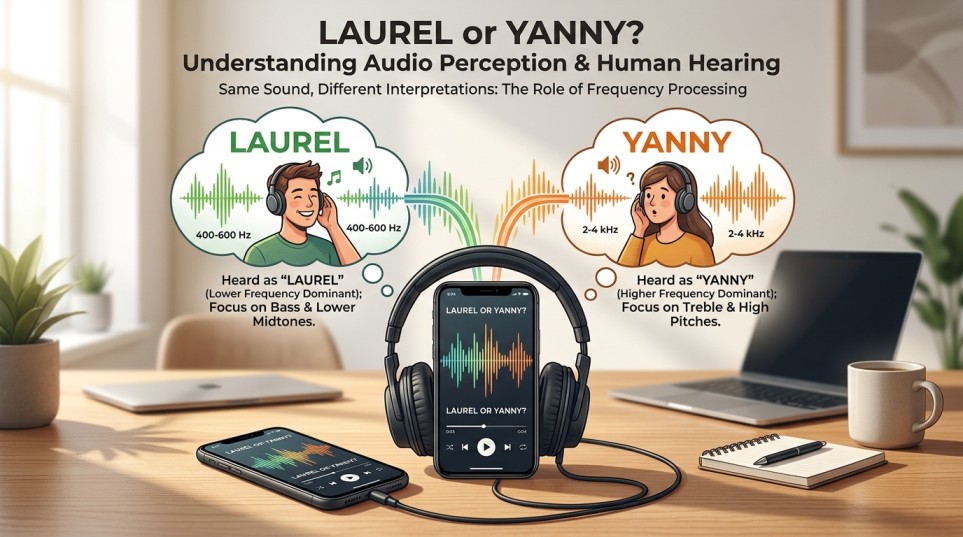

Quick Ans: Laurel or Yanny? Both answers can be correct because the same audio recording can be perceived differently by different listeners. Most experts agree the original recording was laurel, but differences in hearing, audio quality, speaker settings, and sound frequencies can make some people hear yanny instead.
English is full of words that cause confusion, but laurel or yanny became famous for an entirely different reason. Instead of being a grammar or spelling issue, it sparked a worldwide debate about human hearing. Millions of people listened to the same short audio clip and confidently reported hearing completely different words.
The viral recording quickly spread across social media, leaving many people wondering how one sound could produce two distinct interpretations. Scientists, linguists, and audio engineers later studied the clip to explain why our brains process speech differently under certain conditions.
Whether you heard laurel, yanny, or even switched between the two, this guide explains the science behind the phenomenon, why it happened, and what it teaches us about speech perception.
Laurel or Yanny: What’s the Difference?
What Does Laurel Mean?
Laurel is a noun.
It commonly refers to an evergreen shrub whose leaves have been used for decoration and cooking. The word also symbolizes victory or honor because ancient champions were crowned with laurel wreaths.
What Does Yanny Mean?
Yanny is not a standard English dictionary word.
In the famous viral audio clip, it represents the alternative sound many listeners believed they heard. Outside that context, it has no established meaning in modern English.
| Word | Part of Speech | Correct Word | Meaning |
|---|---|---|---|
| laurel | Noun | ✅ Yes | A plant and a symbol of honor or victory |
| yanny | Proper name or perceived sound | ✅ Contextual | A sound some listeners heard in the viral recording |
Quick Recap
Laurel is a real English word with a well established meaning.
Yanny became famous because of an audio illusion rather than its dictionary definition.
The debate was never about spelling or grammar. Instead, it highlighted how differently people can interpret the same sound.
Is Laurel or Yanny a Grammar, Vocabulary, or Usage Issue?
Grammar
No.
This topic has nothing to do with grammar because both words are not interchangeable within sentence structure.
Vocabulary
Partly.
Laurel is a genuine vocabulary word with a dictionary definition.
Yanny became recognizable only because of the viral recording.
Usage
This is primarily an audio perception issue.
People heard different words even though they were listening to the same recording.
Are They Interchangeable?
No.
Outside discussions about the viral audio clip, laurel and yanny cannot replace one another.
Formal Writing
When referring to the plant or the symbol of achievement, use laurel.
Academic discussions about the audio phenomenon may mention both words.
Casual Writing
Many people still jokingly ask friends whether they hear laurel or yanny as a fun hearing test.
Understanding Laurel
Meaning
A laurel is an evergreen plant belonging to the bay family.
Historically, laurel wreaths represented success, wisdom, and victory in ancient Greece and Rome.
Workplace Example
The company’s annual award became a modern laurel for outstanding employees.
Academic Example
The history professor explained why Olympic champions once received laurel wreaths.
Literature Example
The author described the victorious king wearing a crown of laurel leaves.
Everyday Example
She planted a laurel tree in her garden because it stays green throughout the year.
Usage Recap
Use laurel when referring to the plant, symbolic honors, or historical achievements.
It has nothing to do with the audio illusion unless you are discussing the famous recording.
Understanding Yanny
Meaning
Yanny gained worldwide attention after a short audio clip spread across the internet in 2018.
Many listeners believed the recording clearly said yanny, while others heard laurel.
Technology Example
The audio illusion became one of the most discussed internet trends of the year.
Science Example
Researchers analyzed the sound frequencies to explain why listeners reached different conclusions.
Social Media Example
Thousands of users posted videos asking friends whether they heard yanny or laurel.
Usage Recap
Outside discussions about the viral audio clip, yanny has very limited use in English.
Why Did People Hear Different Words?
The Science Behind the Audio
Human hearing does not work like a recording device.
Instead, the brain interprets sound using previous experience, hearing ability, age, and surrounding noise.
The original recording contained multiple frequencies.
Listeners focused on different frequency ranges depending on their hearing and the device they used.
Higher frequencies often made yanny easier to hear.
Lower frequencies tended to emphasize laurel.
Does Age Matter?
Yes.
Younger people often hear higher frequencies more clearly.
Older adults naturally lose sensitivity to some high frequency sounds over time.
That difference influenced what many listeners perceived.
Do Speakers and Headphones Matter?
Absolutely.
Changing headphones, phone speakers, or equalizer settings can alter which frequencies become more noticeable.
Some people even reported hearing one word first and the other after changing devices.
When You Should Not Use Laurel or Yanny
Common Situations to Avoid
Do not use yanny when referring to the plant.
Avoid replacing laurel with yanny in historical writing.
Do not assume hearing one word means another person is wrong.
Avoid using the audio clip as a medical hearing test.
Do not treat the phenomenon as proof of hearing loss.
Never claim the recording permanently says only one word for everyone.
Remember that perception varies from person to person.
Common Mistakes and Decision Rules
Common Mistakes
| Correct Sentence | Incorrect Sentence | Explanation |
|---|---|---|
| The champion received a laurel wreath. | The champion received a yanny wreath. | Laurel is the actual word. |
| Many listeners heard yanny. | Many listeners spelled laurel wrong. | The debate involved perception, not spelling. |
| Scientists studied the audio illusion. | Scientists corrected the pronunciation of laurel. | The issue involved hearing differences. |
| Laurel is a plant. | Yanny is a type of tree. | Yanny is not a plant name. |
Decision Rule
If you mean the plant or the symbol of victory, use laurel.
If you are discussing the famous viral audio illusion, yanny refers to the alternative sound many listeners perceived.
Laurel and Yanny in Modern Technology and AI
The laurel or yanny debate remains one of the best known examples of digital audio perception.
Artificial intelligence researchers often study similar recordings to improve speech recognition systems.
Voice assistants must identify spoken words despite background noise, different accents, and varying sound quality.
The viral clip also demonstrated how human perception can differ from machine processing.
Where Did the Laurel or Yanny Debate Come From?
History
The recording originally came from an online vocabulary pronunciation source.
A student shared the clip online, where it quickly became viral across social media.
News organizations, scientists, celebrities, and technology experts joined the discussion.
Researchers later confirmed that the recording contained frequency characteristics capable of producing both interpretations.
Expert Opinion
Human hearing is an active process. The brain interprets sound rather than simply recording it, which explains why two people can honestly hear different words from the same audio.
This principle has become an important example in psychology, linguistics, and auditory science.
Case Study One
Researchers analyzed the audio spectrum of the viral recording.
After separating different frequency ranges, they found that emphasizing lower frequencies increased the likelihood of hearing laurel, while boosting higher frequencies caused many listeners to hear yanny instead.
Case Study Two
An audio engineering class used the recording to demonstrate equalization techniques.
Students adjusted frequency settings and successfully switched between hearing laurel and yanny. The exercise showed how audio equipment can influence speech perception.
Error Prevention Checklist
Always Use Laurel When
- referring to the plant
- discussing victory wreaths
- writing about ancient history
- describing symbols of achievement
Use Yanny Only When
- discussing the viral audio clip
- explaining the hearing illusion
- talking about internet culture
- describing speech perception research
Related Language and Audio Confusions You Should Master
Understanding similar topics can improve your knowledge of language and perception.
- affect or effect
- accept or except
- hear or listen
- there their or they’re
- compliment or complement
- farther or further
- imply or infer
- discreet or discrete
- stationery or stationary
- homophones in English
Frequently Asked Questions
Was the original recording actually saying laurel?
Most experts believe the original recording was intended to say laurel, although audio frequencies allowed many listeners to perceive yanny.
Why did I hear yanny instead of laurel?
Your hearing range, age, listening device, and audio settings likely emphasized higher frequencies.
Can one person hear both words?
Yes.
Many listeners reported switching between the two after changing headphones or adjusting audio frequencies.
Is yanny a real English word?
Outside the viral recording, yanny is not a standard English dictionary word.
Is laurel a real word?
Yes.
It refers to an evergreen plant and also symbolizes honor and victory.
Did scientists explain the illusion?
Yes.
Researchers found that frequency emphasis and brain interpretation caused listeners to perceive different words.
Can AI hear both laurel and yanny?
AI systems analyze sound differently from humans, but researchers use examples like this to improve speech recognition technology.
Conclusion
When comparing laurel or yanny, there is no spelling mistake or grammar rule to learn. Laurel is the original dictionary word and the intended pronunciation in the recording, while yanny became famous because many listeners genuinely perceived that sound. The phenomenon demonstrates how hearing, technology, and brain processing work together to shape our understanding of spoken language. By understanding the science behind the illusion, you can appreciate why millions of people confidently heard different words from the very same audio clip.