
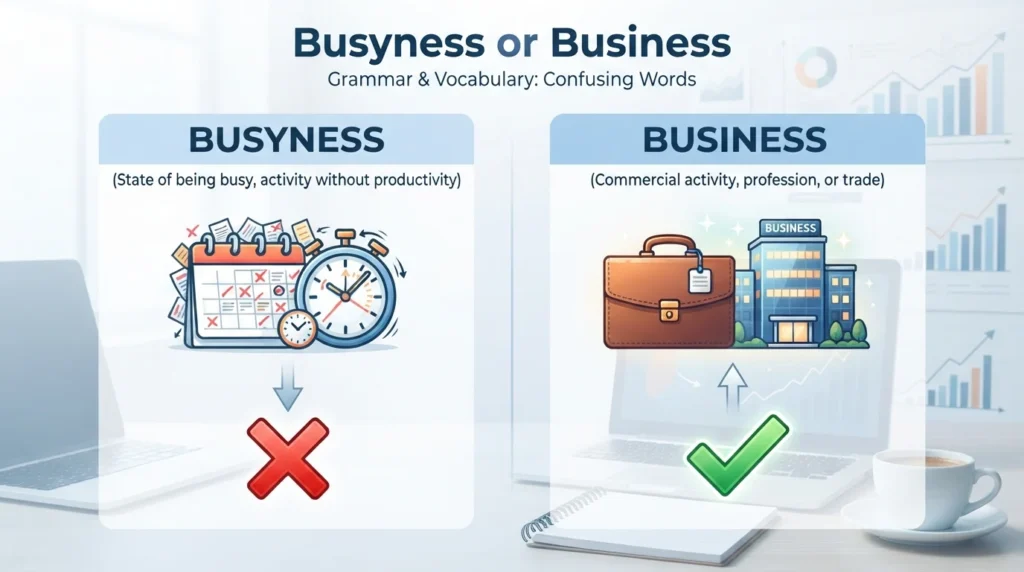

Quick Ans: Busyness and business are both correct words, but they have completely different meanings. Busyness refers to the state of being busy or having a lot to do, while business usually refers to a company, trade, work activity, or an important matter. Because the words look and sound similar, many writers accidentally use one when they mean the other.
English is full of confusing word pairs, and busyness or business is a perfect example. The two words differ by only one letter, yet they cannot be used interchangeably.
Understanding the difference between these terms can improve your writing and help you avoid common mistakes in professional and everyday communication.
This guide explains the meanings, uses, examples, and simple rules for choosing the correct word.
Busyness or Business: What’s the Difference?
What Does Busyness Mean?
Busyness is a noun.
It means the state of being busy or occupied with activities, work, or responsibilities.
Examples:
- The busyness of the holiday season left everyone exhausted.
- She enjoys the busyness of city life.
- His busyness prevented him from attending the meeting.
What Does Business Mean?
Business is also a noun.
It usually refers to:
- A company or organization.
- Trade or commercial activities.
- A person’s work or profession.
- An important matter or concern.
Examples:
- She owns a successful business.
- Our business has grown rapidly this year.
- That’s none of your business.
| Word | Part of Speech | Correct Word | Meaning |
|---|---|---|---|
| Busyness | Noun | ✅ Yes | The state of being busy |
| Business | Noun | ✅ Yes | A company, trade, work, or important matter |
Quick Recap
- Busyness means being occupied or having many activities.
- Business refers to commerce, work, or a matter of concern.
- Although they look similar, the two words have different meanings.
Is Busyness or Business a Grammar, Vocabulary, or Usage Issue?
Grammar
No.
This is not a grammar issue because both words are grammatically correct.
Vocabulary
Yes.
The confusion comes from choosing the correct vocabulary word.
Usage
Yes.
Writers sometimes use business when they mean busyness, or vice versa.
Are Busyness and Business Interchangeable?
No.
Even though the words are similar, they have different meanings and cannot replace one another.
Formal Writing
Use busyness when discussing how occupied someone is.
Use business when referring to companies, trade, work, or important matters.
Casual Writing
People sometimes mistakenly write:
❌ The business of my schedule is overwhelming.
The correct sentence is:
✅ The busyness of my schedule is overwhelming.
Understanding Busyness
Meaning
Busyness refers to the condition of having a lot to do or being constantly occupied.
Workplace Example
The busyness of the office increased during the holiday season.
Academic Example
The researcher struggled to balance her studies with the busyness of family life.
Literature Example
The author described the busyness of the crowded marketplace.
Everyday Example
I enjoy the busyness of weekends because my family visits often.
Usage Recap
Use busyness when talking about:
- Being occupied
- Having a busy schedule
- A lot of activities
- A hectic lifestyle
Understanding Business
Meaning
Business generally refers to commerce, work, a company, or an important matter.
Workplace Example
She started her own online business last year.
Academic Example
He earned a degree in business administration.
Literature Example
The novel follows a family business passed down for generations.
Everyday Example
That’s none of your business.
Usage Recap
Use business when referring to:
- Companies and organizations
- Trade and commerce
- Jobs and professions
- Personal matters or concerns
Why Do People Confuse Busyness and Business?
The confusion happens because:
- The words are spelled similarly.
- They have similar pronunciations.
- Both come from the adjective busy.
However, they developed different meanings over time.
Simply remember:
- Busyness = being busy
- Business = company, work, or matter
Historical Background of the Words
The word business has existed in English for centuries and originally referred to a person’s occupation or concerns.
The word busyness developed later to specifically describe the condition of being busy.
Although they share the same root word, they evolved into separate vocabulary terms with different meanings.
When You Should Not Use Busyness or Business
Common Situations to Avoid
Do not write:
❌ She owns a successful busyness.
✅ She owns a successful business.
Do not write:
❌ The business of the holiday season exhausted everyone.
✅ The busyness of the holiday season exhausted everyone.
Do not use business when talking about how occupied someone is.
Do not use busyness when referring to a company or profession.
Common Mistakes and Decision Rules
Common Mistakes
| Correct Sentence | Incorrect Sentence | Explanation |
|---|---|---|
| The busyness of the city never stops. | The business of the city never stops. | The sentence refers to activity levels. |
| She runs a successful business. | She runs a successful busyness. | A company is called a business. |
| His busyness kept him from attending. | His business kept him from attending. | The sentence refers to being occupied. |
| They studied business in college. | They studied busyness in college. | The subject is business studies. |
Decision Rule
Ask yourself this question:
Are you talking about being busy?
If yes, use busyness.
Are you talking about a company, trade, work, or an important matter?
If yes, use business.
Busyness and Business in Modern Communication
In modern English, business is one of the most commonly used nouns because it relates to work, companies, and commerce.
Busyness is less common but still important when describing hectic schedules and active lifestyles.
Understanding the difference can improve clarity and prevent embarrassing writing mistakes.
Expert Opinion
Language experts consider business and busyness completely separate words despite their similar spellings.
Most dictionaries recommend paying attention to context because the meaning changes entirely depending on which word you choose.
Case Studies
Case Study One
A student wrote:
“The busyness industry is growing rapidly.”
The teacher corrected the sentence to:
“The business industry is growing rapidly.”
The sentence referred to commerce, not being busy.
Case Study Two
An employee wrote:
“My business this week has been exhausting.”
The intended meaning was being occupied, so the sentence should have been:
“My busyness this week has been exhausting.”
Error Prevention Checklist
Always Use Busyness When
- Talking about being occupied
- Describing a hectic schedule
- Discussing activity levels
- Referring to a busy lifestyle
Always Use Business When
- Referring to a company
- Discussing trade or commerce
- Talking about work or professions
- Mentioning an important matter
Related Word Confusions You Should Master
- Principal or Principle
- Affect or Effect
- Than or Then
- Complement or Compliment
- Stationary or Stationery
- Farther or Further
- Accept or Except
- Imply or Infer
- Everyday or Every Day
- Advice or Advise
Frequently Asked Questions
Is busyness a real word?
Yes.
Busyness is a correct English word that means the state of being busy.
Is business a real word?
Yes.
Business refers to commerce, work, companies, or important matters.
Can busyness and business be used interchangeably?
No.
They have different meanings and should not replace each other.
Which word means being occupied?
Busyness means being occupied or having many activities.
Which word means a company?
Business means a company, trade, or commercial activity.
Why do people confuse these words?
Because they have similar spellings and both come from the adjective busy.
Conclusion
When comparing busyness or business, remember that both words are correct but serve different purposes. Busyness describes the state of being busy or occupied, while business refers to companies, trade, work, or matters of concern. A simple rule can help you choose the right word: if you’re talking about activity and a hectic schedule, use busyness. If you’re talking about commerce, work, or a company, use business.