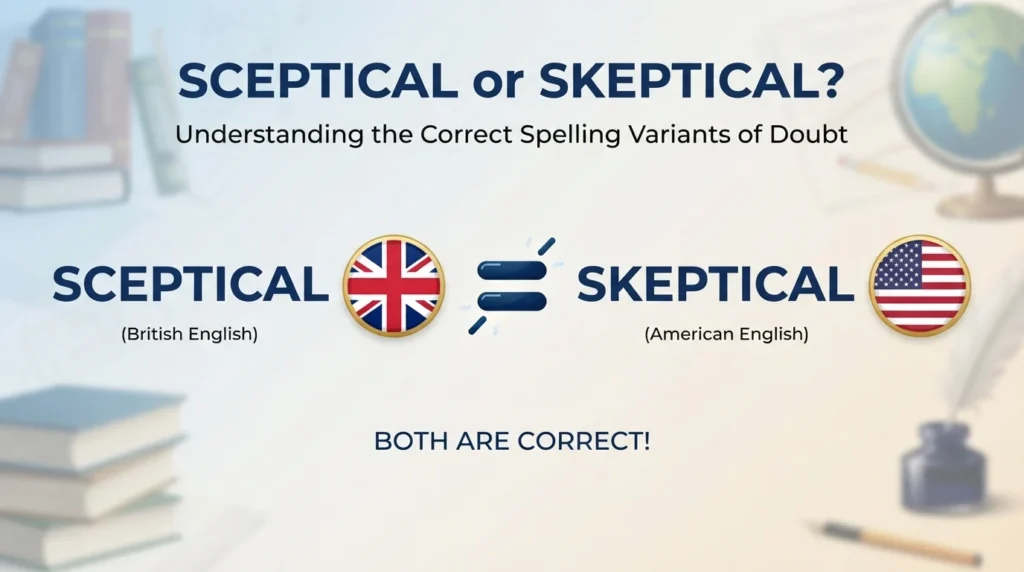

Quick Ans: Both sceptical and skeptical are correct spellings. The difference is mainly regional. Sceptical is the preferred spelling in British English, while skeptical is the standard spelling in American English. They have exactly the same meaning and can usually be used interchangeably depending on your audience.
English has many words that are spelled differently in different countries. One of the most common examples is sceptical or skeptical. People often wonder whether one spelling is right and the other is wrong.
The good news is that both spellings are accepted.
The only thing you need to consider is which version of English you are using.
This guide explains the difference between sceptical and skeptical, when to use each spelling, and how to avoid mistakes in professional writing.
Sceptical or Skeptical: What’s the Difference?
What Does Sceptical Mean?
Sceptical is an adjective.
It describes someone who doubts, questions, or is not easily convinced by something.
It is the preferred spelling in British English.
Examples:
- She was sceptical about the company’s promises.
- The scientist remained sceptical of the new theory.
- I am sceptical that the plan will succeed.
What Does Skeptical Mean?
Skeptical has exactly the same meaning as sceptical.
It is simply the American English spelling.
Examples:
- He was skeptical of the advertisement.
- Many voters are skeptical about the proposal.
- The teacher seemed skeptical of the excuse.
| Word | Part of Speech | Correct Word | Meaning |
|---|---|---|---|
| Sceptical | Adjective | ✅ Yes | Doubting or questioning something |
| Skeptical | Adjective | ✅ Yes | Doubting or questioning something |
Quick Recap
- Sceptical is the British English spelling.
- Skeptical is the American English spelling.
- Both words have the same meaning.
- Neither spelling is incorrect.
Is Sceptical or Skeptical a Grammar, Vocabulary, or Usage Issue?
Grammar
No.
This is not a grammar issue.
Vocabulary
No.
Both words are legitimate vocabulary terms with the same meaning.
Usage
Yes.
The issue is mainly about regional spelling preferences.
Are Sceptical and Skeptical Interchangeable?
Yes.
They have the same meaning and can generally be used interchangeably.
However, you should stay consistent within a piece of writing.
Formal Writing
Use:
- Sceptical for British audiences.
- Skeptical for American audiences.
Casual Writing
Either spelling is acceptable as long as you remain consistent.
Understanding Sceptical
Meaning
A person who is sceptical tends to question claims and requires evidence before believing something.
Workplace Example
The manager was sceptical about the sales projections.
Academic Example
The researchers remained sceptical until additional evidence was provided.
Literature Example
The detective was sceptical of the witness’s story.
Everyday Example
I am sceptical that the weather will improve today.
Usage Recap
Use sceptical when writing for:
- The United Kingdom
- Australia
- New Zealand
- Most British English publications
Understanding Skeptical
Meaning
Skeptical means doubting or questioning a statement, claim, or idea.
It is simply the American English version of sceptical.
Business Example
Investors were skeptical about the startup’s predictions.
Science Example
Scientists remained skeptical until the experiment was repeated.
Media Example
Many readers were skeptical of the news report.
Usage Recap
Use skeptical when writing for:
- The United States
- American publications
- American businesses and websites
Why Are There Two Spellings?
English contains many words that have different spellings in British and American English.
Examples include:
- Colour or Color
- Favourite or Favorite
- Organise or Organize
- Centre or Center
Similarly:
- British English: Sceptical
- American English: Skeptical
Both spellings ultimately come from the Greek word skeptikos, meaning “to inquire” or “to examine.”
Historical Background of the Word
The word originated from ancient Greek philosophy.
The Skeptics were philosophers who questioned whether absolute knowledge was possible.
Over time, English developed two accepted spellings:
- Sceptical in British English.
- Skeptical in American English.
When You Should Not Mix the Spellings
Common Situations to Avoid
Avoid writing:
❌ The company was sceptical in one paragraph and skeptical in the next.
❌ Using British and American spellings randomly in the same article.
Choose one spelling and use it consistently.
Common Mistakes and Decision Rules
Common Mistakes
| Correct Sentence | Incorrect Sentence | Explanation |
|---|---|---|
| She is sceptical about the claim. | She is sceptikal about the claim. | The spelling is incorrect. |
| He is skeptical of the proposal. | He is sceptical and skeptical in the same report. | Stay consistent. |
| The scientist remained skeptical. | The scientist remained skepticall. | Incorrect spelling. |
| Many people are sceptical of advertisements. | Many people are scepticle of advertisements. | Misspelling. |
Decision Rule
If you are writing for:
- A British audience, use sceptical.
- An American audience, use skeptical.
Both words mean exactly the same thing.
Sceptical and Skeptical in Modern Media and Technology
Most grammar-checking tools recognize both spellings.
However, software often suggests one spelling based on the language settings you select.
Search engines also understand that sceptical and skeptical are spelling variations of the same word.
Expert Opinion
Language experts generally agree that neither spelling is more correct than the other.
The choice depends entirely on regional English preferences and consistency.
Case Studies
Case Study One
A British newspaper changed every instance of skeptical to sceptical to maintain its house style.
Case Study Two
An American company edited its website and replaced sceptical with skeptical to better match its audience.
Error Prevention Checklist
Always Use Sceptical When
- Writing for British readers
- Creating content for UK publications
- Following British English style guides
Always Use Skeptical When
- Writing for American readers
- Publishing content in the United States
- Following American English conventions
Related Word Confusions You Should Master
- Colour or Color
- Favourite or Favorite
- Centre or Center
- Organise or Organize
- Licence or License
- Defence or Defense
- Grey or Gray
- Travelling or Traveling
- Judgement or Judgment
- Analogue or Analog
Frequently Asked Questions
Is sceptical or skeptical correct?
Both spellings are correct.
Which spelling is British English?
Sceptical is the British spelling.
Which spelling is American English?
Skeptical is the American spelling.
Do they have different meanings?
No. Both words have exactly the same meaning.
Can I use both spellings in one article?
It is better to choose one spelling and remain consistent.
Which spelling should I use for SEO?
Use the spelling that matches your target audience and include the alternative spelling naturally in the article.
Conclusion
When comparing sceptical or skeptical, both spellings are correct. The only difference is regional preference. Sceptical is the standard spelling in British English, while skeptical is preferred in American English. Since both words mean “doubting” or “questioning,” your choice should depend entirely on your audience and the style of English you are using.