
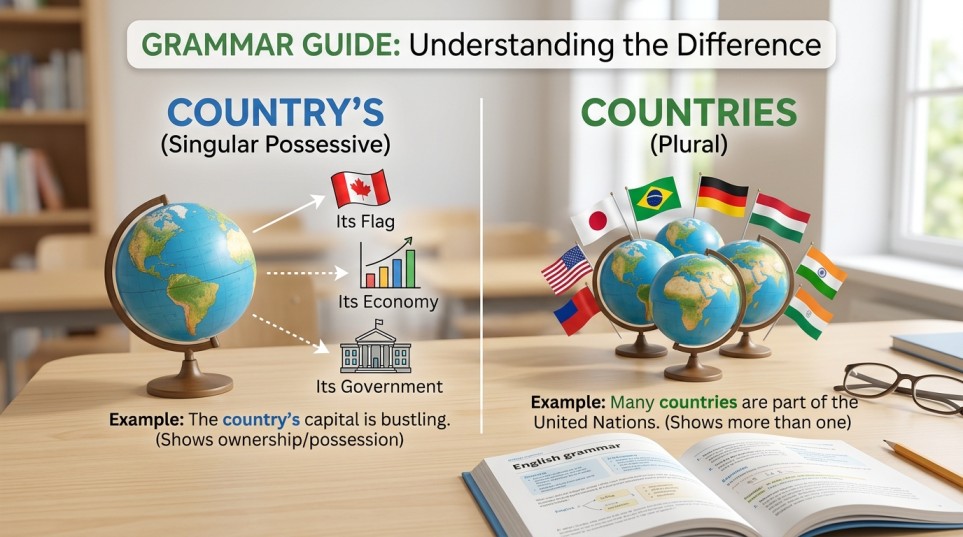

Quick Ans: Country’s or countries? The correct choice depends on what you want to say. Country’s is the singular possessive form that shows something belongs to one country. Countries is simply the plural form of country, referring to more than one nation. Understanding this difference helps you write accurately in academic, professional, and everyday English.
English punctuation and plural forms often confuse writers because a single apostrophe can completely change a word’s meaning. Many people search for country’s or countries when writing essays, reports, travel articles, or business documents. Since both forms are correct in different situations, choosing the right one depends entirely on the sentence.
The confusion usually comes from mixing up possession and plurality. One form shows ownership, while the other simply indicates that there is more than one country. Once you understand this distinction, deciding which word to use becomes much easier.
This guide explains the meaning of each form, when to use it, common mistakes to avoid, and practical examples from real life.
Country’s or Countries: What’s the Difference?
What Does Country’s Mean?
Country’s is the singular possessive form of country. It shows that something belongs to or is associated with one country.
What Does Countries Mean?
Countries is the plural form of country. It simply refers to two or more countries without expressing ownership.
| Word | Part of Speech | Correct | Meaning |
|---|---|---|---|
| country’s | Singular possessive noun | ✅ Yes | Something belongs to one country |
| countries | Plural noun | ✅ Yes | More than one country |
Quick Recap
Use country’s when one country owns or possesses something.
Choose countries when referring to multiple nations.
Both words are correct, but they serve different purposes.
Country’s or Countries: What Is the Difference?
Understanding Country’s
The apostrophe before the s indicates possession.
It answers questions such as whose economy, whose culture, or whose government.
Understanding Countries
The ending ies changes the singular noun into its plural form.
This word refers to multiple nations without showing ownership.
Comparison Examples
| Country’s | Countries |
|---|---|
| The country’s economy is growing. | Many countries are investing in renewable energy. |
| The country’s history is fascinating. | Several countries signed the agreement. |
| The country’s education system has improved. | European countries cooperate on trade. |
Quick Summary
Think of country’s as meaning belonging to one country.
Think of countries as meaning more than one country.
Is Country’s or Countries a Grammar, Vocabulary, or Usage Issue?
Grammar
This is mainly a grammar and punctuation issue because apostrophes change the function of the noun.
Vocabulary
It is not a vocabulary problem since both words come from the same base noun.
Usage
Correct usage depends on whether you want to express ownership or plurality.
Are They Interchangeable?
No.
Replacing one with the other changes the meaning of the sentence.
Formal Writing
Academic papers, legal documents, and professional reports require careful use of apostrophes because punctuation affects meaning.
Casual Writing
Even in everyday conversations and social media posts, using the correct form improves clarity.
Understanding Country’s
Meaning
Country’s indicates that something belongs to one country.
It may describe ownership, characteristics, policies, traditions, economy, geography, or government.
Workplace Example
The country’s export strategy has attracted international investors.
Academic Example
The country’s political system changed significantly during the twentieth century.
Technology Example
The country’s cybersecurity framework continues to evolve.
Travel Example
The country’s national parks attract millions of visitors each year.
News Example
The country’s inflation rate declined during the last quarter.
Usage Recap
Use country’s whenever one nation possesses, owns, controls, or is associated with something.
Understanding Countries
Meaning
Countries refers to more than one nation.
It does not indicate ownership.
Workplace Example
Several countries agreed to expand international trade.
Academic Example
Researchers compared education systems across different countries.
Technology Example
Many countries have introduced artificial intelligence regulations.
Travel Example
She visited twelve countries during her world tour.
Business Example
The company operates in over forty countries.
Usage Recap
Choose countries whenever you mean two or more nations.
No apostrophe is needed.
When You Should Not Use Country’s or Countries
Common Situations to Avoid
Do not use country’s when simply talking about several nations.
Avoid countries when showing ownership by one nation.
Never add an apostrophe just to make a noun plural.
Do not assume every word ending in s needs an apostrophe.
Avoid confusing plural nouns with possessive nouns.
Proofread carefully because apostrophe mistakes are easy to miss.
Always consider whether the sentence expresses ownership.
Check whether you are referring to one country or several.
Common Mistakes and Decision Rules
Common Errors
| Correct Sentence | Incorrect Sentence | Explanation |
|---|---|---|
| The country’s economy is improving. | The countries economy is improving. | The apostrophe shows possession. |
| Many countries support the proposal. | Many country’s support the proposal. | No possession is expressed. |
| The country’s flag is displayed proudly. | The countries flag is displayed proudly. | One country owns the flag. |
| Several countries signed the treaty. | Several country’s signed the treaty. | The sentence refers to multiple nations. |
| The country’s healthcare system improved. | The countries healthcare system improved. | Possession requires an apostrophe. |
Decision Rule
If something belongs to one country, use country’s.
If you simply mean more than one country, use countries.
Country’s and Countries in Modern Technology and AI Tools
Artificial intelligence tools often analyze text for grammar and punctuation errors.
Modern writing assistants can usually detect incorrect apostrophe placement when writers confuse country’s and countries.
Machine translation systems also rely on proper punctuation because possessive forms and plural nouns carry different meanings.
Using the correct form improves clarity for both readers and language processing software.
Where Does the Word Country Come From?
Etymology
The word country comes from the Old French word contrée, meaning a region or land.
It eventually entered Middle English and developed its modern meaning of a nation or state.
The possessive form country’s follows the standard English apostrophe rule, while countries follows the regular plural rule for nouns ending in y.
Expert Opinion
Apostrophes do not make words plural. They simply show possession. Understanding this rule prevents many of the most common writing mistakes in English.
Professional editors often identify misplaced apostrophes as one of the easiest grammar errors to eliminate through careful proofreading.
Case Study One
A university writing center reviewed student essays and discovered that apostrophe mistakes appeared frequently in history and geography assignments.
After providing targeted lessons on possessive nouns and plural forms, students produced more accurate essays and required fewer editing corrections.
Case Study Two
An international marketing agency noticed recurring punctuation errors in website content prepared for global audiences.
Editors created a style guide explaining the difference between possessive nouns and plural nouns. Within a few weeks, grammar related revisions declined significantly across client projects.
Error Prevention Checklist
Always Use Country’s When
- referring to one country’s economy
- describing one country’s culture
- discussing one country’s laws
- talking about one country’s history
- mentioning one country’s government
- describing one country’s population
- referring to one country’s resources
- expressing ownership by one nation
Never Use Countries When
- ownership belongs to one country
- the sentence answers the question whose
- discussing one nation’s policies
- referring to one country’s flag
- describing one country’s geography
- expressing possession
Related Grammar Confusions You Should Master
Learning these topics will strengthen your English writing.
- its or it’s
- peoples or people’s
- company’s or companies
- city’s or cities
- child’s or children
- employee’s or employees
- family’s or families
- business’s or businesses
- woman’s or women
- student’s or students
Frequently Asked Questions
Is country’s grammatically correct?
Yes. It is the singular possessive form of country.
Is countries grammatically correct?
Yes. It is the plural form of country.
What is the difference between country’s and countries?
Country’s shows possession by one country.
Countries refers to more than one nation.
Why does country’s have an apostrophe?
The apostrophe indicates that something belongs to one country.
Can countries have an apostrophe?
Yes. The plural possessive form is countries’ when something belongs to multiple countries.
Example:
The countries’ shared agreement strengthened regional cooperation.
Is country’s used in academic writing?
Yes. Academic writers regularly use it when discussing the characteristics or policies of one nation.
Is countries used in business writing?
Yes. It commonly refers to international markets, global operations, or multiple nations.
How can I remember the difference?
Ask yourself one question.
Are you talking about one country’s possession or many countries?
The answer tells you which form to use.
Conclusion
Choosing between country’s or countries is easier once you understand the role of the apostrophe. Country’s shows that something belongs to one country, while countries simply refers to more than one nation. Although both words are correct, they cannot replace each other because each serves a different grammatical purpose.
Whenever you write, pause for a moment and ask whether your sentence expresses ownership or plurality. That simple habit will help you avoid one of the most common punctuation mistakes in English and make your writing clearer, more professional, and grammatically accurate.