
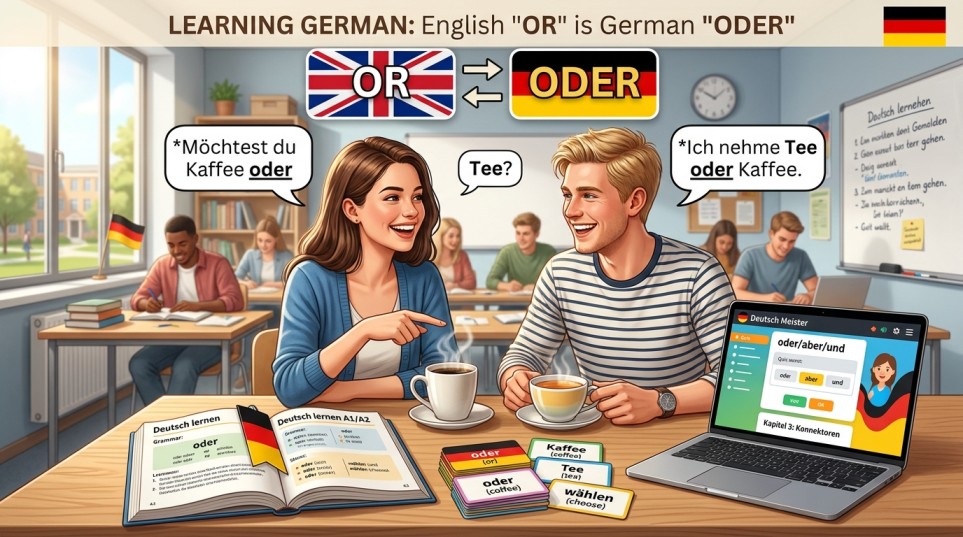

Quick Ans: Or in German is usually translated as oder. It is the standard coordinating conjunction used to present alternatives, choices, or options in both spoken and written German. Whether you’re asking a question, offering a choice, or comparing possibilities, oder is the correct word in almost every situation.
Learning basic conjunctions is one of the fastest ways to improve your German. Among them, oder is one of the most frequently used because it connects ideas and gives people options. If you are learning German for travel, work, school, or everyday conversation, understanding how to use oder correctly will help you speak and write more naturally.
Many English speakers search for or in German because they want a direct translation but quickly discover that context matters. Although oder is the standard equivalent, knowing when and how to use it makes your communication much more accurate.
This guide explains the meaning of oder, how to use it correctly, common mistakes, practical examples, pronunciation tips, and several related expressions every German learner should know.
Or in German: What’s the Difference?
What Does “Or” Mean in English?
The English word or is a coordinating conjunction that introduces an alternative, a choice, or another possibility.
Examples include:
- Tea or coffee?
- Today or tomorrow?
- Stay or leave.
How Do You Say “Or” in German?
In German, the equivalent word is oder.
It performs the same function by connecting two or more alternatives.
| English | German | Part of Speech | Meaning |
|---|---|---|---|
| or | oder | Coordinating conjunction | Presents alternatives or choices |
Quick Recap
The German word for or is oder.
It is used in questions, statements, comparisons, and everyday conversations.
In nearly every situation where English uses or, German uses oder.
Is “Or” in German a Grammar, Vocabulary, or Usage Issue?
Grammar
This topic mainly involves grammar because oder functions as a coordinating conjunction.
Unlike some German conjunctions, oder does not change the normal word order.
Vocabulary
It is also a vocabulary topic because learners must remember that oder is the standard translation of or.
Usage
From a usage perspective, oder is appropriate in both formal and informal communication.
Is It Always Interchangeable?
Almost always.
Whenever English uses or to present alternatives, German generally uses oder.
Formal Usage
Business meetings
Academic writing
Official correspondence
Professional presentations
All commonly use oder.
Informal Usage
Friends and family also use oder in everyday speech.
It is one of the most common words in conversational German.
Understanding Oder
Meaning
Oder connects two or more options, possibilities, or alternatives.
It works much like the English word or.
Workplace Example
Möchten Sie den Bericht heute oder morgen senden?
Would you like to send the report today or tomorrow?
Academic Example
Ist Ihre Prüfung am Montag oder am Dienstag?
Is your exam on Monday or Tuesday?
Technology Example
Möchten Sie die Datei speichern oder löschen?
Would you like to save or delete the file?
Everyday Examples
Kaffee oder Tee?
Coffee or tea?
Auto oder Fahrrad?
Car or bicycle?
Bleibst du hier oder gehst du nach Hause?
Are you staying here or going home?
Usage Recap
Use oder whenever you offer choices, compare alternatives, or ask someone to choose between options.
It works naturally in nearly every type of German conversation.
Pronunciation of Oder
How Is It Pronounced?
The word oder is pronounced approximately as:
OH der
The first syllable receives more emphasis than the second.
Listening to native speakers helps improve pronunciation and rhythm.
Pronunciation Tip
Avoid pronouncing each letter separately.
Instead, say the word smoothly as one connected sound.
When You Should Not Use Oder
Common Situations
Do not use oder when you actually mean and.
Avoid replacing aber, which means but, with oder.
Do not confuse it with und, the German word for and.
Avoid using oder where no alternative exists.
Do not use it repeatedly in long lists because the sentence may become difficult to follow.
Always make sure the connected ideas are genuine alternatives.
Common Mistakes and Decision Rules
Common Mistakes
| Correct Sentence | Incorrect Sentence | Explanation |
|---|---|---|
| Kaffee oder Tee? | Kaffee und Tee? | The speaker wants a choice, not both. |
| Heute oder morgen? | Heute aber morgen? | Oder presents alternatives. |
| Lesen oder schreiben? | Lesen und schreiben? | The meaning changes completely. |
| Bus oder Bahn? | Bus aber Bahn? | Aber means but, not or. |
Decision Rule
If you want to present alternatives or choices, use oder.
If you want to join two things together, use und instead.
Oder in Modern Technology and AI Tools
Modern software frequently uses oder in German language interfaces.
You will often see it in installation menus, mobile applications, online forms, and artificial intelligence tools.
For example, a dialog box may ask whether you want to save oder cancel a file. Voice assistants also use oder when offering different commands or suggesting multiple options.
Understanding this simple conjunction makes German software much easier to navigate.
Where Does Oder Come From?
Etymology
The German word oder has ancient Germanic roots that date back many centuries.
It developed from earlier forms used to express alternatives and choices.
Although pronunciation has changed over time, its basic meaning has remained remarkably consistent throughout the history of the German language.
Expert Insight
Small words often have the biggest impact when learning a new language. Mastering common conjunctions such as oder makes everyday communication smoother and more natural.
Language teachers frequently encourage beginners to learn conjunctions early because they connect simple vocabulary into complete ideas.
Case Study One
A group of beginner German learners practiced only basic vocabulary during their first month.
After adding conjunctions such as oder, und, and aber, they were able to build complete questions instead of isolated words. Their classroom conversations became noticeably more fluent within a few weeks.
Case Study Two
An international company introduced German language training for customer support employees.
The course emphasized practical conversation rather than memorization. Workers quickly learned to use oder when offering product choices to customers. Customer satisfaction improved because conversations sounded more natural and easier to understand.
Error Prevention Checklist
Always Use Oder When
- offering choices
- asking questions with alternatives
- comparing two options
- writing formal German
- speaking with native speakers
- presenting possibilities
- creating multiple choice questions
- translating the English word or
Never Use Oder When
- you actually mean and
- connecting ideas that are not alternatives
- replacing aber
- expressing addition instead of choice
- listing actions that happen together
- translating because
- introducing a reason
- joining unrelated ideas
Related German Grammar Topics You Should Master
Learning oder becomes easier when you also understand these common German words and grammar concepts.
- And in German
- But in German
- Because in German
- Yes in German
- No in German
- German word order
- German question words
- German coordinating conjunctions
- German subordinating conjunctions
- Everyday German conversation
Frequently Asked Questions
What is the German word for or?
The German word for or is oder.
Is oder used in both formal and informal German?
Yes. It is appropriate in every level of communication.
Does oder change German word order?
No. As a coordinating conjunction, it keeps the normal sentence structure.
Can I always translate or as oder?
In almost every ordinary situation, yes.
How do Germans pronounce oder?
It is commonly pronounced as OH der.
Is oder a conjunction?
Yes. It is a coordinating conjunction that introduces alternatives.
Can oder connect complete sentences?
Yes. It can join words, phrases, or complete clauses without changing the normal word order.
Is oder one of the first German words beginners should learn?
Absolutely. It appears frequently in conversations, textbooks, apps, and everyday communication.
Conclusion
If you are wondering about or in German, the answer is simple. The correct translation is oder, a coordinating conjunction used to present alternatives, choices, and possibilities. It works in formal writing, casual conversations, classrooms, workplaces, and technology interfaces without changing the normal German word order.
By practicing oder in real sentences, you will communicate more naturally and understand spoken German with greater confidence. Since it appears in everyday conversations, mastering this small but powerful word is an important step toward German fluency.