
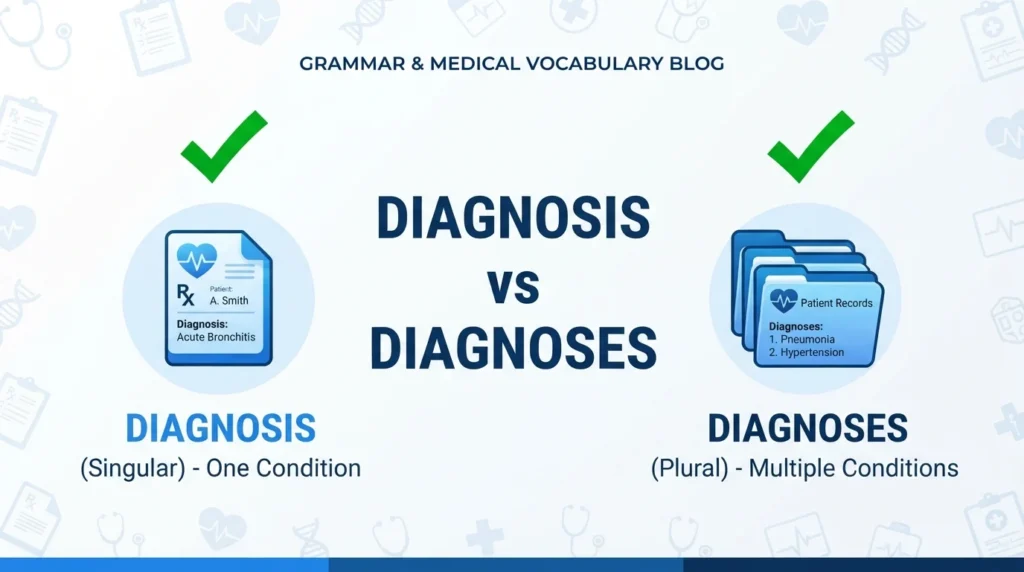

Quick Ans: Diagnosis is the singular form and refers to the identification of one disease, condition, or problem. Diagnoses is the plural form and refers to two or more diagnoses. If you are talking about one medical conclusion, use diagnosis. If you are referring to multiple medical conclusions, use diagnoses.
English has many singular and plural words that can confuse even experienced writers. One common example is diagnoses or diagnosis. Although these words look very similar, they have different meanings and are used in different situations.
Many people mistakenly use diagnoses when talking about a single medical condition or use diagnosis when referring to multiple medical findings.
This guide explains the difference between diagnoses and diagnosis, when to use each one, and how to avoid common mistakes in both medical and everyday writing.
Diagnoses or Diagnosis: What’s the Difference?
What Does Diagnosis Mean?
Diagnosis is a singular noun.
It refers to the identification of a disease, illness, disorder, or other condition after examining symptoms and test results.
Examples:
- The doctor’s diagnosis was pneumonia.
- She received a diagnosis of diabetes.
- Early diagnosis can improve treatment outcomes.
What Does Diagnoses Mean?
Diagnoses is the plural form of diagnosis.
It is used when referring to two or more medical conclusions.
Examples:
- The doctors compared several diagnoses before choosing a treatment.
- Multiple diagnoses were recorded in the patient’s file.
- The specialists discussed their different diagnoses during the meeting.
| Word | Part of Speech | Correct Usage | Meaning |
|---|---|---|---|
| Diagnosis | Singular Noun | ✅ One condition | Identification of one disease or condition |
| Diagnoses | Plural Noun | ✅ Two or more conditions | More than one diagnosis |
Quick Recap
- Diagnosis = One medical conclusion.
- Diagnoses = More than one medical conclusion.
- They are not interchangeable.
Is Diagnoses or Diagnosis a Grammar, Vocabulary, or Usage Issue?
Grammar
Yes.
This is mainly a grammar issue because it involves choosing the correct singular or plural noun.
Vocabulary
Partly.
Both words have the same meaning but differ in number.
Usage
Using the wrong form can make medical, academic, and professional writing inaccurate.
Are Diagnosis and Diagnoses Interchangeable?
No.
Use diagnosis when talking about one condition.
Use diagnoses when referring to two or more conditions.
Formal Writing
Medical reports, research papers, and academic writing require the correct singular or plural form.
Casual Writing
Even in everyday conversations, choosing the correct form improves clarity.
Understanding Diagnosis
Meaning
A diagnosis is the process or result of identifying a disease, disorder, or condition.
Workplace Example
The employee submitted a medical certificate containing the doctor’s diagnosis.
Academic Example
Students learned how to make an accurate diagnosis based on patient symptoms.
Literature Example
The novel describes a young man’s struggle after receiving a difficult diagnosis.
Everyday Example
The doctor’s diagnosis explained why she had been feeling tired.
Usage Recap
Use diagnosis whenever you are referring to one medical finding or conclusion.
Understanding Diagnoses
Meaning
Diagnoses refers to multiple medical findings or conclusions.
Hospital Example
Several diagnoses were reviewed before surgery.
Research Example
The study compared thousands of cancer diagnoses collected over five years.
Healthcare Example
Different specialists provided different diagnoses for the same patient.
Usage Recap
Use diagnoses whenever more than one diagnosis is involved.
Why Do People Confuse Diagnosis and Diagnoses?
Many English nouns borrowed from Greek have unusual plural forms.
Instead of simply adding -s, the ending changes.
For example:
- Analysis → Analyses
- Crisis → Crises
- Thesis → Theses
- Diagnosis → Diagnoses
Because these words follow different plural rules, many writers accidentally use the wrong form.
The Origin of the Word Diagnosis
The word diagnosis comes from the Greek word diagnōsis, meaning “to distinguish” or “to determine.”
English kept the original Greek plural form, which is why the plural becomes diagnoses instead of diagnosises.
When You Should Not Use Diagnosis or Diagnoses Incorrectly
Common Situations to Avoid
Do not write:
❌ The doctor gave three diagnosis.
✅ The doctor gave three diagnoses.
Do not write:
❌ The diagnoses was accurate.
✅ The diagnosis was accurate.
Always match the noun with whether you are talking about one or multiple medical conclusions.
Common Mistakes and Decision Rules
Common Mistakes
| Correct Sentence | Incorrect Sentence | Explanation |
|---|---|---|
| The diagnosis was correct. | The diagnoses was correct. | Diagnosis is singular. |
| The doctors discussed several diagnoses. | The doctors discussed several diagnosis. | Diagnoses is plural. |
| She received a diagnosis yesterday. | She received diagnoses yesterday. | Only one medical finding. |
| Multiple diagnoses were recorded. | Multiple diagnosis were recorded. | Plural noun required. |
Decision Rule
Ask yourself one question:
Are you talking about one medical conclusion or more than one?
- One = Diagnosis
- More than one = Diagnoses
Diagnosis and Diagnoses in Modern Healthcare
Electronic health records, hospitals, and medical research use both words every day.
Doctors record a patient’s diagnosis after examining symptoms, while researchers often analyze thousands of diagnoses to study disease patterns and improve treatments.
Using the correct word is essential for clear medical communication.
Expert Opinion
Medical style guides and healthcare professionals consistently distinguish between diagnosis and diagnoses based solely on number.
Understanding the singular and plural forms helps improve accuracy in medical, academic, and professional writing.
Case Studies
Case Study One
A nursing student repeatedly wrote diagnoses when referring to one patient’s condition.
After learning the singular and plural rule, the student’s clinical reports became more accurate and easier to understand.
Case Study Two
A hospital research paper analyzed over 10,000 patient diagnoses collected from multiple departments.
Using the correct plural form ensured the research followed professional medical writing standards.
Error Prevention Checklist
Always Use Diagnosis When
- Referring to one disease or condition
- Discussing one patient’s medical result
- Writing about a single medical conclusion
- Preparing an individual medical report
Always Use Diagnoses When
- Referring to multiple diseases
- Comparing several medical conclusions
- Writing research papers
- Discussing groups of patients
Related Word Confusions You Should Master
- Analysis or Analyses
- Thesis or Theses
- Crisis or Crises
- Basis or Bases
- Criterion or Criteria
- Affect or Effect
- Principal or Principle
- Compliment or Complement
- Stationary or Stationery
- Farther or Further
Frequently Asked Questions
Is diagnosis singular or plural?
Diagnosis is singular.
What is the plural of diagnosis?
The correct plural is diagnoses.
Can I say “two diagnosis”?
No.
The correct phrase is two diagnoses.
Why is the plural diagnoses instead of diagnosises?
Because the word comes from Greek and follows the original Greek plural form.
Is diagnosis only used in medicine?
No.
It can also describe identifying the cause of problems in psychology, engineering, technology, education, and business.
Which word is more common?
Diagnosis is more common because people often discuss individual medical conditions, while diagnoses appears more frequently in research and healthcare settings.
Conclusion
When comparing diagnoses or diagnosis, the difference is simple once you understand the singular and plural forms. Diagnosis refers to one medical conclusion, while diagnoses refers to two or more. Choosing the correct word improves accuracy in medical reports, academic writing, and everyday communication. A simple rule to remember is this: if there is only one condition, use diagnosis; if there are multiple conditions, use diagnoses.