
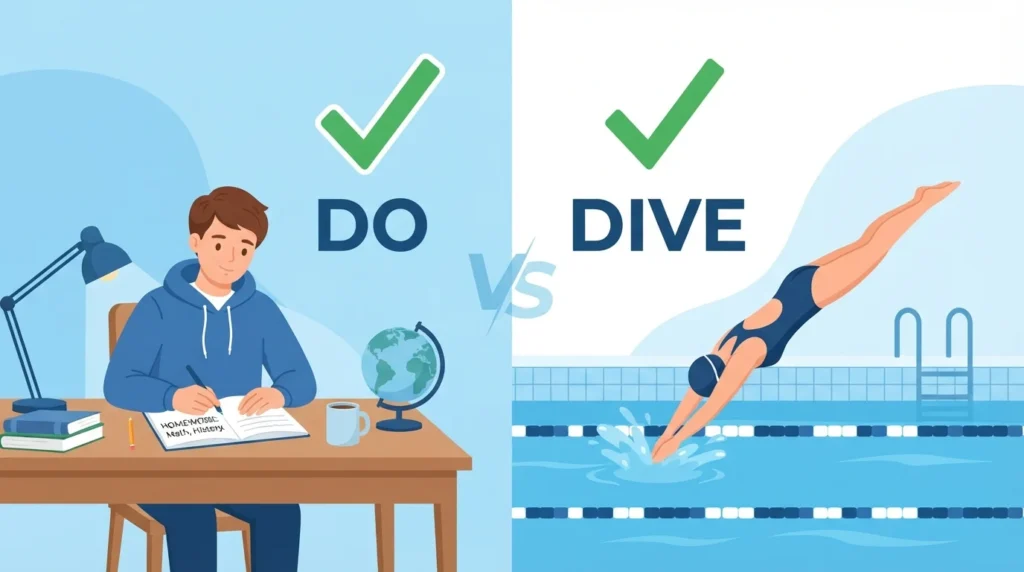

Quick Ans: Do and dive are completely different English words with different meanings. Do means to perform, complete, or carry out an action, while dive means to jump or plunge into water or to move downward quickly. Because they look somewhat similar and are both common verbs, English learners sometimes confuse them. However, they are not interchangeable.
English contains many words that sound somewhat alike but have entirely different meanings. One example is do or dive. While both are verbs, they describe completely different actions and are used in different contexts.
Understanding the difference between these two words will help you avoid common writing and speaking mistakes.
This guide explains the meanings, grammar, examples, common mistakes, and the correct usage of do and dive.
Do or Dive: What’s the Difference?
What Does Do Mean?
Do is a verb.
It means to perform, complete, carry out, or accomplish an action, task, or activity.
Examples:
- I need to do my homework.
- She always does her best.
- They did an excellent job.
What Does Dive Mean?
Dive is a verb.
It means to jump headfirst into water or to move quickly downward. It can also be used figuratively to describe becoming deeply involved in something.
Examples:
- The swimmer will dive into the pool.
- The bird dived toward the water.
- Let’s dive into today’s lesson.
| Word | Part of Speech | Correct Word | Meaning |
|---|---|---|---|
| Do | Verb | ✅ Yes | Perform or complete an action |
| Dive | Verb | ✅ Yes | Jump into water or move downward quickly |
Quick Recap
- Do means to perform an action.
- Dive means to jump into water or move downward.
- They have completely different meanings.
- They should never replace one another.
Is Do or Dive a Grammar, Vocabulary, or Usage Issue?
Grammar
No.
Both words are grammatically correct but serve different purposes.
Vocabulary
Yes.
This is mainly a vocabulary issue because the two words have different meanings.
Usage
Yes.
Choosing the wrong word changes the meaning of your sentence completely.
Are Do and Dive Interchangeable?
No.
Although both are verbs, they describe different actions and cannot replace each other.
Formal Writing
Use do for tasks, work, assignments, and actions.
Use dive only when referring to diving, downward movement, or exploring a topic deeply.
Casual Writing
Expressions like “Let’s dive in!” are common in conversations and presentations.
Understanding Do
Meaning
Do refers to performing an action or completing a task.
It is one of the most frequently used verbs in English.
Workplace Example
Please do the report before Friday.
Academic Example
Students should do their assignments on time.
Literature Example
The hero promised to do everything possible to save the village.
Everyday Example
I usually do the dishes after dinner.
Usage Recap
Use do when referring to:
- Work
- Homework
- Chores
- Tasks
- Responsibilities
- Actions
Understanding Dive
Meaning
Dive means to jump into water headfirst or move rapidly downward.
It can also mean becoming deeply involved in a subject.
Sports Example
The athlete performed a perfect dive during the competition.
Education Example
Let’s dive deeper into this topic.
Nature Example
The eagle dived toward its prey.
Everyday Example
The children dived into the swimming pool.
Usage Recap
Use dive when referring to:
- Swimming
- Water sports
- Sudden downward movement
- Exploring a topic deeply
Why Do People Confuse Do and Dive?
The confusion usually happens because both are short, common English verbs.
Some English learners mistakenly think they are related because both involve actions.
In reality, they have completely different meanings and origins.
Historical Background
The word do comes from Old English dōn, meaning “to perform” or “to make.”
The word dive comes from Old English dyfan, meaning “to sink” or “to plunge into water.”
Although both words are ancient English verbs, they developed independently and are unrelated in meaning.
When You Should Not Use Do or Dive
Common Situations to Avoid
Do not write:
❌ I will dive my homework.
❌ She did into the swimming pool.
Correct forms:
✅ I will do my homework.
✅ She dived into the swimming pool.
Common Mistakes and Decision Rules
Common Mistakes
| Correct Sentence | Incorrect Sentence | Explanation |
|---|---|---|
| I need to do my homework. | I need to dive my homework. | Homework is completed, not dived. |
| He dived into the lake. | He did into the lake. | Dive describes entering water. |
| She did a great job. | She dived a great job. | Use do for performing work. |
| Let’s dive into the lesson. | Let’s do into the lesson. | Dive is the correct expression. |
Decision Rule
Use do when talking about:
- Tasks
- Work
- Activities
- Responsibilities
Use dive when talking about:
- Swimming
- Jumping into water
- Moving downward
- Exploring a topic deeply
Do and Dive in Modern English
Both words are extremely common in modern English.
Do appears in almost every type of writing because it is one of the most frequently used verbs.
Dive is common in sports, education, presentations, and business, especially in expressions like “Let’s dive into the details.”
Expert Opinion
English language experts recommend learning words based on their meanings rather than their appearance.
Although do and dive are both verbs, they belong to different vocabulary groups and should never be substituted for one another.
Case Studies
Case Study One
An English learner wrote, “I need to dive my project tonight.”
The corrected sentence became:
“I need to do my project tonight.”
Case Study Two
A presentation speaker said, “Let’s dive into today’s topic.”
This is the correct idiomatic expression because it means to begin exploring something in depth.
Error Prevention Checklist
Always Use Do When
- Completing work
- Doing homework
- Performing tasks
- Carrying out responsibilities
- Describing actions
Always Use Dive When
- Jumping into water
- Talking about swimming
- Describing downward movement
- Exploring a subject deeply
- Using expressions like “dive into”
Related Word Confusions You Should Master
- Do or Make
- Dive or Drove
- Lay or Lie
- Affect or Effect
- Accept or Except
- Principal or Principle
- Farther or Further
- Compliment or Complement
- Imply or Infer
- Than or Then
Frequently Asked Questions
Is it do or dive my homework?
Do is correct.
Can dive mean to start learning something?
Yes.
The expression “dive into a topic” means to explore it deeply.
Are do and dive synonyms?
No.
They have completely different meanings.
Is dive only used for swimming?
No.
It is also used figuratively, such as “dive into the details” or “dive into research.”
Can I replace do with dive?
No.
Doing so changes the meaning of the sentence and makes it incorrect.
Conclusion
When comparing do or dive, remember that they are entirely different verbs. Do means to perform or complete an action, while dive means to plunge into water or become deeply involved in a subject. They are not interchangeable, and using the correct word will make your English clearer, more accurate, and more professional.