
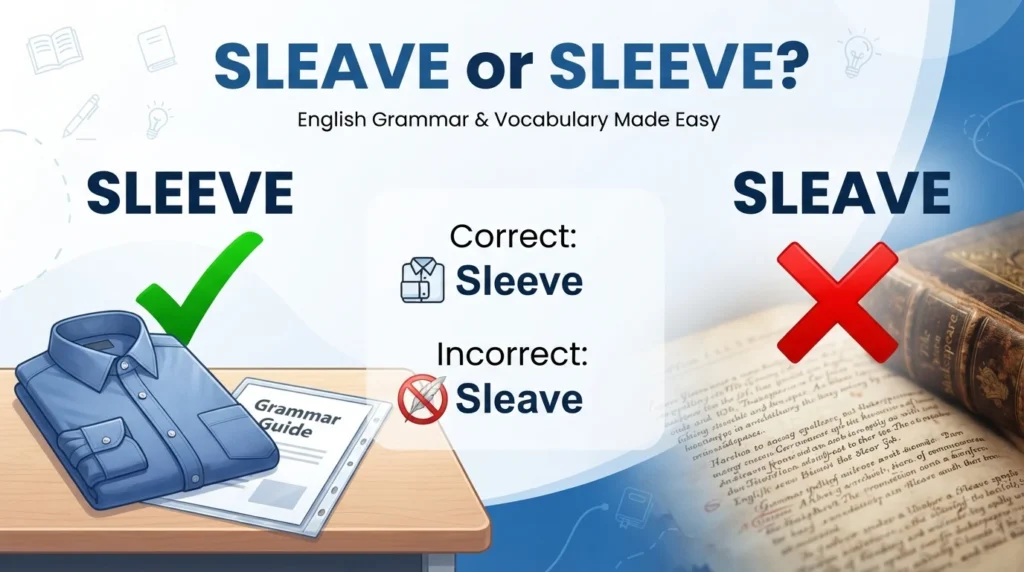

Quick Ans: Sleeve is the correct spelling. Sleave is generally considered a misspelling in modern English when referring to the part of a shirt, jacket, or dress that covers the arm. While sleave has an old literary meaning in historical texts, it is almost never used in everyday English. In nearly all situations, sleeve is the word you should use.
English contains many words that look or sound similar, making spelling mistakes common. One example is sleave or sleeve. Many people accidentally write sleave when they actually mean sleeve, especially while typing quickly or relying on pronunciation.
Understanding the difference between these two words will help you write more accurately in academic, professional, and everyday communication.
This guide explains the meanings, correct usage, historical background, common mistakes, and when you should use sleeve instead of sleave.
Sleave or Sleeve: What’s the Difference?
What Does Sleeve Mean?
Sleeve is both a noun and, in some contexts, a verb.
As a noun, it refers to the part of a garment that covers all or part of the arm.
It can also refer to a protective cover used for documents, records, cables, or electronic devices.
Examples:
- She rolled up her sleeves before cooking.
- This jacket has long sleeves.
- Put the document inside a plastic sleeve.
What Does Sleave Mean?
Sleave is an old English word with a very rare literary meaning.
Historically, it referred to untwisted silk, loose thread, or fine fibers. Today, it is considered an archaic word and is almost never used outside discussions of historical literature or Shakespeare.
For modern writing, sleave should not be used when talking about clothing.
| Word | Part of Speech | Correct Word | Meaning |
|---|---|---|---|
| Sleeve | Noun/Verb | ✅ Yes | Part of clothing that covers the arm; a protective cover |
| Sleave | Noun (Archaic) | ⚠️ Rare | Fine silk fibers or untwisted thread in historical English |
Quick Recap
- Sleeve is the correct modern English word.
- Sleave is an archaic literary word.
- For clothing and everyday writing, always use sleeve.
Is Sleave or Sleeve a Grammar, Vocabulary, or Usage Issue?
Grammar
No.
This is not a grammar issue.
Vocabulary
Yes.
The confusion involves choosing the correct vocabulary word.
Usage
Yes.
Using sleave instead of sleeve in modern writing is usually considered a spelling mistake unless you are discussing historical literature.
Are Sleave and Sleeve Interchangeable?
No.
Although the words look similar, they have different meanings.
Formal Writing
Use sleeve when referring to clothing, protective covers, or engineering components.
Use sleave only when discussing historical English literature or archaic vocabulary.
Casual Writing
In everyday conversation, emails, and social media, sleeve is almost always the correct choice.
Understanding Sleeve
Meaning
A sleeve is the part of a garment that covers the arm.
The word can also describe a protective covering for objects such as documents, CDs, cables, or electronic equipment.
Workplace Example
Please place the contract inside a protective plastic sleeve.
Academic Example
The laboratory technician wore a protective arm sleeve while handling chemicals.
Fashion Example
The designer added elegant lace sleeves to the wedding dress.
Everyday Example
He rolled up his shirt sleeves before washing the car.
Usage Recap
Use sleeve when referring to:
- Shirts
- Jackets
- Dresses
- Protective covers
- Arm protectors
- Cable sleeves
- Document sleeves
Understanding Sleave
Meaning
Sleave is an obsolete English word that historically referred to fine silk fibers or untwisted thread.
It occasionally appears in Shakespeare and older literary works but is rarely used today.
Literature Example
The word sleave appears in older English literature with meanings related to thread or silk fibers.
Historical Example
Scholars studying historical English texts may encounter the word sleave.
Usage Recap
Use sleave only when:
- Studying Shakespeare
- Reading historical literature
- Discussing obsolete English vocabulary
- Explaining the origin of older English words
Why Do People Confuse Sleave and Sleeve?
The confusion happens because the two words look and sound similar.
Many people accidentally replace sleeve with sleave due to:
- Typing mistakes
- Pronunciation similarities
- Autocorrect errors
- Lack of familiarity with the archaic word
In modern English, sleeve is the correct choice in nearly every situation.
Historical Background of the Word Sleave
The word sleave dates back to Middle English and was used to describe loose silk fibers or untwisted thread.
It became well known through William Shakespeare’s Macbeth, where the phrase “the sleave of care” appears. In that context, sleave refers to thread rather than clothing.
Today, the word survives mainly in literary discussions and historical dictionaries.
When You Should Not Use Sleave
Common Situations to Avoid
Do not write:
❌ Shirt sleave
❌ Long sleave dress
❌ Roll up your sleaves
❌ Jacket sleave
Always write:
✅ Shirt sleeve
✅ Long sleeve dress
✅ Roll up your sleeves
✅ Jacket sleeve
Common Mistakes and Decision Rules
Common Mistakes
| Correct Sentence | Incorrect Sentence | Explanation |
|---|---|---|
| Roll up your sleeves. | Roll up your sleaves. | Sleeve is the correct modern word. |
| This shirt has long sleeves. | This shirt has long sleaves. | Sleave is not used for clothing. |
| Put the paper in a plastic sleeve. | Put the paper in a plastic sleave. | Sleeve refers to a protective cover. |
| Shakespeare used the word sleave. | Shakespeare used the word sleeve to mean thread. | In historical literature, sleave has a different meaning. |
Decision Rule
If you are referring to:
- Clothing
- Fashion
- Protective covers
- Documents
- Cables
Always use sleeve.
Use sleave only when discussing historical English or literary works.
Sleeve in Modern Language and Technology
The word sleeve appears in many industries beyond fashion.
Examples include:
- Laptop sleeve
- Cable sleeve
- Document sleeve
- Tattoo sleeve
- Compression sleeve
Modern dictionaries, grammar checkers, and AI writing tools recognize sleeve as the standard spelling for these meanings.
Expert Opinion
Major English dictionaries define sleeve as the correct modern word for clothing and protective covers.
Linguists classify sleave as an archaic or obsolete word that survives mainly in historical literature.
Case Studies
Case Study One
An online clothing store mistakenly listed several products as long sleave shirts.
After correcting the spelling to long sleeve shirts, the website appeared more professional and improved user trust.
Case Study Two
A student reading Macbeth assumed that sleave was a spelling mistake.
The literature teacher explained that it is an archaic English word referring to silk fibers rather than clothing.
Error Prevention Checklist
Always Use Sleeve When
- Referring to shirts or jackets
- Writing about dresses
- Describing protective covers
- Talking about laptop or document sleeves
- Writing professional or academic content
Use Sleave Only When
- Studying Shakespeare
- Reading historical literature
- Discussing obsolete English vocabulary
- Explaining the history of English words
Related Word Confusions You Should Master
- Sleave or Sleeve
- Cloth or Clothes
- Wear or Ware
- Fabric or Fibre
- Principal or Principle
- Affect or Effect
- Accept or Except
- Complement or Compliment
- Stationary or Stationery
- Than or Then
Frequently Asked Questions
Is sleave or sleeve correct?
Sleeve is the correct spelling for modern English.
Is sleave a real word?
Yes. It is an archaic English word that refers to fine silk fibers or thread.
Why do people spell sleeve as sleave?
Most often because of typing mistakes or confusion caused by similar pronunciation.
Can I use sleave when talking about shirts?
No. The correct word is sleeve.
What does sleeve mean?
It refers to the part of a garment that covers the arm or a protective cover for an object.
Where is the word sleave still used?
It is mainly found in historical literature, Shakespeare, and discussions of obsolete English vocabulary.
Conclusion
When comparing sleave or sleeve, sleeve is the correct spelling for almost every modern situation. It refers to the part of clothing that covers the arm and also describes protective covers used for documents, electronics, and other objects. Sleave, on the other hand, is an archaic English word that survives mainly in historical literature and Shakespearean texts. Whenever you are writing about clothing or everyday objects, always choose sleeve to ensure your writing is accurate and professional.