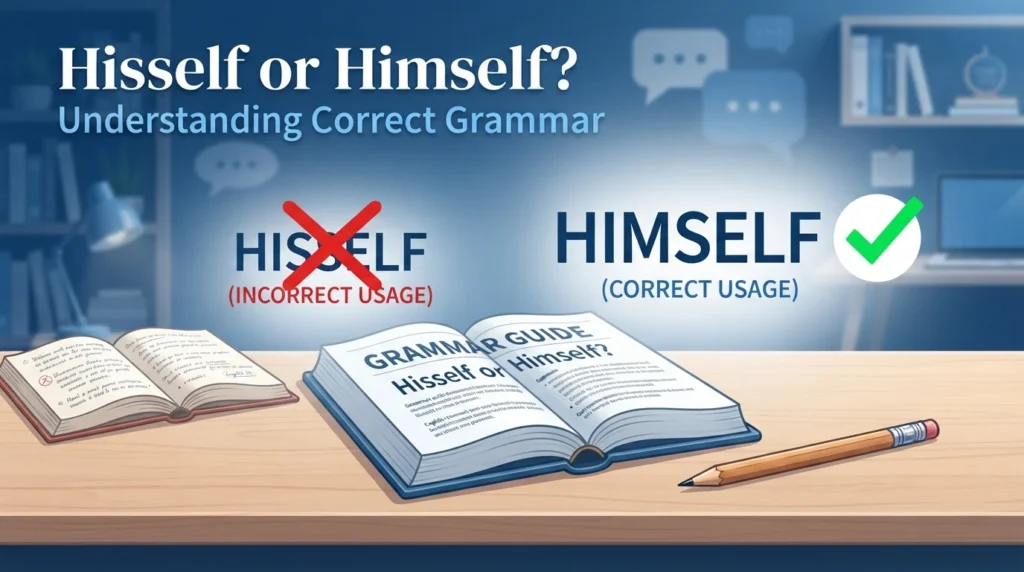

Quick Ans: Himself is the correct standard English word. Hisself is considered nonstandard English and should generally be avoided in formal writing, academic work, and professional communication. While hisself may appear in certain regional dialects or literary dialogue, himself is the only grammatically accepted reflexive pronoun in Standard English.
English contains many words that sound natural in everyday speech but are not considered correct in formal English. One common example is hisself or himself. Some people grow up hearing hisself in regional dialects, while others only know himself.
Understanding the difference between these two forms will help you write more accurately and communicate professionally.
This guide explains the meanings, grammar rules, examples, common mistakes, and when you should use himself instead of hisself.
Hisself or Himself: What’s the Difference?
What Does Himself Mean?
Himself is a reflexive pronoun.
It is used when the subject and object of a sentence refer to the same male person or animal.
Examples:
- He taught himself how to play the guitar.
- John introduced himself to the audience.
- The boy blamed himself for the mistake.
What Does Hisself Mean?
Hisself is a nonstandard form of himself.
Although it appears in some regional dialects and informal speech, it is not considered correct in Standard English.
You should avoid using hisself unless you are intentionally writing dialogue or representing a specific dialect.
| Word | Part of Speech | Correct Word | Meaning |
|---|---|---|---|
| Himself | Reflexive Pronoun | ✅ Yes | Refers back to a male subject |
| Hisself | Nonstandard Pronoun | ❌ No (Standard English) | Dialectal form of “himself” |
Quick Recap
- Himself is the correct reflexive pronoun.
- Hisself is a nonstandard dialect form.
- Use himself in school, business, and professional writing.
Is Hisself or Himself a Grammar, Vocabulary, or Usage Issue?
Grammar
Yes.
This is primarily a grammar issue because it involves the correct use of reflexive pronouns.
Vocabulary
No.
Both words refer to the same idea, but only one is accepted in Standard English.
Usage
Yes.
While hisself exists in some dialects, standard usage requires himself.
Are Hisself and Himself Interchangeable?
No.
Only himself is appropriate in Standard English.
Formal Writing
Always use himself in:
- Academic writing
- Business communication
- Professional emails
- Official documents
Casual Writing
Even in casual writing, himself is usually the better choice.
Use hisself only when quoting someone’s speech or writing realistic fictional dialogue.
Understanding Himself
Meaning
Himself is a reflexive pronoun that refers back to a male subject already mentioned in the sentence.
Workplace Example
The manager prepared the presentation himself.
Academic Example
The student taught himself advanced mathematics.
Literature Example
The hero found himself alone after the battle.
Everyday Example
He fixed the bicycle himself.
Usage Recap
Use himself when:
- The subject performs an action on himself.
- You want to add emphasis.
- You are writing in Standard English.
Understanding Hisself
Meaning
Hisself is a dialectal or nonstandard version of himself.
It appears in some varieties of English but is not accepted in formal grammar.
Regional Speech Example
Some speakers naturally say, “He hurt hisself.”
Fiction Example
Authors sometimes use hisself to make dialogue sound authentic or represent a character’s regional accent.
Usage Recap
Avoid hisself unless you are:
- Writing dialogue
- Quoting spoken language
- Representing a regional dialect
Why Do People Say Hisself?
The word hisself developed naturally in some English dialects over many generations.
Speakers often create language patterns that seem more regular, and hisself follows the same pattern as words like:
- myself
- yourself
- herself
Although it sounds logical to some speakers, Standard English recognizes only himself.
Historical Background
The form hisself has existed for centuries in several regional dialects of English, including some varieties spoken in Britain, Ireland, and North America.
Modern dictionaries classify it as nonstandard or dialectal, meaning it should not be used in formal writing.
When You Should Not Use Hisself
Common Situations to Avoid
Do not write:
❌ He introduced hisself.
❌ John blamed hisself.
❌ The teacher prepared hisself.
Instead write:
✅ He introduced himself.
✅ John blamed himself.
✅ The teacher prepared himself.
Common Mistakes and Decision Rules
Common Mistakes
| Correct Sentence | Incorrect Sentence | Explanation |
|---|---|---|
| He taught himself Spanish. | He taught hisself Spanish. | Himself is the standard reflexive pronoun. |
| John introduced himself. | John introduced hisself. | Use himself in Standard English. |
| He blamed himself. | He blamed hisself. | Hisself is nonstandard. |
| The boy dressed himself. | The boy dressed hisself. | Himself is grammatically correct. |
Decision Rule
If you are writing:
- School assignments
- Business documents
- Professional emails
- Articles or blogs
Always use himself.
Use hisself only when accurately representing regional speech or fictional dialogue.
Himself in Modern English
Modern dictionaries, grammar books, and style guides all recognize himself as the correct reflexive pronoun.
Grammar-checking software and AI writing tools also identify hisself as a nonstandard form in most contexts.
Using himself improves clarity, professionalism, and grammatical accuracy.
Expert Opinion
English language experts agree that himself is the standard reflexive pronoun.
Although hisself has historical and dialectal use, it is not appropriate in formal or academic English.
Case Studies
Case Study One
A student repeatedly used hisself in a school essay.
The teacher corrected every instance to himself, explaining that hisself is considered nonstandard English.
Case Study Two
A novelist used hisself in the dialogue of a rural character.
Editors kept the word because it accurately reflected the character’s regional speech while leaving narration in Standard English.
Error Prevention Checklist
Always Use Himself When
- Writing professionally
- Completing school assignments
- Preparing academic papers
- Writing business emails
- Publishing online content
Use Hisself Only When
- Writing fictional dialogue
- Quoting someone’s speech
- Representing a regional dialect
- Discussing language variation
Related Grammar Confusions You Should Master
- Myself or Me
- Who or Whom
- Their or There or They’re
- Its or It’s
- Me or I
- Lay or Lie
- Affect or Effect
- Accept or Except
- Who’s or Whose
- Principal or Principle
Frequently Asked Questions
Is himself or hisself correct?
Himself is the correct form in Standard English.
Is hisself a real word?
Yes, but it is a nonstandard dialect word, not a standard English pronoun.
Why do some people say hisself?
It developed naturally in regional dialects and has been used in spoken English for centuries.
Can I use hisself in an essay?
No.
Academic and professional writing should always use himself.
Is hisself grammatically correct?
Not in Standard English.
It is considered a dialectal form.
Can authors use hisself in novels?
Yes.
Writers sometimes use hisself in dialogue to reflect a character’s speech or regional background.
Conclusion
When comparing hisself or himself, himself is the only correct choice in Standard English. It is the proper reflexive pronoun used in academic, professional, and everyday writing. Although hisself has existed in regional dialects for centuries and may appear in literature or informal speech, it is considered nonstandard. To write clearly and correctly, always choose himself unless you are intentionally representing dialect or authentic spoken language.