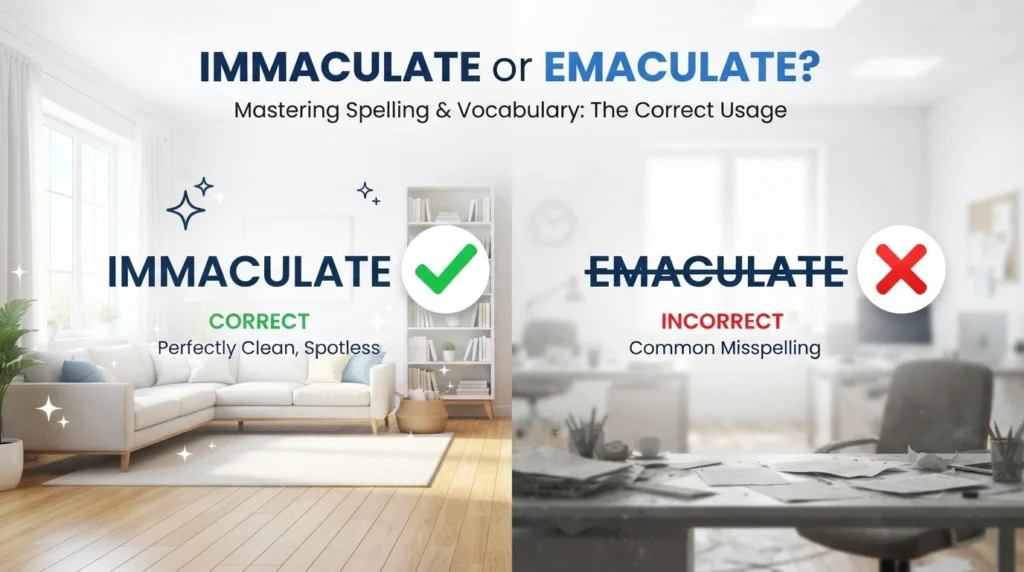

Quick Ans: Immaculate is the correct spelling. Emaculate is a misspelling and is not recognized as a standard English word. If you want to describe something as perfectly clean, flawless, or free from mistakes, you should always use immaculate.
English contains many words with unusual spellings, and immaculate or emaculate is a common source of confusion. Because the word is pronounced quickly in everyday speech, some people mistakenly spell it as emaculate.
However, only one spelling is accepted in English dictionaries and professional writing.
This guide explains the difference between the two spellings, why the confusion exists, and when you should use immaculate correctly.
Immaculate or Emaculate: What’s the Difference?
What Does Immaculate Mean?
Immaculate is an adjective.
It means:
- Perfectly clean or tidy.
- Completely free from mistakes or flaws.
- Pure or spotless.
Examples:
- Her house was immaculate.
- He gave an immaculate performance.
- The hotel room looked immaculate.
What Does Emaculate Mean?
Emaculate is an incorrect spelling.
It does not appear in standard English dictionaries and should not be used in formal or informal writing.
| Word | Part of Speech | Correct Word | Meaning |
|---|---|---|---|
| Immaculate | Adjective | ✅ Yes | Perfectly clean, flawless, or spotless |
| Emaculate | Misspelling | ❌ No | Incorrect spelling of immaculate |
Quick Recap
- Immaculate is the correct spelling.
- Emaculate is a misspelling.
- Use immaculate to describe something that is perfect, spotless, or free from errors.
Is Immaculate or Emaculate a Grammar, Vocabulary, or Usage Issue?
Grammar
No. This is not a grammar issue.
Vocabulary
Yes. The confusion involves choosing the correct vocabulary word and spelling.
Usage
Yes. Using emaculate instead of immaculate is considered a spelling mistake in professional and academic writing.
Are Immaculate and Emaculate Interchangeable?
No.
Only immaculate is a real English word, so the two spellings cannot be used interchangeably.
Formal Writing
Always use immaculate in:
- Essays
- Business writing
- Academic papers
- Professional communication
Casual Writing
Even in text messages and social media posts, immaculate remains the correct spelling.
Understanding Immaculate
Meaning
The word immaculate describes something that is perfectly clean, flawless, or without mistakes.
It can refer to physical cleanliness, appearance, behavior, or performance.
Workplace Example
The employee maintained an immaculate record throughout his career.
Academic Example
She submitted an immaculate research paper with no grammatical errors.
Literature Example
The author described the palace as immaculate, with shining marble floors.
Everyday Example
His car is always immaculate because he washes it every weekend.
Usage Recap
Use immaculate when referring to:
- Clean and tidy places
- Perfect performances
- Error-free work
- Spotless appearance
- Pure or flawless conditions
Understanding Emaculate
Meaning
Emaculate has no official meaning in standard English.
It is simply a common misspelling of immaculate.
Internet Example
Many search engines show results for immaculate when users accidentally type emaculate.
Writing Example
Most spell-check tools automatically correct emaculate to immaculate.
Usage Recap
Avoid using emaculate in:
- Articles
- Essays
- Emails
- Business documents
- Academic writing
Why Do People Spell It as Emaculate?
The confusion happens because immaculate is often pronounced quickly in conversation.
Some people hear the first syllable incorrectly and assume the word starts with E instead of Im.
English also contains many words with unusual spelling patterns, which makes mistakes like emaculate common.
Historical Background of the Word Immaculate
The word immaculate comes from the Latin word immaculatus, meaning “without stain” or “spotless.”
Over time, it entered English and came to describe anything that is perfectly clean, pure, or free from defects.
When You Should Not Use Emaculate
Common Situations to Avoid
Do not write:
❌ The room was emaculate.
❌ She has an emaculate sense of style.
❌ He delivered an emaculate presentation.
❌ The garden looked emaculate.
Always write:
✅ The room was immaculate.
✅ She has an immaculate sense of style.
✅ He delivered an immaculate presentation.
✅ The garden looked immaculate.
Common Mistakes and Decision Rules
Common Mistakes
| Correct Sentence | Incorrect Sentence | Explanation |
|---|---|---|
| The kitchen was immaculate. | The kitchen was emaculate. | Immaculate is the correct spelling. |
| She has an immaculate record. | She has an emaculate record. | Emaculate is incorrect. |
| The hotel room looked immaculate. | The hotel room looked emaculate. | Use immaculate instead. |
| He gave an immaculate performance. | He gave an emaculate performance. | Emaculate is not a standard word. |
Decision Rule
If you mean:
- Perfectly clean
- Flawless
- Spotless
- Free from mistakes
Always use immaculate.
Never use emaculate.
Immaculate in Modern Writing and Communication
The word immaculate is commonly used in:
- Business writing
- Product reviews
- Sports commentary
- Academic writing
- Everyday conversations
Search engines, dictionaries, and AI writing tools all recognize immaculate as the correct spelling.
Expert Opinion
Language experts and dictionaries agree that immaculate is the only correct spelling.
The form emaculate exists mainly because of pronunciation errors and spelling confusion.
Case Studies
Case Study One
A student repeatedly wrote emaculate in an essay.
After using a spell checker, every instance was corrected to immaculate, improving the paper’s professionalism.
Case Study Two
A hotel review described the rooms as emaculate.
The editor corrected the word to immaculate before publication because the original spelling was incorrect.
Error Prevention Checklist
Always Use Immaculate When
- Describing something spotless
- Talking about flawless work
- Referring to perfect cleanliness
- Writing professionally
- Describing error-free performance
Never Use Emaculate When
- Writing essays
- Publishing articles
- Sending professional emails
- Creating business documents
- Describing cleanliness or perfection
Related Word Confusions You Should Master
- Definitely or Definately
- Separate or Seperate
- Occurred or Occured
- Embarrass or Embarass
- Privilege or Privelege
- Accommodation or Accomodation
- Judgment or Judgement
- Principal or Principle
- Affect or Effect
- Stationary or Stationery
Frequently Asked Questions
Is immaculate or emaculate correct?
Immaculate is correct.
Is emaculate a real English word?
No. It is considered a misspelling of immaculate.
What does immaculate mean?
It means perfectly clean, flawless, pure, or without mistakes.
Can immaculate describe a person’s work?
Yes. You can describe someone’s work, performance, or record as immaculate.
Why do people spell it as emaculate?
The mistake usually happens because of pronunciation and confusion about the word’s spelling.
Is immaculate a formal word?
Yes. It is commonly used in both formal and informal English.
Conclusion
When comparing immaculate or emaculate, only one spelling is correct. Immaculate is the accepted English word used to describe something that is perfectly clean, flawless, or free from mistakes. Emaculate is simply a common misspelling and should be avoided in all types of writing. Remember this simple rule: if you mean spotless, perfect, or without flaws, always write immaculate.