
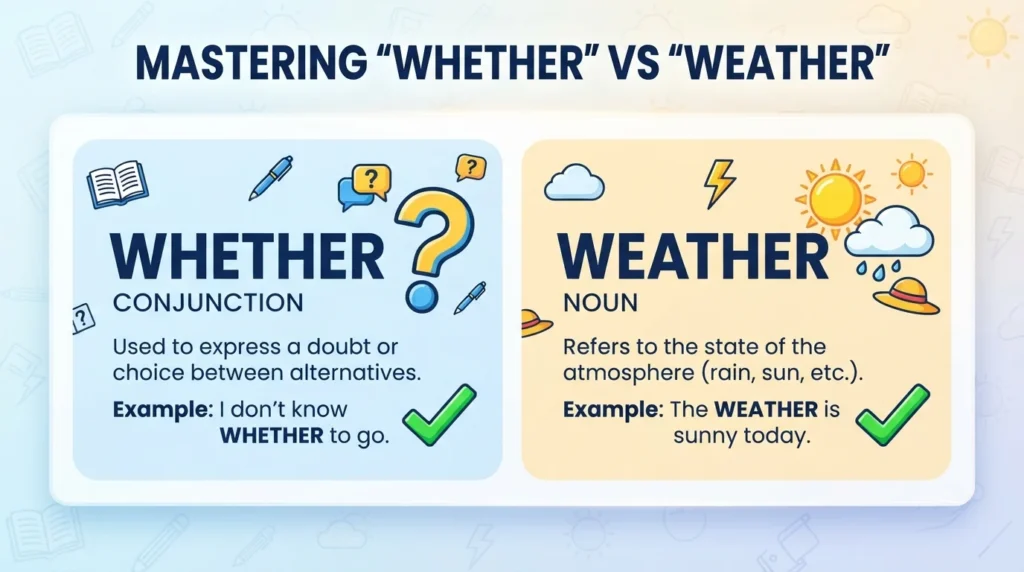

Quick Ans: Whether and weather are both correct English words, but they have completely different meanings. Whether is used when talking about choices, possibilities, or alternatives. Weather refers to atmospheric conditions such as rain, sunshine, wind, or snow.
Because the two words sound almost identical, many writers accidentally confuse them. However, using the wrong one can completely change the meaning of a sentence.
This guide explains the difference between whether or weather, when to use each word, and simple tricks to avoid mistakes.
Whether or Weather: What’s the Difference?
What Does Whether Mean?
Whether is a conjunction.
It introduces choices, alternatives, or uncertainty.
Examples:
- I don’t know whether she will come.
- We haven’t decided whether to travel this summer.
- Tell me whether you agree or disagree.
What Does Weather Mean?
Weather is a noun.
It refers to the condition of the atmosphere, including rain, sunshine, wind, temperature, and storms.
Examples:
- The weather is beautiful today.
- Bad weather delayed the flight.
- We checked the weather forecast before leaving.
| Word | Part of Speech | Correct Meaning |
|---|---|---|
| Whether | Conjunction | Expresses choices or uncertainty |
| Weather | Noun | Atmospheric conditions such as rain, wind, or sunshine |
Quick Recap
- Whether = choice, possibility, or uncertainty.
- Weather = climate and atmospheric conditions.
- They sound similar but have completely different meanings.
Is Whether or Weather a Grammar, Vocabulary, or Usage Issue?
Grammar
Partly.
The confusion often affects sentence structure because whether is a conjunction.
Vocabulary
Yes.
These are two different vocabulary words with separate meanings.
Usage
Yes.
Using one in place of the other creates a spelling and meaning error.
Are Whether and Weather Interchangeable?
No.
These words are never interchangeable because they have different definitions and grammatical functions.
Formal Writing
Always use whether when discussing choices or possibilities.
Always use weather when discussing climate or atmospheric conditions.
Casual Writing
The same rule applies in emails, text messages, and social media posts.
Understanding Whether
Meaning
Whether introduces alternatives or uncertainty.
It often means “if” or presents two possibilities.
Workplace Example
The manager has not decided whether to approve the proposal.
Academic Example
Researchers debated whether the new method was effective.
Literature Example
The character wondered whether he had made the right decision.
Everyday Example
I don’t know whether to order pizza or burgers.
Usage Recap
Use whether when:
- discussing choices
- expressing uncertainty
- presenting alternatives
- asking indirect questions
Understanding Weather
Meaning
Weather refers to conditions in the atmosphere, such as temperature, wind, rain, and snow.
Travel Example
The bad weather caused several flight cancellations.
Science Example
Meteorologists study weather patterns.
News Example
The weather forecast predicts heavy rain tomorrow.
Everyday Example
The weather is perfect for a picnic.
Usage Recap
Use weather when talking about:
- rain
- sunshine
- storms
- temperature
- climate conditions
Why Do People Confuse Whether and Weather?
The confusion exists because the two words are pronounced almost the same.
However, their meanings are completely different.
A simple way to remember them is:
- Whether contains “if” thinking and choices.
- Weather contains “ea”, which can remind you of the earth’s atmosphere.
When You Should Not Use Whether or Weather
Common Situations to Avoid
Do not write:
❌ I don’t know weather she is coming.
❌ The whether is nice today.
Always write:
✅ I don’t know whether she is coming.
✅ The weather is nice today.
Common Mistakes and Decision Rules
Common Mistakes
| Correct Sentence | Incorrect Sentence | Explanation |
|---|---|---|
| I don’t know whether he will attend. | I don’t know weather he will attend. | Whether expresses uncertainty. |
| The weather is cold today. | The whether is cold today. | Weather refers to climate conditions. |
| We discussed whether to move. | We discussed weather to move. | Whether introduces a choice. |
| The weather forecast predicts rain. | The whether forecast predicts rain. | Weather refers to atmospheric conditions. |
Decision Rule
Ask yourself one question:
Are you talking about a choice or uncertainty?
- Yes → Use whether.
Are you talking about rain, temperature, or climate?
- Yes → Use weather.
Whether and Weather in Modern Technology
Technology uses both words frequently.
Weather applications provide forecasts and storm warnings.
Meanwhile, artificial intelligence systems often analyze whether certain information is correct or inaccurate.
Grammar-checking tools usually catch mistakes involving whether and weather because they are common homophone errors.
Expert Opinion
Language experts classify weather and weather as homophones words that sound alike but have different meanings and spellings.
Learning the distinction improves both writing accuracy and reading comprehension.
Case Studies
Case Study One
A student wrote:
“I don’t know weather I passed the exam.”
The teacher corrected it to:
“I don’t know whether I passed the exam.”
The sentence involved uncertainty, not climate.
Case Study Two
A travel website accidentally published:
“Check the whether before your trip.”
The mistake was later corrected because the sentence referred to atmospheric conditions.
Error Prevention Checklist
Always Use Whether When
- discussing choices
- expressing uncertainty
- presenting alternatives
- asking indirect questions
- using “whether or not”
Always Use Weather When
- discussing rain or sunshine
- talking about temperature
- mentioning storms
- referring to forecasts
- describing climate conditions
Related Word Confusions You Should Master
- Affect or Effect
- Accept or Except
- Than or Then
- Their, There, or They’re
- Complement or Compliment
- Farther or Further
- Who’s or Whose
- Principal or Principle
- Stationary or Stationery
- Hear or Here
Frequently Asked Questions
Is whether or weather correct?
Both are correct, but they have different meanings.
What does whether mean?
It refers to choices, alternatives, or uncertainty.
What does weather mean?
It refers to atmospheric conditions such as rain, wind, or sunshine.
Can whether and weather be used interchangeably?
No. They have completely different meanings.
How do I remember the difference?
If the sentence involves a choice, use whether.
If it involves climate or temperature, use weather.
Is weather a noun?
Yes. It is a noun referring to atmospheric conditions.
Is whether a conjunction?
Yes. It is a conjunction used to introduce alternatives or uncertainty.
Conclusion
When comparing whether or weather, both words are correct, but they serve entirely different purposes. Whether is used when talking about choices, possibilities, or uncertainty, while weather refers to atmospheric conditions such as rain, sunshine, and temperature. Remember this simple rule: if your sentence is about a decision or alternative, use whether. If it is about climate or forecasts, use weather.