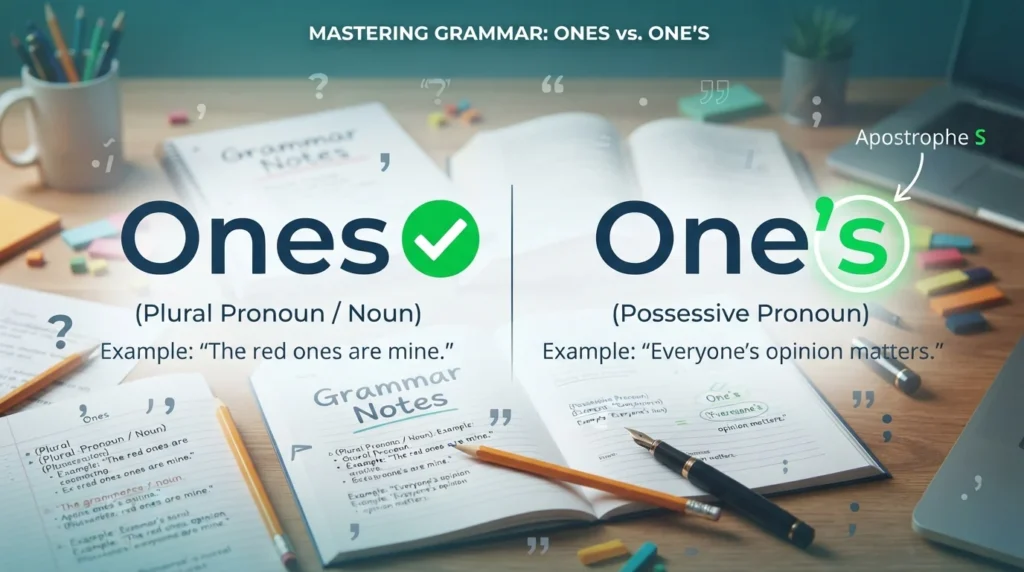

Quick Ans: Ones is the plural form of one, while one’s is the possessive form of one. They are both correct, but they have different meanings and cannot be used interchangeably. Use ones when referring to more than one thing and one’s when showing that something belongs to one person or to the pronoun one.
English punctuation often causes confusion, especially when apostrophes are involved. One common example is ones or one’s. Many writers mistakenly add an apostrophe to make a word plural, while others omit the apostrophe when showing possession.
Understanding the difference between ones and one’s will help you avoid common grammar mistakes and improve your writing.
This guide explains the meanings, grammar rules, examples, and common errors related to ones or one’s.
Ones or One’s: What’s the Difference?
What Does Ones Mean?
Ones is the plural form of one.
It refers to more than one person, thing, or item that has already been mentioned.
Examples:
- I prefer the red shoes over the blue ones.
- These cookies are better than the old ones.
- The new phones are more expensive than the previous ones.
What Does One’s Mean?
One’s is the possessive form of one.
It means that something belongs to a person in a general sense or belongs to the pronoun one.
Examples:
- One should always do one’s best.
- It is important to keep one’s promises.
- A person must protect one’s reputation.
| Word | Part of Speech | Correct Use | Meaning |
|---|---|---|---|
| Ones | Pronoun/Noun | ✅ Yes | More than one thing or item |
| One’s | Possessive Pronoun | ✅ Yes | Belonging to one person or to the pronoun “one” |
Quick Recap
- Ones = plural form of one.
- One’s = possessive form of one.
- The apostrophe in one’s shows possession, not plurality.
Is Ones or One’s a Grammar, Vocabulary, or Usage Issue?
Grammar
Yes.
This is primarily a grammar and punctuation issue involving apostrophes.
Vocabulary
No.
Both words already exist in English and have established meanings.
Usage
Yes.
Using ones and one’s incorrectly can change the meaning of a sentence.
Are Ones and One’s Interchangeable?
No.
Although the words look similar, they serve different grammatical purposes and cannot replace each other.
Formal Writing
Use ones when referring to multiple things.
Use one’s when expressing possession.
Casual Writing
The same rules apply in emails, text messages, and social media posts.
Understanding Ones
Meaning
Ones refers to more than one person, object, or thing that has already been mentioned.
It often replaces a noun to avoid repetition.
Workplace Example
The newer laptops are faster than the old ones.
Academic Example
The revised theories are more convincing than the earlier ones.
Literature Example
The author preferred the shorter poems to the longer ones.
Everyday Example
I bought the black socks instead of the white ones.
Usage Recap
Use ones when:
- Referring to multiple items
- Avoiding repetition
- Comparing groups of things
Understanding One’s
Meaning
One’s is the possessive form of one.
It indicates that something belongs to a person in a general sense.
Workplace Example
One should maintain one’s professionalism at work.
Academic Example
A student must manage one’s time wisely.
Literature Example
One can discover one’s true character during difficult times.
Everyday Example
It is important to keep one’s room clean.
Usage Recap
Use one’s when:
- Showing possession
- Referring generally to a person
- Following the pronoun one
Why Do People Confuse Ones and One’s?
Many people mistakenly believe that an apostrophe makes a word plural.
However, apostrophes usually indicate:
- Possession
- Contractions
They generally do not make nouns plural.
This misunderstanding leads many writers to use one’s when they actually mean ones.
When You Should Not Use Ones or One’s
Common Situations to Avoid
Do not write:
❌ I like the blue one’s.
Correct:
✅ I like the blue ones.
Do not write:
❌ One should do ones best.
Correct:
✅ One should do one’s best.
Avoid using an apostrophe simply to make a word plural.
Common Mistakes and Decision Rules
Common Mistakes
| Correct Sentence | Incorrect Sentence | Explanation |
|---|---|---|
| I prefer the new ones. | I prefer the new one’s. | No possession is involved. |
| One should do one’s best. | One should do ones best. | Possession requires an apostrophe. |
| These are the expensive ones. | These are the expensive one’s. | Ones is plural here. |
| A person should know one’s limits. | A person should know ones limits. | One’s shows possession. |
Decision Rule
Ask yourself two questions:
Are you talking about more than one thing?
→ Use ones.
Are you showing possession?
→ Use one’s.
Ones and One’s in Modern Writing and AI
Grammar-checking tools and AI writing assistants often flag incorrect uses of ones and one’s because apostrophe errors are extremely common.
Understanding the difference helps improve:
- Professional writing
- Academic essays
- Business communication
- SEO content
Expert Opinion
Grammar experts agree that apostrophes should never be used simply to create plural forms.
The distinction between ones and one’s is a classic example of how punctuation can completely change meaning.
Case Studies
Case Study One
A business report repeatedly used one’s when referring to multiple products.
After editing the document, all instances were corrected to ones.
Case Study Two
A student wrote:
“One should do ones best.”
The teacher corrected it to:
“One should do one’s best.”
The correction helped the student understand the difference between plurality and possession.
Error Prevention Checklist
Always Use Ones When
- Referring to multiple things
- Comparing items
- Replacing repeated nouns
- Talking about several objects
Always Use One’s When
- Showing possession
- Referring to the pronoun one
- Saying one’s best, one’s life, or one’s opinion
Related Grammar Confusions You Should Master
- Its or It’s
- Whose or Who’s
- Your or You’re
- Their, There, or They’re
- Peoples or People’s
- Someone Else’s or Someone Elses’
- Students or Student’s
- Every Day or Everyday
- Affect or Effect
- Then or Than
Frequently Asked Questions
Is it ones or one’s?
Both are correct, but they have different meanings.
What does ones mean?
It is the plural form of one.
What does one’s mean?
It is the possessive form of one.
Is an apostrophe used to make words plural?
Usually, no.
Apostrophes are generally used to show possession or contractions.
Which sentence is correct: “the red ones” or “the red one’s”?
The red ones is correct.
Which sentence is correct: “one should do ones best” or “one should do one’s best”?
One should do one’s best is correct.
Conclusion
When comparing ones or one’s, remember this simple rule: ones is plural, while one’s is possessive. The apostrophe in one’s shows ownership and should never be used simply to make a word plural. By understanding this difference, you can avoid one of the most common punctuation mistakes in English and write with greater confidence and accuracy.