
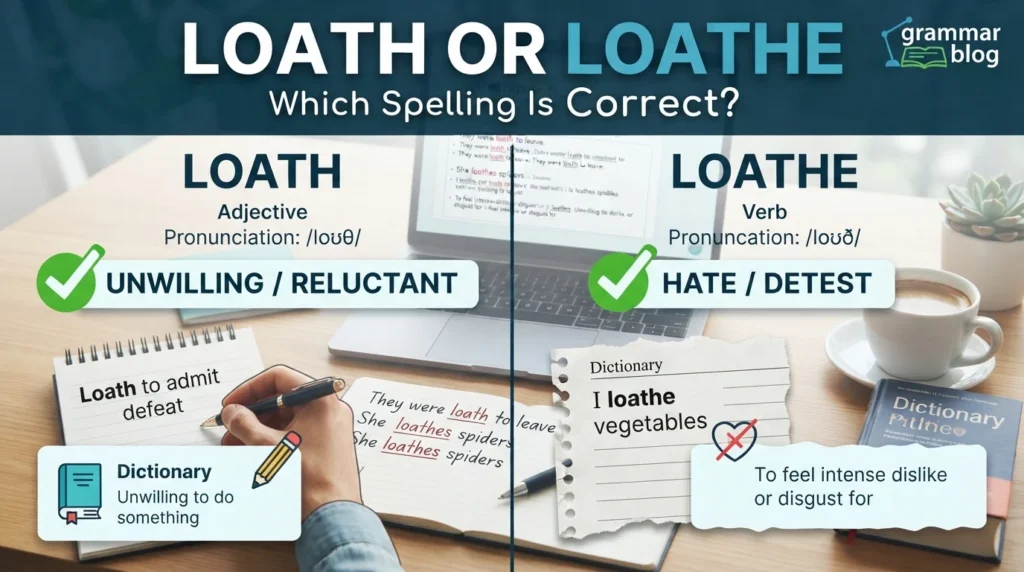

Quick Ans:Loath and loathe are both correct English words, but they have completely different meanings and uses. Loath is an adjective that means unwilling or reluctant to do something, while loathe is a verb that means to strongly dislike or hate something. The confusion happens because these words sound almost identical but function differently in sentences.
English contains many words that look and sound similar but have different meanings. One common example is loath or loathe. Many writers confuse these words because the extra e at the end changes the word’s function and meaning.
Understanding the difference between loath and loathe can help you avoid spelling mistakes and improve your writing accuracy.
This guide explains the meanings, differences, examples, and correct usage of both words.
Loath or Loathe: What’s the Difference?
What Does Loath Mean?
Loath is an adjective.
It means:
- Unwilling to do something.
- Reluctant or hesitant about an action.
- Not wanting something to happen.
Examples:
- She was loath to leave her hometown.
- He was loath to admit his mistake.
- They were loath to change the original plan.
What Does Loathe Mean?
Loathe is a verb.
It means:
- To hate something strongly.
- To feel extreme dislike or disgust toward someone or something.
Examples:
- I loathe dishonesty.
- She loathes waking up early.
- They loathe unfair treatment.
| Word | Part of Speech | Correct Word | Meaning |
|---|---|---|---|
| Loath | Adjective | ✅ Yes | Unwilling or reluctant |
| Loathe | Verb | ✅ Yes | To strongly dislike or hate |
Quick Recap
- Loath means unwilling or reluctant.
- Loathe means to hate strongly.
- They sound similar but have different meanings.
- The final e in loathe changes it into a verb.
Is Loath or Loathe a Grammar, Vocabulary, or Usage Issue?
Grammar
Partly.
The confusion involves using the wrong word form in a sentence.
Vocabulary
Yes.
Both words have different meanings and should be selected carefully.
Usage
Yes.
Using loathe when you mean loath can change the meaning of your sentence completely.
Are Loath and Loathe Interchangeable?
No.
Although they sound similar, they cannot replace each other.
Formal Writing
Use the correct word depending on your meaning.
Examples:
- She was loath to criticize her manager.
- He loathes corruption.
Casual Writing
Both words can appear in everyday communication, but the correct meaning must be maintained.
Understanding Loath
Meaning
Loath describes a person’s unwillingness or hesitation toward an action.
It is usually followed by to + verb.
Common structure:
Someone is loath to do something
Workplace Example
The employee was loath to accept the new policy without further discussion.
Academic Example
Researchers were loath to make conclusions without enough evidence.
Literature Example
The character was loath to reveal his hidden secret.
Everyday Example
She was loath to throw away her old family photographs.
Usage Recap
Use loath when someone is:
- Reluctant
- Hesitant
- Unwilling
- Resistant to an action
Understanding Loathe
Meaning
Loathe means to dislike or hate something intensely.
It is an action word, so it functions as a verb.
Workplace Example
Many employees loathe unnecessary meetings.
Academic Example
Some students loathe difficult subjects because they find them challenging.
Literature Example
The villain loathed anyone who challenged his power.
Everyday Example
I loathe waiting in long lines.
Usage Recap
Use loathe when describing:
- Strong dislike
- Hatred
- Extreme dislike
- Negative feelings
Why Do People Confuse Loath and Loathe?
The confusion happens because both words:
- Have almost identical pronunciation.
- Share the same spelling base.
- Look very similar when written.
However, their meanings are completely different.
A simple trick:
- Loath = reluctant
- Loathe = hate
Remember that loathe has an extra “e” and acts as a verb.
Historical Background of the Words
The word loath comes from Old English roots meaning unpleasant or hateful.
Over time, English developed related forms, including loathe, which became a verb meaning to strongly dislike.
Although they share a historical connection, modern English uses them differently.
When You Should Not Use Loath or Loathe
Common Situations to Avoid
Do not write:
❌ I loath chocolate.
❌ She was loathe to leave.
❌ He is loathe dishonest behavior.
Correct:
✅ I loathe chocolate.
✅ She was loath to leave.
✅ He loathes dishonest behavior.
Common Mistakes and Decision Rules
Common Mistakes
| Correct Sentence | Incorrect Sentence | Explanation |
|---|---|---|
| She was loath to apologize. | She was loathe to apologize. | Loath means unwilling. |
| I loathe bad manners. | I loath bad manners. | Loathe means hate. |
| He was loath to accept help. | He was loathe to accept help. | Use loath before an action. |
| They loathe unfair rules. | They loath unfair rules. | Use loathe as a verb. |
Decision Rule
If you mean:
- Unwilling or reluctant → Use loath
- Strong dislike or hate → Use loathe
Loath and Loathe in Modern Writing and Technology
Grammar-checking tools often identify mistakes between loath and loathe because they are commonly confused.
Correct word selection helps improve:
- Professional emails
- Academic writing
- Articles
- Online content
Using the right word also improves clarity for readers.
Expert Opinion
Language experts recommend remembering the grammatical difference:
Loath is an adjective.
Loathe is a verb.
Although pronunciation is similar, their meanings should never be mixed.
Case Studies
Case Study One
A company report stated:
“The manager was loathe to approve the proposal.”
The intended meaning was that the manager was reluctant, so the correct word should have been:
“The manager was loath to approve the proposal.”
Case Study Two
A student wrote:
“I loath cheating.”
The teacher corrected it because the sentence describes strong dislike, requiring the verb:
“I loathe cheating.”
Error Prevention Checklist
Always Use Loath When
- Someone is unwilling
- Someone is hesitant
- Someone is reluctant to act
- Followed by “to + verb”
Always Use Loathe When
- Expressing hatred
- Showing strong dislike
- Describing negative feelings
- Using it as an action verb
Related Word Confusions You Should Master
- Affect or Effect
- Accept or Except
- Advice or Advise
- Compliment or Complement
- Principal or Principle
- Than or Then
- Lose or Loose
- Further or Farther
- Stationary or Stationery
- Breath or Breathe
Frequently Asked Questions
Is loath or loathe correct?
Both are correct, but they have different meanings.
What does loath mean?
Loath means unwilling or reluctant to do something.
What does loathe mean?
Loathe means to hate or strongly dislike something.
Are loath and loathe pronounced the same?
Yes.
They are usually pronounced the same, which causes confusion.
Is loathe a verb?
Yes.
Loathe is a verb that describes strong dislike.
Is loath an adjective?
Yes.
Loath describes unwillingness or reluctance.
Conclusion
When comparing loath or loathe, both words are correct but they are used in different situations. Loath means unwilling or reluctant, while loathe means to strongly dislike or hate something. The easiest way to remember the difference is that loath describes hesitation, while loathe describes hatred. Choosing the correct word will make your writing clearer and more professional.