
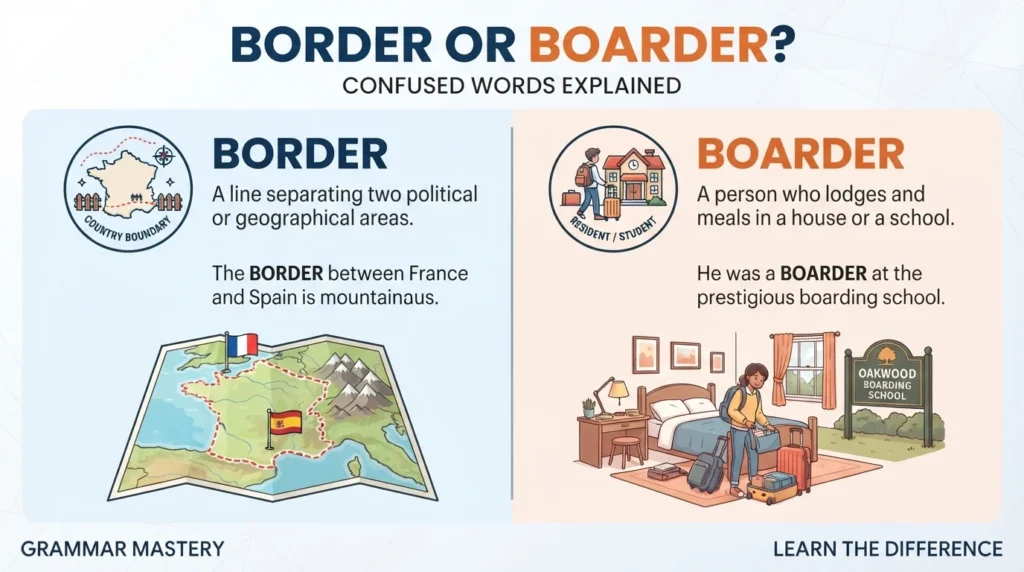

Quick Ans: Border and Boarder are both correct English words, but they have completely different meanings. Border refers to a boundary, edge, or dividing line between places, while Boarder refers to a person who pays to live and receive meals in someone else’s home, school, or accommodation. The confusion happens because both words sound similar but are used in different situations.
English has many words that sound alike but have different meanings. These words are called homophones, and border or boarder is a common example.
Understanding the difference between these two words helps you avoid mistakes in writing, especially when describing countries, travel, housing, or education.
This guide explains the meanings, differences, examples, and correct usage of border and boarder.
Border or Boarder: What’s the Difference?
What Does Border Mean?
Border is a noun and verb.
As a noun, it means:
- A boundary between two areas or countries.
- The outer edge of something.
- A dividing line.
As a verb, it means:
- To touch or surround the edge of something.
- To share a boundary with another place.
Examples
- The United States shares a border with Canada.
- She decorated the picture with a colorful border.
- The two countries agreed to protect their border.
What Does Boarder Mean?
Boarder is a noun.
It refers to:
- A person who pays to live in a house or building and receives meals.
- A student who lives at a boarding school.
- Someone who rents a room with food included.
Examples
- The house owner welcomed a new boarder.
- He was a boarder at a private school.
- The hostel provides rooms for international boarders.
| Word | Part of Speech | Correct Word | Meaning |
|---|---|---|---|
| Border | Noun/Verb | ✅ Yes | Boundary, edge, or dividing line |
| Boarder | Noun | ✅ Yes | Person who lives somewhere with meals provided |
Quick Recap
- Border means a boundary, edge, or dividing line.
- Boarder means a person who pays to live somewhere with meals.
- They sound similar but have different meanings.
- The correct choice depends on the context.
Is Border or Boarder a Grammar, Vocabulary, or Usage Issue?
Grammar
No.
This is not a grammar rule problem.
Both words are grammatically correct.
Vocabulary
Yes.
The issue is understanding the meaning of each word.
Usage
Yes.
Using the wrong word can completely change the meaning of a sentence.
Are Border and Boarder Interchangeable?
No.
They cannot replace each other because their meanings are different.
Formal Writing
Use border when discussing:
- Countries
- Maps
- Geography
- Boundaries
- Designs
Use boarder when discussing:
- Housing
- Boarding schools
- Accommodation
Casual Writing
The same rule applies in everyday conversations.
The context decides which word is correct.
Understanding Border
Meaning
A border is a line or area that separates one place from another.
It can describe physical boundaries between countries, states, cities, or objects.
Workplace Example
The company expanded its operations near the international border.
Academic Example
Students studied how political borders changed throughout history.
Geography Example
The river forms a natural border between the two regions.
Everyday Example
She added a black border around the photo frame.
Usage Recap
Use border when talking about:
- Country boundaries
- State lines
- Edges of objects
- Decorative outlines
- Dividing areas
Understanding Boarder
Meaning
A boarder is someone who lives in a place where they receive accommodation and meals.
The word comes from board, which historically meant food or meals.
Workplace Example
The landlord rented the extra room to a boarder.
Academic Example
The school provides separate facilities for day students and boarders.
Housing Example
The house has two rooms available for boarders.
Everyday Example
The family welcomed a new boarder into their home.
Usage Recap
Use boarder when referring to:
- A person renting a room with meals
- A student living at a boarding school
- Someone receiving housing and food
Why Do People Confuse Border and Boarder?
The confusion happens because:
- They sound almost identical.
- They have similar spelling.
- Many people focus on pronunciation instead of meaning.
However, the extra a in boarder connects it to the word board, which relates to food and accommodation.
Historical Background of Border and Boarder
Border History
The word border comes from Old French and originally referred to the edge or boundary of land.
Over time, it became associated with political boundaries between countries and regions.
Boarder History
The word boarder comes from the older meaning of board, which referred to meals or food.
A person receiving food and lodging became known as a boarder.
When You Should Not Use Border or Boarder
Common Situations to Avoid
Do not write:
❌ The student cross the school boarder.
✅ The student crossed the school border.
❌ The family rented a room to a country border.
✅ The family rented a room to a boarder.
❌ Canada shares a boarder with the USA.
✅ Canada shares a border with the USA.
Common Mistakes and Decision Rules
Common Mistakes
| Correct Sentence | Incorrect Sentence | Explanation |
|---|---|---|
| Canada has a long border with the USA. | Canada has a long boarder with the USA. | Border means boundary. |
| The school has many boarders. | The school has many borders. | Boarders are students who live there. |
| She added a border to the image. | She added a boarder to the image. | Border means an edge or decoration. |
| The landlord welcomed a boarder. | The landlord welcomed a border. | Boarder means a resident. |
Decision Rule
Ask yourself:
Am I talking about a boundary or edge?
Use:
✅ Border
Am I talking about a person who lives somewhere with meals?
Use:
✅ Boarder
Border and Boarder in Modern Technology
The word border is commonly used in technology and design.
Examples:
- CSS borders in website design
- Image borders
- Screen borders
The word boarder is mostly used in housing, education, and accommodation contexts.
Expert Opinion
Language experts classify border and boarder as homophones because they sound similar but have different meanings.
Correct usage depends on understanding the context rather than pronunciation alone.
Case Studies
Case Study One
A travel website wrote:
“Travelers must check their documents at the country boarder.”
The correct word was:
“Travelers must check their documents at the country border.”
Because the sentence referred to a national boundary.
Case Study Two
A school website wrote:
“Our school accepts international borders.”
The correct word was:
“Our school accepts international boarders.”
Because it referred to students living at the school.
Error Prevention Checklist
Always Use Border When
- Talking about countries
- Describing boundaries
- Discussing edges
- Designing images or pages
- Referring to dividing lines
Always Use Boarder When
- Talking about residents
- Discussing boarding schools
- Describing rented accommodation
- Referring to people receiving meals and housing
Related Word Confusions You Should Master
- Affect or Effect
- Accept or Except
- Principal or Principle
- Stationary or Stationery
- Complement or Compliment
- Capital or Capitol
- Weather or Whether
- Lose or Loose
- Advice or Advise
- Desert or Dessert
Frequently Asked Questions
Is border or boarder correct?
Both are correct words, but they have different meanings.
What is the difference between border and boarder?
A border is a boundary or edge, while a boarder is a person who lives somewhere with meals provided.
Is a person living at a boarding school called a boarder?
Yes.
Students who live at boarding schools are called boarders.
Is border used for countries?
Yes.
Countries have borders that separate them from other countries.
Why do border and boarder sound the same?
They are homophones, meaning they have the same pronunciation but different meanings.
Can I use boarder for a boundary?
No.
A boundary is called a border, not a boarder.
Conclusion
When comparing border or boarder, both words are correct, but they have completely different meanings. A border refers to a boundary, edge, or dividing line, while a boarder refers to a person who lives somewhere and receives meals. Remember this simple rule: if you are talking about a place or edge, use border. If you are talking about a person living with accommodation and food, use boarder.