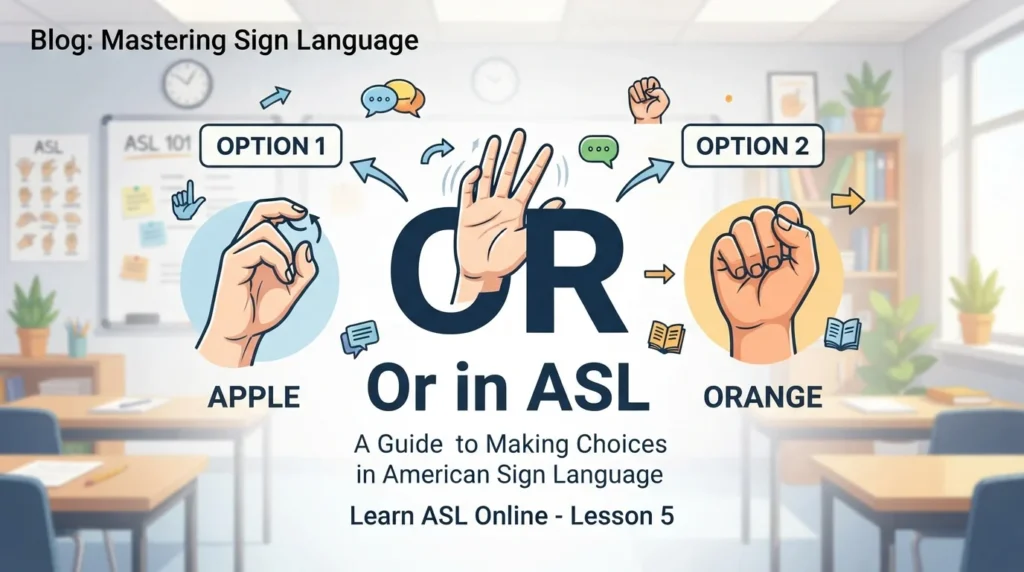

Quick Ans: In American Sign Language (ASL), the word or is used to show a choice between two or more options. Instead of relying heavily on a separate sign for “or,” ASL often expresses alternatives through facial expressions, body language, and sentence structure. In many cases, signers simply present two choices and raise their eyebrows to indicate a question or alternative.
English and ASL do not always work in the same way. Many English words have direct signs in ASL, but some concepts, including or, are communicated differently.
Understanding how or in ASL works can help learners create more natural and grammatically correct signs.
This guide explains the meaning of or in ASL, how it is used, common mistakes, and examples of natural ASL sentence structure.
Or in ASL: What’s the Meaning?
What Does Or Mean in English?
Or is a conjunction.
It is used to connect choices, alternatives, or possibilities.
Examples:
- Would you like tea or coffee?
- Do you want to stay home or go outside?
- Is the answer true or false?
What Does Or Mean in ASL?
In ASL, or usually represents a choice between options.
However, ASL often communicates this idea without signing the word or directly. Instead, signers:
- Present both options.
- Use facial expressions.
- Raise their eyebrows.
- Pause slightly between choices.
| Word | Part of Speech | Used in ASL? | Meaning |
|---|---|---|---|
| or | Conjunction | ✅ Yes | Indicates a choice between alternatives |
| OR sign in ASL | Grammar marker | ✅ Contextual | Often expressed through sentence structure and facial expressions |
Quick Recap
- Or means a choice between options.
- ASL sometimes uses a sign for OR, but often relies on sentence structure instead.
- Facial expressions play an important role in expressing alternatives.
Is Or in ASL a Grammar, Vocabulary, or Usage Issue?
Grammar
Yes.
The concept of or affects sentence structure in ASL.
Vocabulary
Partly.
ASL has a sign for OR, but it is not always necessary.
Usage
Yes.
Using or naturally in ASL depends heavily on context and non-manual signals, such as facial expressions.
Is the Word Or Always Signed in ASL?
No.
Many native signers do not use a separate sign for or in every sentence.
Instead, they simply present the choices.
English: Tea or coffee?
Natural ASL: TEA COFFEE WHICH?
The alternatives themselves make the meaning clear.
Formal ASL Instruction
ASL textbooks may teach a specific sign for OR, especially for beginners.
Everyday ASL Conversations
In casual signing, many people rely on natural sentence structure rather than a separate sign.
Understanding Or in ASL
Meaning
The concept of or indicates alternatives or choices.
Everyday Example
Do you want pizza or burgers?
ASL Structure: PIZZA BURGER WHICH?
Classroom Example
Should we study math or science?
ASL Structure: MATH SCIENCE WHICH?
Family Example
Are you staying home or going out?
ASL Structure: HOME STAY GO-OUT WHICH?
Usage Recap
Use the concept of or when:
- Offering choices
- Asking preference questions
- Presenting alternatives
- Comparing two options
Understanding the OR Sign in ASL
Meaning
ASL does have a sign for OR, although it is not required in every sentence.
The sign is more commonly used in formal instruction or when clarity is needed.
Learning Example
Beginning ASL students often learn the sign for OR as part of conjunction vocabulary.
Communication Example
Experienced signers frequently omit the sign because the sentence already shows the alternatives.
Usage Recap
The sign for OR can be used:
- In educational settings
- For emphasis
- When additional clarity is needed
- In longer or more complex sentences
Why Is Or Different in ASL?
ASL is a visual language with its own grammar.
It does not follow English word-for-word.
Instead of depending on conjunctions like or, ASL often uses:
- Facial expressions
- Head movements
- Eyebrow raises
- Sentence order
This makes communication more visual and efficient.
Historical Background of ASL Grammar
American Sign Language developed independently from English grammar.
Over time, ASL created its own methods of expressing ideas, including alternatives and choices.
Because of this, many English connecting words are expressed differently in ASL.
When You Should Not Overuse OR in ASL
Common Situations to Avoid
Do not:
❌ Translate English word-for-word.
❌ Add the sign for OR in every sentence.
❌ Ignore facial expressions.
❌ Forget that ASL grammar differs from English grammar.
Instead:
✅ Present the choices naturally.
✅ Use appropriate facial expressions.
✅ Follow ASL sentence structure.
Common Mistakes and Decision Rules
Common Mistakes
| Correct ASL Idea | Incorrect Approach | Explanation |
|---|---|---|
| TEA COFFEE WHICH? | TEA OR COFFEE word-for-word | ASL often omits OR. |
| PIZZA BURGER WHICH? | Signing every English word exactly | ASL uses its own grammar. |
| HOME GO-OUT WHICH? | Ignoring facial expressions | Non-manual markers are important. |
| Present alternatives naturally | Translating directly from English | ASL is not signed English. |
Decision Rule
If you are presenting choices in ASL:
- Show the alternatives.
- Use facial expressions.
- Use the sign for OR only when necessary.
Or in Modern ASL Education
ASL teachers often introduce the sign for OR to help beginners understand conjunctions.
However, advanced learners quickly discover that native signers frequently communicate alternatives without signing the word directly.
Understanding this difference is important for sounding natural in ASL.
Expert Opinion
ASL linguists explain that many English conjunctions do not have exact one-to-one equivalents in ASL.
The meaning of or is often conveyed through sentence structure and non-manual signals rather than a separate sign.
Case Studies
Case Study One
A beginner ASL student translated every English sentence word-for-word.
After learning natural ASL grammar, they began presenting choices without signing OR unnecessarily.
Case Study Two
An ASL instructor taught students to use facial expressions and eyebrow raises when asking alternative questions.
The students’ signing became much more natural and easier to understand.
Error Prevention Checklist
Use the Concept of Or When
- Offering choices
- Asking preference questions
- Presenting alternatives
- Comparing options
Avoid These Mistakes
- Translating English directly into ASL
- Signing every conjunction
- Ignoring facial expressions
- Forgetting ASL sentence structure
Related ASL Topics You Should Master
- And in ASL
- Yes or No Questions in ASL
- WH Questions in ASL
- Facial Expressions in ASL
- ASL Sentence Structure
- Non-Manual Signals in ASL
- Basic ASL Grammar
- ASL Classifiers
- Fingerspelling in ASL
- Common ASL Mistakes
Frequently Asked Questions
Is there a sign for OR in ASL?
Yes. ASL has a sign for OR, but it is not always necessary.
Do native signers always use the OR sign?
No. Many native signers simply present the choices.
How do you ask “Tea or coffee?” in ASL?
A natural structure is:
TEA COFFEE WHICH?
Is ASL the same as signed English?
No.
ASL has its own grammar and sentence structure.
Why is facial expression important?
Facial expressions help show that the signer is presenting alternatives or asking a question.
Should beginners learn the OR sign?
Yes.
Learning the sign is helpful, but understanding natural ASL usage is even more important.
Conclusion
Understanding or in ASL is about more than learning a single sign. In American Sign Language, alternatives and choices are often expressed through sentence structure, facial expressions, and non-manual signals rather than by signing the word or directly. By learning how native signers naturally present choices, you can communicate more effectively and develop a better understanding of authentic ASL grammar.