
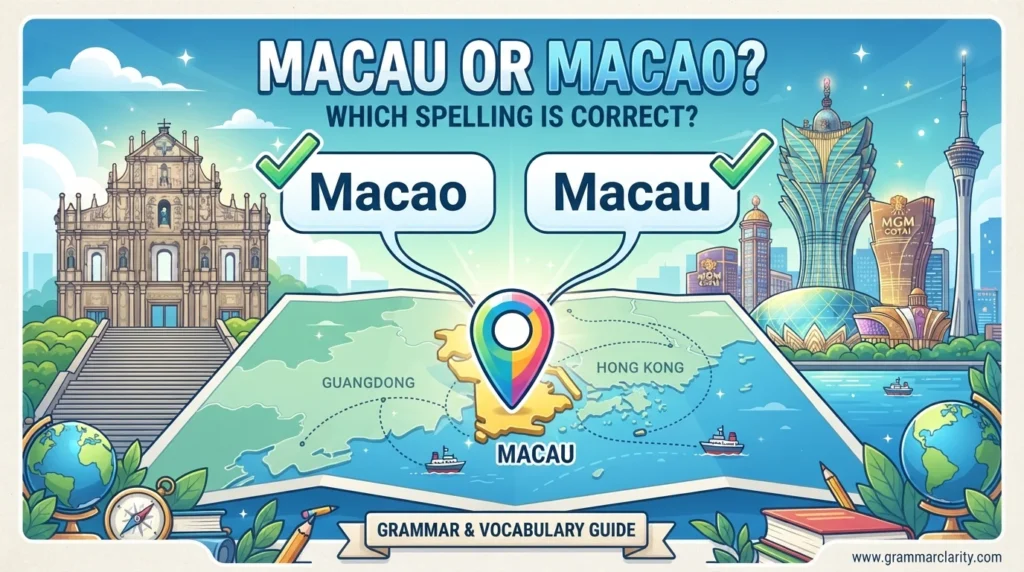

Quick Ans: Both Macao and Macau are correct, but they are used in different contexts. Macau is the modern and more widely used English spelling, while Macao is the older Portuguese spelling that still appears in official names and historical references. In most modern writing, Macau is the preferred choice.
English often has place names with multiple accepted spellings, and macao or macau is a perfect example. Many people wonder whether one spelling is wrong or whether both names refer to different places.
The answer is simpler than it seems.
Both names refer to the same region: the Special Administrative Region of China located on the southern coast near Hong Kong.
This guide explains the difference between Macao and Macau, when to use each spelling, and why both forms still exist today.
Macao or Macau: What’s the Difference?
What Does Macau Mean?
Macau is the modern English spelling of the region.
It refers to:
- The Special Administrative Region of China.
- One of the world’s largest gambling and tourism destinations.
- A former Portuguese colony.
Today, most English-language publications and travel websites use Macau.
What Does Macao Mean?
Macao is the older Portuguese spelling of the same place.
It still appears in:
- Official government names.
- Historical documents.
- Certain organizations and institutions.
For example, the official name is:
Macao Special Administrative Region of the People’s Republic of China.
| Word | Part of Speech | Correct Word | Meaning |
|---|---|---|---|
| Macau | Proper Noun | ✅ Yes | Modern English spelling of the Chinese special administrative region |
| Macao | Proper Noun | ✅ Yes | Official and historical spelling of the same place |
Quick Recap
- Macau and Macao refer to the same place.
- Macau is more common in modern English.
- Macao is still used in official and historical contexts.
- Neither spelling is incorrect.
Is Macao or Macau a Grammar, Vocabulary, or Usage Issue?
Grammar
No.
This topic is not related to grammar.
Vocabulary
Yes.
The issue involves choosing the preferred spelling of a place name.
Usage
Yes.
The correct choice depends on context and audience.
Are Macao and Macau Interchangeable?
Usually, yes.
Both names identify the same region, but one spelling may be more appropriate depending on the situation.
Formal Writing
In government and legal references, Macao is often preferred because it appears in the official name of the region.
Casual Writing
In travel blogs, news articles, and everyday English, Macau is generally preferred.
Understanding Macau
Meaning
Macau is the modern English name for the Special Administrative Region of China.
It is famous for:
- Casinos and resorts
- Portuguese heritage
- Historic architecture
- Tourism and entertainment
Travel Example
We spent three days exploring Macau’s historic district.
Business Example
The company plans to expand its operations in Macau.
News Example
Millions of tourists visit Macau every year.
Everyday Example
My friend recently moved to Macau for work.
Usage Recap
Use Macau when:
- Writing travel content
- Creating blog posts
- Writing news articles
- Referring to the city in modern English
Understanding Macao
Meaning
Macao is the official and historical spelling of the same region.
It remains important because it appears in various official names and government documents.
Government Example
The Macao Special Administrative Region maintains its own legal and economic systems.
Historical Example
Portugal administered Macao for more than four centuries.
Academic Example
The research paper examined the colonial history of Macao.
Usage Recap
Use Macao when:
- Referring to official government names
- Discussing historical topics
- Quoting legal documents
- Writing academic content about colonial history
Why Do Both Spellings Exist?
The two spellings exist because of history and language.
Portugal governed the region from the sixteenth century until 1999. During that period, the Portuguese spelling Macao became internationally recognized.
Over time, English-speaking countries increasingly adopted the spelling Macau, especially in media and tourism.
As a result, both spellings remain in use today.
Historical Background of Macao and Macau
The region was one of Europe’s oldest settlements in East Asia and became an important trading center between China and the West.
After sovereignty returned to China in 1999, the official English name remained:
Macao Special Administrative Region of the People’s Republic of China.
However, international tourism and media continued to popularize the spelling Macau.
When You Should Not Use the Wrong Context
Common Situations to Avoid
Avoid replacing official government titles with Macau if the official name uses Macao.
Avoid assuming that Macao and Macau refer to different places.
Do not treat one spelling as a mistake because both are correct.
Common Mistakes and Decision Rules
Common Mistakes
| Correct Sentence | Incorrect Sentence | Explanation |
|---|---|---|
| Macau is famous for its casinos. | Macao and Macau are different cities. | They are the same place. |
| The official name includes Macao. | Macao is an incorrect spelling. | Both spellings are correct. |
| We visited Macau last summer. | We visited a place called Macao instead of Macau. | Both names refer to the same region. |
| The report mentioned the Macao SAR government. | The report used the wrong spelling. | Official documents often use Macao. |
Decision Rule
Use Macau for:
- Modern English writing
- Tourism content
- News articles
- General communication
Use Macao for:
- Official names
- Historical writing
- Government documents
- Legal references
Macao and Macau in Modern Media and Technology
Search engines recognize both spellings and usually provide the same results.
Travel companies and international media generally prefer Macau, while government websites frequently use Macao.
Understanding both spellings helps avoid confusion when reading official documents or historical materials.
Expert Opinion
Language experts consider Macau and Macao to be accepted alternative spellings of the same geographical location.
The choice depends more on context and style than on correctness.
Case Studies
Case Study One
A travel website changed all instances of Macao to Macau to match modern search habits and improve user familiarity.
Case Study Two
A university research paper retained the spelling Macao because it focused on Portuguese colonial history and official government records.
Error Prevention Checklist
Always Use Macau When
- Writing travel content
- Creating blog posts
- Publishing news articles
- Referring to the city in everyday English
- Writing tourism guides
Use Macao When
- Referring to official names
- Discussing historical events
- Quoting government documents
- Writing academic research
- Using legal terminology
Related Place Name Confusions You Should Master
- Beijing or Peking
- Mumbai or Bombay
- Myanmar or Burma
- Kyiv or Kiev
- Czechia or the Czech Republic
- Holland or the Netherlands
- Persia or Iran
- Türkiye or Turkey
- Sri Lanka or Ceylon
- Saigon or Ho Chi Minh City
Frequently Asked Questions
Is Macao or Macau correct?
Both are correct and refer to the same place.
Which spelling is more common today?
Macau is more common in modern English.
Why is the official name Macao?
Because the region retained the historical Portuguese spelling in its official English name.
Are Macao and Macau different cities?
No. They are the same place.
Which spelling should I use in a travel article?
Use Macau, as it is more familiar to modern readers.
Which spelling should I use in historical research?
Use Macao, especially when referring to official documents or Portuguese colonial history.
Conclusion
When comparing macao or macau, both spellings are correct and refer to the same Special Administrative Region of China. Macau is the preferred spelling in modern English, travel writing, and news coverage, while Macao remains important in official names and historical contexts. The best choice depends on your audience and the type of writing you are creating.