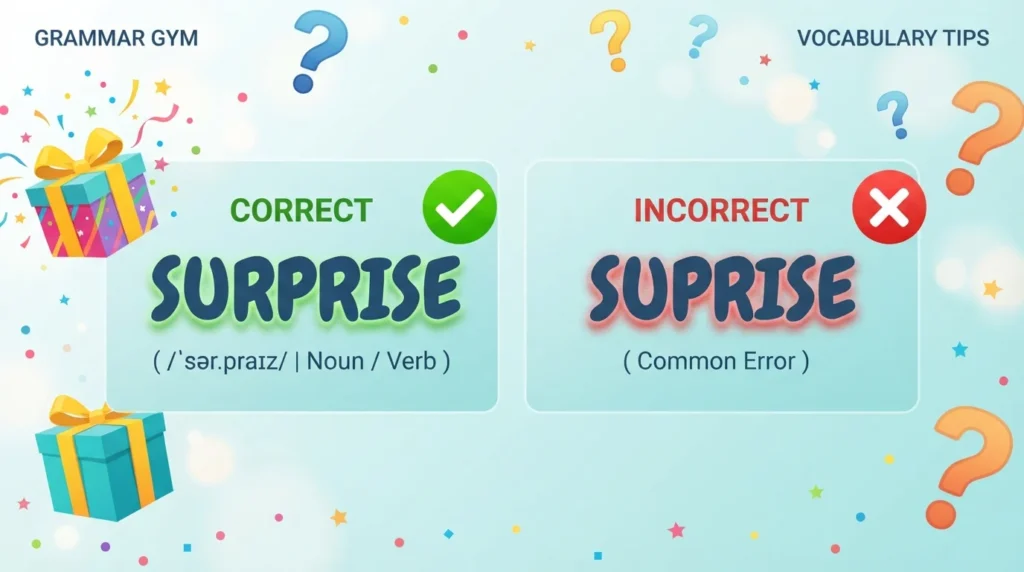

Quick Ans: Surprise is the correct spelling. Suprise is a common misspelling and should not be used in formal or informal writing. The confusion usually happens because people accidentally omit the first r when spelling the word.
English contains many words with tricky spellings, and surprise or surprise is one of the most commonly misspelled word pairs. Many writers and students accidentally type surprise, especially when writing quickly.
However, only one spelling is correct.
This guide explains the difference between the two spellings, why the mistake happens, and when you should always use surprise.
Surprise or Suprise: What’s the Difference?
What Does Surprise Mean?
Surprise can be a noun or a verb.
As a noun, it means an unexpected event or something that happens suddenly.
As a verb, it means to cause someone to feel astonished or amazed.
Examples:
- The birthday party was a wonderful surprise.
- Her gift completely surprised me.
- We planned a surprise celebration.
What Does Suprise Mean?
Suprise is an incorrect spelling.
It is not recognized by English dictionaries and is considered a spelling mistake.
| Word | Part of Speech | Correct Word | Meaning |
|---|---|---|---|
| Surprise | Noun/Verb | ✅ Yes | An unexpected event or to astonish someone |
| Suprise | Misspelling | ❌ No | Incorrect spelling of surprise |
Quick Recap
- Surprise is the correct spelling.
- Suprise is a misspelling.
- The correct word contains two r letters.
Is Surprise or Suprise a Grammar, Vocabulary, or Usage Issue?
Grammar
No. This is not a grammar issue.
Vocabulary
Yes. The confusion involves choosing the correct spelling of a vocabulary word.
Usage
Yes. Using suprise instead of surprise is considered incorrect in professional and academic writing.
Are Surprise and Suprise Interchangeable?
No.
Only surprise is a valid English word, so the two spellings cannot be used interchangeably.
Formal Writing
Always use surprise in:
- Business emails
- Academic papers
- News articles
- Professional documents
Casual Writing
Even in text messages and social media posts, surprise remains the correct spelling.
Understanding Surprise
Meaning
A surprise is something unexpected that causes amazement, excitement, or shock.
As a verb, to surprise means to do something unexpected that astonishes someone.
Workplace Example
The company announced a bonus as a surprise for its employees.
Academic Example
The teacher gave the class a surprise quiz.
Literature Example
The ending of the novel came as a complete surprise.
Everyday Example
My friends organized a surprise birthday party for me.
Usage Recap
Use surprise when referring to:
- Unexpected events
- Gifts or celebrations
- Astonishment or amazement
- Something done without warning
Understanding Suprise
Meaning
Suprise has no meaning in standard English.
It is simply a misspelling of surprise.
Internet Example
Many people type suprise because they accidentally leave out the first r.
Writing Example
Most spell-check tools automatically change suprise to surprise.
Usage Recap
Avoid using suprise in:
- Essays
- Articles
- Emails
- Business documents
- Academic writing
Why Do People Spell It as Suprise?
The mistake usually happens because English pronunciation makes the first r difficult to notice.
When speaking quickly, some people pronounce the word in a way that sounds similar to suprise, leading to spelling errors.
Another reason is simple typing mistakes.
The correct spelling always includes two r letters:
S-U-R-P-R-I-S-E
Historical Background of the Word Surprise
The word surprise comes from the Old French word surprendre, meaning “to overtake unexpectedly.”
Over time, the spelling evolved into the modern English form surprise, which has remained unchanged for centuries.
When You Should Not Use Suprise
Common Situations to Avoid
Do not write:
❌ Suprise party
❌ Suprise gift
❌ Suprise announcement
❌ Suprise visit
Always write:
✅ Surprise party
✅ Surprise gift
✅ Surprise announcement
✅ Surprise visit
Common Mistakes and Decision Rules
Common Mistakes
| Correct Sentence | Incorrect Sentence | Explanation |
|---|---|---|
| The news was a surprise. | The news was a suprise. | Surprise is the correct spelling. |
| They planned a surprise party. | They planned a suprise party. | Suprise is incorrect. |
| Her visit surprised everyone. | Her visit suprised everyone. | The verb also keeps both r’s. |
| The ending was a complete surprise. | The ending was a complete suprise. | Always spell it with two r’s. |
Decision Rule
If you mean:
- An unexpected event
- Something astonishing
- A hidden gift or celebration
- To amaze someone
Always use surprise.
Never use suprise.
Surprise in Modern Media and Technology
Search engines, dictionaries, and AI writing tools recognize surprise as the standard spelling.
Most grammar-checking software automatically flags suprise as a spelling error.
Using the correct spelling improves your credibility and professionalism.
Expert Opinion
Language experts agree that surprise is the only accepted spelling.
The form suprise exists mainly because of typing mistakes and pronunciation confusion.
Case Studies
Case Study One
A business website repeatedly used the spelling suprise offer.
After correcting the spelling to surprise offer, the content appeared more professional and trustworthy.
Case Study Two
A student wrote suprise test several times in an essay.
The teacher corrected each instance because suprise is not a recognized English word.
Error Prevention Checklist
Always Use Surprise When
- Writing about unexpected events
- Describing parties or gifts
- Talking about astonishment
- Writing professionally
- Creating academic content
Never Use Suprise When
- Writing essays
- Publishing articles
- Sending business emails
- Creating website content
- Describing unexpected events
Related Word Confusions You Should Master
- Separate or Seperate
- Receive or Recieve
- Definitely or Definately
- Occasion or Ocassion
- Embarrass or Embarass
- Weird or Wierd
- Principal or Principle
- Than or Then
- Affect or Effect
- Complement or Compliment
Frequently Asked Questions
Is surprise or suprise correct?
Surprise is correct.
Why do people spell surprise as suprise?
Because they accidentally omit the first r or rely on pronunciation instead of the correct spelling.
Is suprise a real English word?
No. It is a misspelling.
How do you remember the spelling of surprise?
Remember that surprise has two r letters:
S-U-R-P-R-I-S-E.
Is surprise a noun or a verb?
It can be both.
- Noun: The gift was a surprise.
- Verb: The gift surprised me.
Does spell-check recognize suprise?
Yes. Most writing tools flag suprise as an error and suggest surprise.
Conclusion
When comparing surprise or surprise, only one spelling is correct. Surprise is the accepted English word used for unexpected events and feelings of amazement, while surprise is simply a common spelling mistake. Remember this simple rule: whenever you write the word, make sure it contains two surprises, never surprise.