
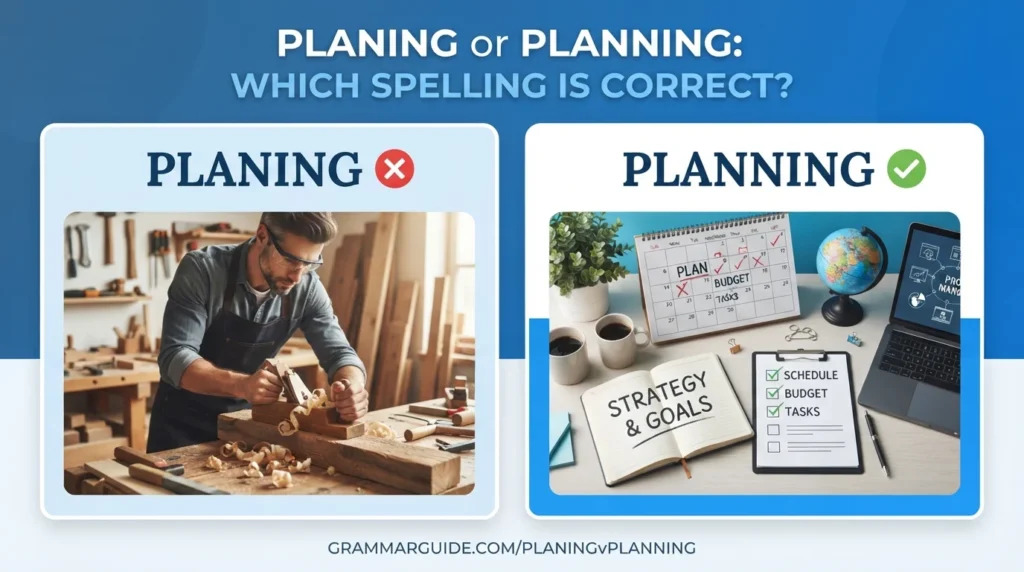

Quick Ans: Planning is the correct spelling in almost every situation. Planing is a real English word, but it has a completely different meaning. If you’re talking about making plans, organizing tasks, or preparing for the future, planning is the word you should use.
Many English learners and even native speakers get confused between planing and planning because the two words look almost identical. The only visible difference is an extra n, but that single letter changes the meaning entirely.
If you’ve searched for planing or planning, you’re probably wondering which spelling is correct. The answer depends on what you want to say. In most everyday conversations, emails, assignments, blog posts, business documents, and professional writing, planning is the correct choice.
In this complete guide, you’ll learn the difference between planing or planning, discover why one spelling is usually correct, understand the grammar rule behind it, explore real-life examples, avoid common mistakes, and learn an easy trick to remember the correct spelling forever.
| Correct Word |
|---|
| ✅ Planning (when talking about making plans) |
Planing vs. Planning: Which One Is Correct?
The correct spelling depends on the meaning of your sentence.
If you’re talking about preparing for something, organizing work, setting goals, or thinking about the future, the correct word is planning.
However, planing is also a real English word. It refers to smoothing the surface of wood with a tool called a plane, or in some technical contexts, moving smoothly over a surface, such as a boat or aircraft.
For everyday English, though, people almost always mean planning.
| Word | Correct? | Meaning |
| Planning | ✅ Yes | Making plans, organizing, preparing for the future |
| Planing | ✅ Yes (different meaning) | Smoothing wood with a plane or gliding over a surface |
The confusion happens because many people accidentally remove one n from planning, making the word incorrect for the intended meaning.
Why Is It Planning and Not Planing?
The answer comes from a common English spelling rule.
The base word is:
Plan
When a one-syllable verb ends in a single vowel followed by a single consonant, you usually double the final consonant before adding -ing.
So:
Plan → Planning ✅
Not:
Plan → Planing ❌ (when you mean making plans)
The extra n is necessary because it follows the standard spelling rule in English.
Other examples include:
- Run → Running
- Sit → Sitting
- Swim → Swimming
- Begin → Beginning
Notice that each word doubles the final consonant before adding -ing.
The same rule applies to plan.
What Does Planning Mean?
The word planning refers to the process of preparing for something before it happens.
It involves thinking ahead, setting goals, organizing resources, solving problems, and deciding the best course of action.
People use planning in almost every area of life.
1. Planning for School
Students use planning to complete assignments, prepare for exams, and manage their study schedules.
Examples:
- She is planning her study timetable.
- Good planning helps students achieve better grades.
- They are planning their science project.
2. Planning at Work
Businesses rely on planning to complete projects, meet deadlines, and improve productivity.
Examples:
- We are planning next year’s marketing campaign.
- The manager spent the morning planning the budget.
- Careful planning saved both time and money.
3. Planning Personal Goals
People often plan vacations, weddings, birthdays, savings, and career goals.
Examples:
- They are planning a trip to Italy.
- She is planning her wedding.
- I’m planning to start my own business.
What Does Planing Mean?
Unlike planning, planing is a technical word.
It comes from the verb plane, not plan.
Its most common meaning is smoothing wood using a woodworking tool called a plane.
Examples:
- The carpenter is planing the wooden board.
- He spent the afternoon planing the edges of the table.
In engineering and transportation, planing can also describe a boat or aircraft gliding smoothly over a surface.
For example:
- The speedboat was planing across the water.
Because these situations are uncommon in everyday writing, most people searching planing or planning actually need planning.
Common Mistakes People Make
Many writers accidentally type planing when they mean planning.
Here are some common mistakes.
❌ We are planing our vacation.
✅ We are planning our vacation.
❌ She is planing her future.
✅ She is planning her future.
❌ They started planing the event last month.
✅ They started planning the event last month.
❌ Good planing leads to success.
✅ Good planning leads to success.
These mistakes are easy to avoid once you remember the spelling rule.
Easy Trick to Remember the Difference
Here’s a simple memory trick.
If you’re talking about making plans, remember this formula:
Plan + ning = Planning
The extra n helps remind you that you’re organizing, preparing, and thinking ahead.
If you’re talking about cutting or smoothing wood, then planing is correct.
Think of it this way:
Planning = Plans
Planing = Plane (woodworking tool)
Once you connect each word with its meaning, you’ll never confuse them again.
Examples of Planning in Sentences
Below are some examples showing how planning is used correctly.
- We are planning a family vacation.
- Careful planning reduces mistakes.
- She enjoys planning birthday parties.
- They started planning the new office.
- Good financial planning can improve your future.
- He is planning to buy a new house.
- The company is planning to expand overseas.
- Proper planning saves both time and money.
- She’s planning her career carefully.
- They spent weeks planning the conference.
Examples of Planing in Sentences
Here are examples where planing is actually correct.
- The carpenter is planing a wooden board.
- He finished planing the table before painting it.
- The woodworker enjoys planing furniture by hand.
- The speedboat was planing across the lake.
- The aircraft began planing over the water during landing.
Notice that these examples have nothing to do with making plans.
Planning or Planing in Business Writing
In professional communication, planning is one of the most frequently used words.
Examples include:
- Strategic planning
- Business planning
- Financial planning
- Project planning
- Event planning
- Career planning
- Marketing planning
- Resource planning
- Workforce planning
- Budget planning
Using planing in these situations would be incorrect.
Planning or Planing in Academic Writing
Students often use the word planning in essays, reports, and assignments.
For example:
- Planning is an important part of project management.
- Effective planning improves academic performance.
- Time planning helps students meet deadlines.
- Lesson planning is essential for teachers.
- Research planning ensures better results.
Again, planing would not fit these contexts.
Quick Comparison
| Feature | Planning | Planing |
| Refers to making plans | ✅ Yes | ❌ No |
| Refers to woodworking | ❌ No | ✅ Yes |
| Common in everyday English | ✅ Yes | Rare |
| Used in business writing | ✅ Yes | ❌ No |
| Used in school assignments | ✅ Yes | ❌ No |
| Standard spelling for organizing | ✅ Yes | ❌ No |
| Remember This Rule |
| Plan → Planning ✅ |
| Plane → Planing ✅ |
Frequently Asked Questions
Is planning or planing correct?
If you’re talking about organizing, preparing, or making plans, planning is the correct spelling.
Why does planning have two “n”s?
Because the verb plan follows the English spelling rule that doubles the final consonant before adding -ing.
Is planing a real word?
Yes. Planing is a real English word, but it refers to smoothing wood with a plane or gliding over a surface.
Which word should I use in business writing?
Always use planning when discussing projects, strategies, budgets, meetings, goals, or future activities.
How can I remember the difference?
Remember this simple trick:
Planning = Making plans
Planing = Using a plane
Conclusion
Although planing and planning look very similar, they have completely different meanings. Planning is the correct spelling when you’re talking about organizing, preparing, setting goals, or making plans for the future. Planing, on the other hand, is a specialized term used mainly in woodworking and certain technical fields.
Whenever you’re writing emails, essays, blog posts, business reports, or everyday conversations, you’ll almost always need planning. Remember the simple spelling rule Plan → Planning and you’ll never confuse these two words again.