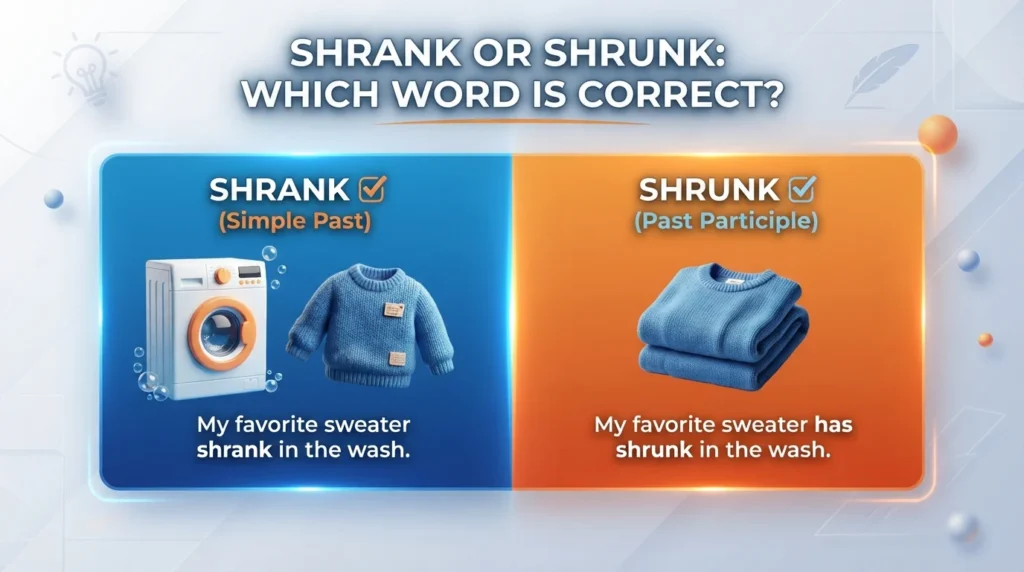

Quick Ans: Both shrank and shrunk are correct, but they are used in different grammatical situations. Shrank is the simple past tense of shrink, while shrunk is the past participle and is usually used with helping verbs such as has, have, or had.
If you’ve ever wondered whether you should write shrank or shrunk, you’re not alone. Many English learners and even native speakers confuse these two forms because both come from the same verb shrink. Although they are closely related, they are not interchangeable in every sentence.
Understanding the difference between shrank and shrunk will improve your grammar, make your writing sound more natural, and help you avoid one of the most common English verb mistakes.
In this complete guide, you’ll learn the meanings of shrank and shrunk, discover when each one should be used, explore grammar rules, compare them with real-life examples, and find an easy memory trick so you’ll never confuse them again.
Shrank vs. Shrunk: Which One Is Correct?
The answer is simple:
- Shrank is the simple past tense of shrink.
- Shrunk is the past participle of shrink.
Both words are correct, but they are used in different types of sentences.
| Word | Grammar Form | Correct? | Example |
| Shrank | Simple Past | ✅ Yes | The sweater shrank after washing. |
| Shrunk | Past Participle | ✅ Yes | The sweater has shrunk after several washes. |
The key is remembering which verb tense you are using.
What Does “Shrink” Mean?
Before learning the difference between shrank and shrunk, it’s helpful to understand the base verb.
Shrink means:
- to become smaller
- to reduce in size
- to become less in amount
- to contract
- to pull back because of fear or embarrassment
Examples
- Cotton clothes may shrink in hot water.
- The company hopes to shrink its expenses.
- He didn’t shrink from responsibility.
When Should You Use “Shrank”?
Use shrank when talking about something that happened in the past without using a helping verb.
It is the simple past tense.
Formula
Subject + shrank + object
Examples
- My sweater shrank after I washed it.
- The lake shrank during the summer.
- Sales shrank significantly last year.
- The crowd shrank as the weather became colder.
- His confidence shrank after the failure.
In every sentence above, the action happened in the past and is complete.
When Should You Use “Shrunk”?
Use shrunk as the past participle.
It normally appears with helping verbs such as:
- has
- have
- had
- was
- were
- is
- are
- be
- been
Formula
Subject + has/have/had + shrunk
Examples
- My sweater has shrunk.
- The market has shrunk considerably.
- Their profits have shrunk this year.
- The shirt had shrunk before I wore it again.
- The fabric has shrunk after several washes.
These sentences use perfect tenses, so shrunk is required.
Why Do People Confuse Shrank and Shrunk?
Many people assume both words mean exactly the same thing.
Although they both come from the verb shrink, their grammatical functions are different.
Compare these sentences:
✅ The dress shrank in the dryer.
✅ The dress has shrunk in the dryer.
Both are correct because the verb tense is different.
However:
❌ The dress has shrank.
❌ The dress had shrank.
These are incorrect because shrank cannot be used as a past participle in standard English.
Shrank vs. Shrunk: Side-by-Side Comparison
| Feature | Shrank | Shrunk |
| Verb Form | Simple Past | Past Participle |
| Used Alone | ✅ Yes | ❌ Usually No |
| Used After Has/Have/Had | ❌ No | ✅ Yes |
| Formal English | ✅ Yes | ✅ Yes |
| Common in Everyday Speech | ✅ Yes | ✅ Yes |
Examples of Shrank in Sentences
Below are examples showing the correct use of shrank.
- The wool sweater shrank after one wash.
- Our profits shrank last quarter.
- The glacier shrank because of rising temperatures.
- His audience shrank over time.
- The balloon shrank as the air escaped.
- The company shrank its workforce.
- My jeans shrank in hot water.
- The river shrank during the drought.
- Her confidence shrank after the criticism.
- The economy shrank unexpectedly.
Examples of Shrunk in Sentences
Here are examples using shrunk correctly.
- My sweater has shrunk.
- Their savings have shrunk over the years.
- The company’s profits have shrunk dramatically.
- His confidence has shrunk since the incident.
- The shirt had shrunk before I noticed.
- The fabric has shrunk after repeated washing.
- The population has shrunk over the last decade.
- The ice has shrunk because of warmer temperatures.
- My favorite jacket has shrunk.
- The audience has shrunk significantly.
Common Grammar Mistakes
Many learners accidentally mix these two forms.
Incorrect
❌ My sweater has shrank.
Correct
✅ My sweater has shrunk.
Incorrect
❌ The lake has shrank.
Correct
✅ The lake has shrunk.
Incorrect
❌ My shirt shrunk yesterday.
Preferred Standard English
✅ My shirt shrank yesterday.
Memory Trick to Remember the Difference
A simple trick makes remembering these words easy.
Think of this pattern:
- Yesterday = Shrank
- Has/Have/Had = Shrunk
Examples:
Yesterday the sweater shrank.
The sweater has shrunk.
Whenever you see has, have, or had, your brain should automatically choose shrunk.
Is “Shrunk” Ever Used Without a Helping Verb?
In modern standard English, shrunk is generally used as a past participle.
However, in some regional dialects and informal speech, you may hear people use shrunk as a simple past tense.
For example:
“My shirt shrunk.”
Although this is common in casual conversation, most grammar guides recommend using shrank as the simple past in formal writing.
Shrank or Shrunk in American and British English
Both American English and British English follow the same standard grammar.
Simple Past:
✅ shrank
Past Participle:
✅ shrunk
There is no major difference between the two varieties regarding these forms.
Words Often Confused With Shrank and Shrunk
Many irregular verbs create similar confusion.
Examples include:
- drank / drunk
- sank / sunk
- sprang / sprung
- began / begun
- rang / rung
Like shrank and shrunk, these pairs follow the same grammar pattern:
Simple Past → Past Participle
Quick Comparison
| Situation | Correct Word |
| Yesterday my shirt | Shrank ✅ |
| My shirt has | Shrunk ✅ |
| The river last summer. | Shrank ✅ |
| The river has over time. | Shrunk ✅ |
| Our profits last year. | Shrank ✅ |
| Our profits have recently. | Shrunk ✅ |
Frequently Asked Questions
Is shrank or shrunk correct?
Both are correct. Shrank is the simple past tense, while shrunk is the past participle.
Which is correct: “has shrank” or “has shrunk”?
Has shrunk is correct.
Can I say “my shirt shrunk”?
In everyday conversation, many people do. However, in standard English and formal writing, my shirt shrank is preferred.
Is shrunk a real word?
Yes. It is the past participle of shrink.
What is the easiest way to remember the difference?
Remember this simple rule:
Yesterday = Shrank
Has/Have/Had = Shrunk
Conclusion
Choosing between shrank and shrunk becomes easy once you understand the verb tense. Use shrank for the simple past when describing an action that happened in the past without a helping verb. Use shrunk as the past participle after helping verbs like has, have, or had. Following this simple grammar rule will make your English sound more natural, accurate, and professional in both writing and conversation.