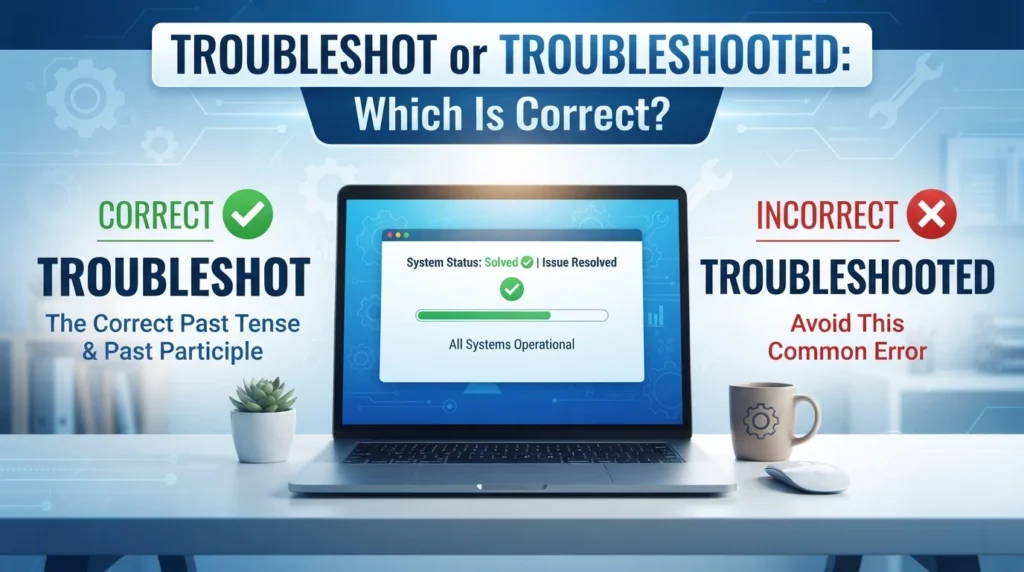

Quick Ans: Troubleshot is the correct past tense and past participle of troubleshooting in modern English. Troubleshooted is considered nonstandard and should generally be avoided in professional, academic, and technical writing.
Have you ever wondered whether you should write troubleshot or troubleshooted? You’re not alone. Many English learners, IT professionals, students, and even native speakers hesitate when choosing between these two forms.
Since troubleshoot is commonly used in technology, engineering, customer support, and business, using the correct past tense is important. Whether you’re writing a resume, technical documentation, email, blog post, or school assignment, choosing the right form helps your writing sound more professional and credible.
In this comprehensive guide, you’ll learn the difference between troubleshot or troubleshooted, discover which one is grammatically correct, understand why the confusion exists, see real-world examples, and learn an easy trick to remember the correct usage forever.
Troubleshot vs. Troubleshooted: Which One Is Correct?
The correct word is troubleshot.
Troubleshot is the standard past tense and past participle of the verb troubleshoot. It is the form recommended by modern dictionaries and widely used by IT professionals, software companies, engineers, and technical writers.
Troubleshooted, on the other hand, is generally considered nonstandard. Although some people use it informally because it follows the regular -ed pattern, it is not the preferred form in standard English.
| Word | Correct? | Meaning |
|---|---|---|
| Troubleshot | ✅ Yes | Correct past tense and past participle of troubleshoot |
| Troubleshooted | ❌ No (Nonstandard) | Common but incorrect or nonstandard alternative |
What Does Troubleshoot Mean?
Before understanding the correct past tense, it’s important to know what troubleshoot actually means.
Troubleshoot means to identify, diagnose, and solve a problem or fault in a system, machine, computer, software, network, or process.
It is one of the most common verbs in technical English.
Examples
- The technician will troubleshoot the network issue.
- Our support team can troubleshoot software errors.
- Engineers troubleshoot production problems every day.
The action always involves finding the cause of a problem and fixing it.
Why Is It Troubleshot Instead of Troubleshooted?
This is the question that confuses most writers.
Unlike regular verbs, troubleshoot follows an irregular pattern.
The second part of the word comes from the verb shoot.
Notice these forms:
- Shoot → Shot
- Troubleshoot → Troubleshot
Because shoot becomes shot, troubleshoot becomes troubleshot.
It does not become troubleshooted.
Think of it this way:
Shoot → Shot
Troubleshoot → Troubleshot
Once you remember the pattern of shoot, you’ll never forget the correct form.
Why Do People Say Troubleshooted?
Many English learners naturally assume every verb forms its past tense by adding -ed.
For example:
- Walk → Walked
- Clean → Cleaned
- Repair → Repaired
So they incorrectly apply the same rule:
- Troubleshoot → Troubleshooted ❌
However, English contains many irregular verbs that don’t follow this pattern.
Since troubleshoot is based on shoot, its past tense changes differently.
That is why troubleshot is accepted while troubleshooted is generally avoided.
How Is Troubleshot Used?
The word troubleshot can function as both the past tense and the past participle.
1. Past Tense
Use troubleshot when describing a completed action.
Examples:
- The technician troubleshot the printer yesterday.
- She troubleshot the server before the meeting.
- Our engineer troubleshot the network outage.
2. Past Participle
Use it with helping verbs.
Examples:
- The issue has been troubleshot successfully.
- Every problem had already been troubleshot before launch.
- The equipment was fully troubleshot before delivery.
Real-Life Examples of Troubleshot
Here are practical examples you may see in workplaces and technical environments.
- The IT department troubleshot the email issue within an hour.
- Our developers troubleshot the software bug before release.
- The engineer troubleshot the machine during maintenance.
- She troubleshot the Wi-Fi connection successfully.
- The customer support team troubleshot hundreds of cases this week.
- They had already troubleshot the system before the upgrade.
- Every network issue was carefully troubleshot.
- He troubleshot the application using diagnostic tools.
- We troubleshot the database error before deployment.
- The hardware problem was completely troubleshot.
Common Mistakes to Avoid
Many writers accidentally use troubleshooted.
Here are some examples.
❌ The technician troubleshooted the computer.
✅ The technician troubleshot the computer.
❌ We have troubleshooted the problem.
✅ We have troubleshot the problem.
❌ She troubleshooted the printer yesterday.
✅ She troubleshot the printer yesterday.
Using troubleshot will make your writing sound more professional and grammatically accurate.
Easy Trick to Remember the Correct Word
Here’s a simple memory trick.
The last part of troubleshoot is shoot.
What is the past tense of shoot?
Shot
Therefore:
Troubleshoot → Troubleshot
Not:
Troubleshoot → Troubleshooted
Remember this simple formula:
Shoot → Shot
Troubleshoot → Troubleshot
This is the easiest way to remember the correct form.
Troubleshot vs. Troubleshooted in Professional Writing
Professional industries almost always prefer troubleshot.
You’ll commonly find it in:
- IT documentation
- Software manuals
- Technical support articles
- Engineering reports
- User guides
- Product documentation
- Company knowledge bases
- Business emails
- System maintenance reports
Using troubleshot demonstrates familiarity with standard English and technical writing conventions.
Is Troubleshooted Ever Acceptable?
Some speakers occasionally use troubleshooted, especially in informal conversation.
However, most respected dictionaries, style guides, and professional publications recommend troubleshot.
If you’re writing for school, work, certification exams, websites, or clients, always choose troubleshot.
It is the safer, more widely accepted option.
Troubleshot or Troubleshooted: Quick Comparison
| Feature | Troubleshot | Troubleshooted |
| Correct standard English | ✅ Yes | ❌ No |
| Used in professional writing | ✅ Yes | ❌ Rarely |
| Found in technical documentation | ✅ Yes | ❌ Almost Never |
| Recommended for resumes and reports | ✅ Yes | ❌ No |
| Grammatically preferred | ✅ Yes | ❌ No |
Remember: If you’re choosing between troubleshot or troubleshooted, the correct answer is troubleshot.
Frequently Asked Questions
Is troubleshot or troubleshooted correct?
Troubleshot is the correct form in standard English.
Why isn’t troubleshooted correct?
Because troubleshoot follows the irregular pattern of shoot → shot, making its past tense troubleshot.
Is troubleshot a real word?
Yes. It is the accepted past tense and past participle of troubleshoot.
Can I use troubleshooted in formal writing?
No. It is generally considered nonstandard and should be avoided in academic, technical, and professional writing.
How do IT professionals usually write it?
Most IT professionals, software companies, and technical writers use troubleshot in reports, manuals, and documentation.
What is the easiest way to remember the correct form?
Remember:
Shoot → Shot
So:
Troubleshoot → Troubleshot
Conclusion
Choosing between troubleshot or troubleshooted becomes easy once you understand the grammar behind the word. Since troubleshoot is built from the verb shoot, it follows the same irregular pattern: shoot → shot, which gives us troubleshot. Although troubleshooted occasionally appears in informal usage, it is not the preferred form in modern English. Whether you’re writing technical documentation, an email, a resume, or a blog post, using troubleshot ensures your writing is accurate, professional, and aligned with standard English grammar.