
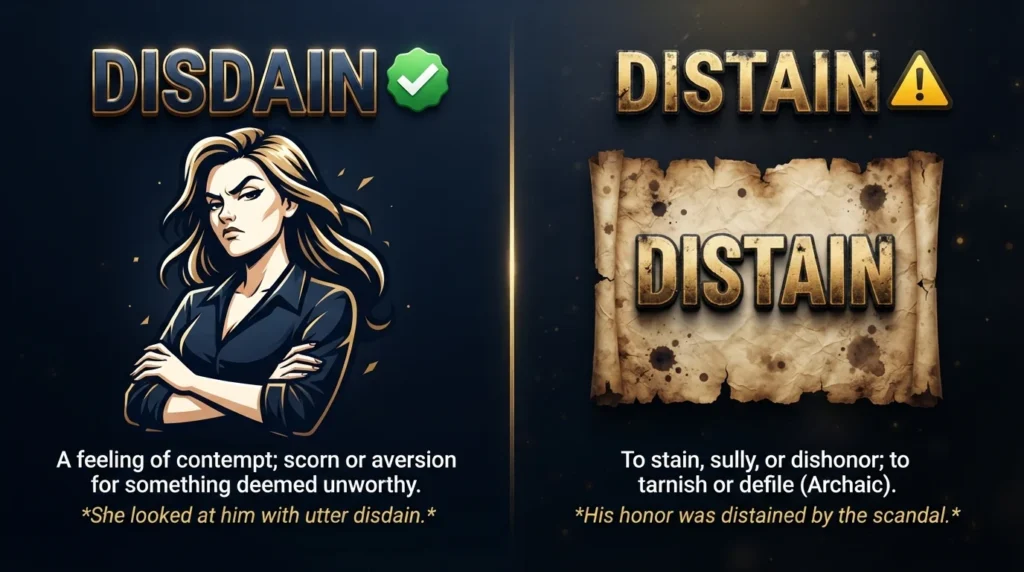

Quick Ans: Both disdain and distain are real English words, but they have completely different meanings. If you want to express contempt, disrespect, or a feeling that someone or something is beneath you, the correct word is disdain. Distain is an old and very rare verb that means to stain or discolor something and is almost never used in modern English.
Many English learners and even native speakers confuse disdain and distain because they differ by only one letter. Spell checkers may not always catch the mistake because both words exist in English, but using the wrong one can completely change the meaning of your sentence.
In this guide, you’ll learn the difference between disdain or distain, discover when each word should be used, explore their meanings with real examples, understand why they are often confused, and learn a few simple tricks that will help you remember the correct word forever.
Disdain vs. Distain: Which One Is Correct?
If you’re talking about hatred, contempt, disrespect, or looking down on someone, the correct word is disdain.
Distain is also a real word, but it has a completely different meaning and is considered archaic (old-fashioned) in modern English.
| Word | Correct? | Meaning |
|---|---|---|
| Disdain | ✅ Yes | Contempt, scorn, or feeling someone is unworthy of respect |
| Distain | ✅ Rare | To stain, discolor, or tarnish something (archaic) |
For modern English writing, essays, emails, blog posts, business communication, and exams, disdain is almost always the word you need.
What Does Disdain Mean?
Disdain means a strong feeling that someone or something is unworthy of respect.
A person who shows disdain believes another person, idea, or thing is beneath them.
It can be used as both a noun and a verb.
Disdain as a Noun
As a noun, disdain refers to the feeling itself.
Examples:
- She looked at the proposal with disdain.
- His voice was filled with disdain.
- They treated the rules with complete disdain.
- The audience expressed their disdain for the poor performance.
Disdain as a Verb
As a verb, disdain means to consider someone or something beneath your dignity.
Examples:
- He disdained dishonest behavior.
- She disdains unnecessary arguments.
- They disdained accepting charity.
- The manager disdained making false promises.
What Does Distain Mean?
Unlike disdain, the word distain has nothing to do with respect or contempt.
Distain means to stain, discolor, or tarnish something.
This word comes from older forms of English and is rarely used today.
In fact, many dictionaries label it as archaic, meaning it belongs to historical or literary English rather than everyday communication.
Examples of Distain
- The smoke distained the white walls.
- Rainwater distained the old painting.
- Time had distained the ancient manuscript.
Although these sentences are grammatically acceptable, modern writers would almost always choose stain instead of distain.
Why Do People Confuse Disdain and Distain?
There are several reasons why these two words are commonly mixed up.
1. Nearly Identical Spelling
The only difference is one letter.
- Disdain
- Distain
Because they look almost identical, people often type the wrong one accidentally.
2. Similar Pronunciation
When spoken quickly, they can sound alike, especially for English learners.
3. Both Are Real Words
Unlike many spelling mistakes, distain actually exists in the dictionary.
That makes the confusion even more common because spell-check software may not highlight the mistake.
4. Distain Is Extremely Rare
Since most people never encounter distain, they assume it’s simply another spelling of disdain, which is incorrect.
Why Is Disdain the Right Choice in Most Situations?
If your sentence talks about emotions, attitudes, respect, arrogance, criticism, or contempt, you should almost always choose disdain.
For example:
✅ She looked at him with disdain.
❌ She looked at him with distain.
Another example:
✅ The politician spoke with disdain.
❌ The politician spoke with distain.
Using disdain makes your writing accurate and natural.
How to Remember the Difference
A simple memory trick can save you from making this mistake.
Think about the word:
Disdain = Disrespect
Both begin with “Dis-“.
If your sentence is about disrespect, choose disdain.
Now think about distain.
It contains the word stain.
That can remind you that it relates to staining or discoloring, not emotions.
Remember:
Disdain → Disrespect ✅
Distain → Stain (old word) ✅
This trick works almost every time.
Examples of Disdain in Sentences
Here are some examples showing the correct use of disdain.
- She couldn’t hide her disdain for dishonesty.
- His disdain for corruption was obvious.
- They spoke with disdain about the decision.
- The teacher showed disdain toward cheating.
- He regarded the rumor with disdain.
- Many readers expressed disdain for the ending.
- She disdains rude behavior.
- His expression revealed complete disdain.
- The critics wrote with obvious disdain.
- Their actions reflected disdain for the law.
Examples of Distain in Sentences
Although uncommon, these examples show the historical meaning.
- Dust had distained the curtains.
- Smoke distained the ceiling.
- The old cloth was distained with age.
- Mud distained his boots.
- Years of weather had distained the stone.
In modern English, most writers simply use stain instead.
Common Mistakes to Avoid
Many people accidentally replace disdain with distain because they assume the words are interchangeable.
For example:
❌ She looked at him with distain.
✅ She looked at him with disdain.
Another example:
❌ His distain for dishonesty was obvious.
✅ His disdain for dishonesty was obvious.
If you’re talking about an attitude or emotion, disdain is almost certainly the correct choice.
Quick Comparison
| Feature | Disdain | Distain |
| Modern English | ✅ Very Common | ❌ Extremely Rare |
| Expresses contempt | ✅ Yes | ❌ No |
| Means to stain something | ❌ No | ✅ Yes |
| Suitable for essays | ✅ Yes | ❌ Usually No |
| Used in business writing | ✅ Yes | ❌ No |
| Recommended for everyday English | ✅ Yes | ❌ No |
Remember: If your sentence is about contempt, disrespect, arrogance, or scorn, always choose disdain.
Frequently Asked Questions
Is disdain or distain correct?
Both words exist, but disdain is the correct choice when talking about contempt or disrespect. Distain is an old word meaning “to stain” and is rarely used today.
What does disdain mean?
Disdain means a feeling of contempt, scorn, or believing that someone or something is beneath your respect.
Is distain a real word?
Yes. Distain is a real English word, but it is archaic and means to stain or discolor something.
Which word should I use in modern English?
You should almost always use disdain, unless you’re reading or writing historical literature where distain appears with its original meaning.
How can I remember the difference?
Think of this simple rule:
Disdain = Disrespect
Distain = Stain
Conclusion:
Although disdain and distain look almost identical, they have very different meanings. Disdain is the word used to describe contempt, disrespect, or scorn, making it the correct choice in nearly every modern conversation, essay, article, or professional document. Distain, on the other hand, is an old and uncommon verb meaning to stain or discolor, and it rarely appears in everyday English. Whenever you’re unsure which word to use, remember that disdain belongs to the language of emotions and attitudes, while distain belongs to historical descriptions of staining. Choosing the right word will make your writing more accurate, natural, and professional.