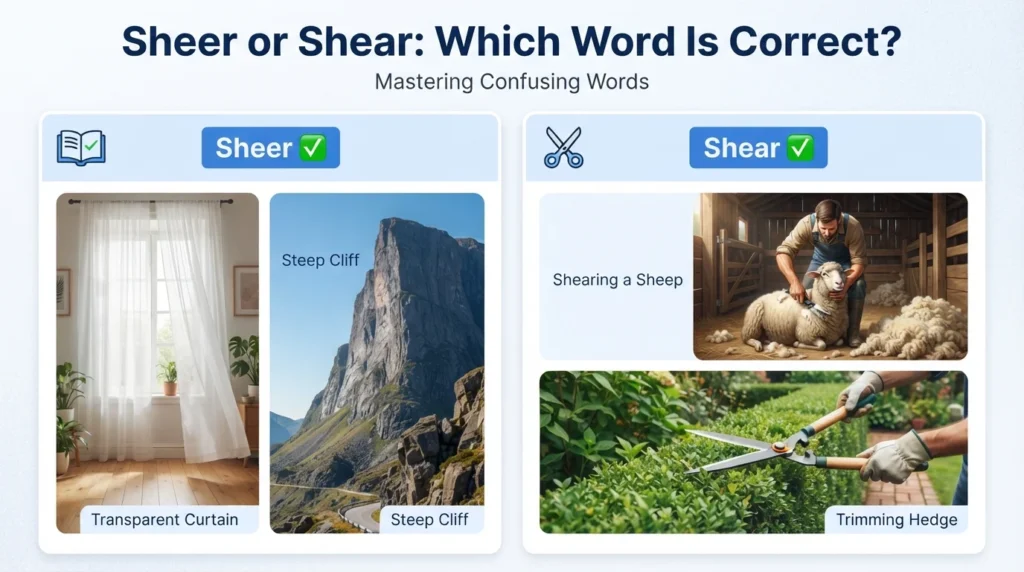

Quick Ans: Sheer and shear are both correct English words, but they have completely different meanings. Sheer usually means complete, very steep, or transparent, while shear means to cut, trim, or break by force. Choosing the right word depends entirely on the context.
Many English learners get confused between sheer and shear because they sound exactly the same. Since they are homophones (words with the same pronunciation but different spellings and meanings), it’s easy to mix them up in writing.
However, using the wrong word can completely change the meaning of your sentence. For example, saying “a sheer sheep” instead of “to shear a sheep” is grammatically incorrect and confusing.
In this comprehensive guide, you’ll learn the difference between sheer or shear, their meanings, pronunciation, grammar, examples, memory tricks, common mistakes, and when to use each word correctly. By the end of this article, you’ll never confuse these two commonly mixed-up English words again.
Sheer vs. Shear: Which One Is Correct?
The answer is simple:
Both sheer and shear are correct words.
The important question isn’t which spelling is correct, but which word fits your sentence.
| Word | Part of Speech | Meaning | Correct? |
|---|---|---|---|
| Sheer | Adjective / Adverb | Complete, transparent, extremely steep | ✅ Yes |
| Shear | Verb / Noun | To cut, trim, or break by force | ✅ Yes |
Although they sound identical, their meanings are completely unrelated.
What Does Sheer Mean?
The word sheer has several meanings depending on the situation. It is most commonly used as an adjective.
1. Sheer Means Complete or Absolute
One of the most common meanings of sheer is complete, total, or absolute.
It emphasizes that something exists without any doubt or mixture.
Examples:
- Winning the competition was a matter of sheer determination.
- It was sheer luck that saved us.
- His success came through sheer hard work.
- The audience watched in sheer amazement.
- Escaping the accident was sheer coincidence.
In these examples, sheer means complete or absolute.
2. Sheer Means Very Steep
Sheer can also describe something that rises or falls almost vertically.
Examples:
- The hikers climbed a sheer cliff.
- The mountain had sheer rock walls.
- Looking down the sheer drop made everyone nervous.
- The castle stood on a sheer hillside.
Here, sheer describes something extremely steep.
3. Sheer Means Thin or Transparent
In fashion and textiles, sheer refers to a fabric that is very light, thin, or see through.
Examples:
- She wore a sheer blouse.
- The curtains were made from sheer fabric.
- A sheer scarf covered her shoulders.
- Designers often use sheer materials in evening dresses.
This meaning is very common in clothing and interior design.
What Does Shear Mean?
Unlike sheer, the word shear usually functions as a verb.
It means to cut, trim, clip, or separate something by force.
1. Shear Means to Cut Wool from Sheep
The most familiar meaning of shear is cutting wool from sheep.
Examples:
- Farmers shear sheep every year.
- They began shearing the sheep in spring.
- The workers carefully sheared hundreds of sheep.
- Professional equipment helps shear animals safely.
This is the origin of the word.
2. Shear Means to Cut or Trim
Shear can also refer to cutting plants, bushes, hedges, or hair.
Examples:
- They sheared the bushes before winter.
- Gardeners shear hedges regularly.
- The machine can shear metal sheets.
- Workers used special tools to shear steel.
3. Shear Means Breaking Through Force
In engineering and physics, shear describes force that causes materials to slide or break.
Examples:
- The earthquake caused shear stress.
- Engineers study shear forces when designing bridges.
- Strong winds created shear pressure on the building.
- Metal may fail under excessive shear force.
Why Do People Confuse Sheer and Shear?
The biggest reason is pronunciation.
Both words are pronounced exactly the same.
Because English contains many homophones, writers sometimes choose the wrong spelling.
For example:
❌ It was shear luck.
✅ It was sheer luck.
Another example:
❌ The farmer sheered the sheep.
✅ The farmer sheared the sheep.
Although only one letter changes, the meaning changes completely.
Sheer vs. Shear: Side-by-Side Comparison
| Feature | Sheer | Shear |
| Meaning | Complete, transparent, steep | Cut, trim, separate |
| Part of Speech | Adjective, Adverb | Verb, Noun |
| Used for Clothing | ✅ Yes | ❌ No |
| Used for Sheep | ❌ No | ✅ Yes |
| Used for Luck | ✅ Yes | ❌ No |
| Used in Engineering | Rarely | ✅ Yes |
Grammar Rule
Understanding the grammar makes choosing the correct word much easier.
Use Sheer When:
- Talking about complete or absolute situations.
- Describing transparent fabric.
- Describing steep surfaces.
- Emphasizing intensity.
Use Shear When:
- Talking about cutting.
- Referring to sheep or wool.
- Discussing trimming plants.
- Mentioning engineering or physics.
Examples of Sheer in Sentences
Here are more examples using sheer correctly.
- The victory was achieved through sheer persistence.
- We stood beside a sheer cliff.
- The curtains were made of sheer silk.
- She smiled with sheer joy.
- His talent is sheer brilliance.
- The building rose from a sheer rock face.
- It was sheer excitement.
- They escaped by sheer luck.
- Her dress featured sheer sleeves.
- The audience watched in sheer disbelief.
Examples of Shear in Sentences
Now let’s see shear in action.
- Farmers shear sheep every spring.
- Please shear the hedge evenly.
- The machine can shear thick steel.
- Workers sheared the bushes yesterday.
- Engineers calculated the shear force.
- Wind shear delayed the flight.
- The blades can shear metal quickly.
- They sheared the wool carefully.
- Construction materials must resist shear stress.
- Gardeners often shear shrubs into neat shapes.
Common Mistakes
Many writers accidentally replace one word with the other.
Incorrect
❌ It was shear determination.
Correct
✅ It was sheer determination.
Incorrect
❌ The farmer sheered the sheep.
Correct
✅ The farmer sheared the sheep.
Incorrect
❌ She bought a shear dress.
Correct
✅ She bought a sheer dress.
Incorrect
❌ The sheer force broke the metal.
Correct
✅ The shear force broke the metal.
Easy Trick to Remember the Difference
A simple memory trick can help.
Remember “Sheer”
Think of the double EE in sheer as Easy to see through.
EE → Easy → See-through → Transparent
It also reminds you of sheer luck and sheer determination.
Remember “Shear”
Think of the A in shear as Action.
Cutting is an action.
Farmers shear sheep.
Gardeners shear hedges.
Machines shear metal.
Is Sheer or Shear Used More Often?
Both words are common, but they appear in different situations.
Sheer is more common in everyday conversations because people often say:
- sheer luck
- sheer determination
- sheer joy
- sheer cliff
Meanwhile, shear appears frequently in agriculture, engineering, construction, aviation, and manufacturing.
Neither word is better they simply belong in different contexts.
Frequently Asked Questions
Is it sheer or shear luck?
The correct phrase is sheer luck.
Is it shear sheep or sheer sheep?
The correct verb is shear sheep.
Is a transparent dress called sheer or shear?
The correct word is sheer.
What does shear mean?
It means to cut, trim, clip, or separate something using force.
Why are sheer and shear confusing?
Because they are homophones they sound the same but have different meanings and spellings.
Conclusion
Although sheer and shear sound exactly alike, they are two completely different words with different meanings and uses. Use sheer when talking about something that is complete, transparent, or extremely steep. Use shear when referring to cutting, trimming, removing wool from sheep, or discussing force in engineering. Learning the difference between these two homophones will make your English more accurate, natural, and professional. Whenever you’re unsure between sheer or shear, think about the meaning of your sentence first that will always lead you to the correct choice.