
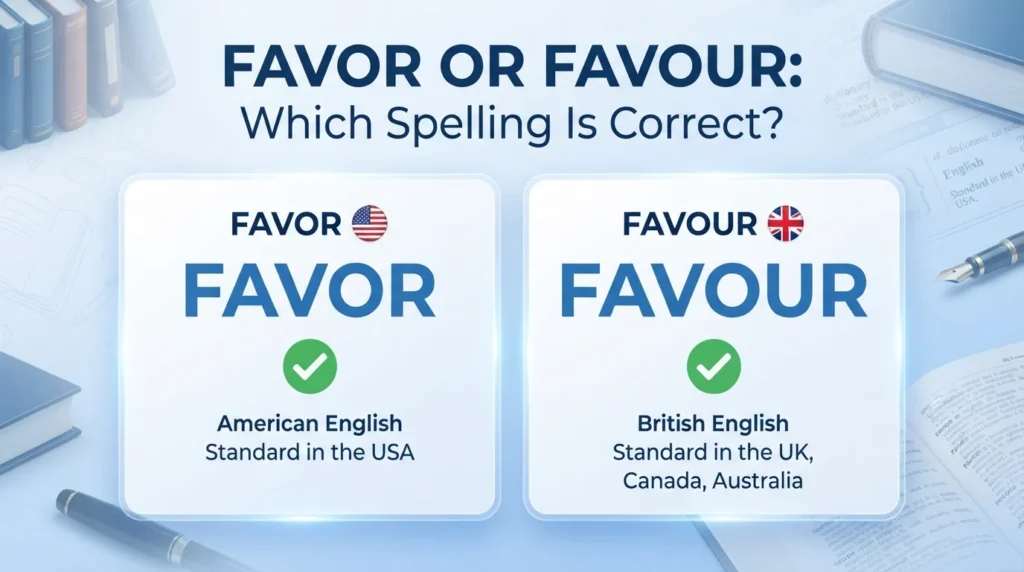

Quick Ans: Both favor and favour are correct. The only difference is the variety of English you are using. Favor is the preferred spelling in American English, while favour is the standard spelling in British, Canadian, Australian, and most other forms of English.
English learners often wonder whether they should write favor or favour. Since both spellings appear in books, websites, newspapers, and official documents, it’s easy to become confused. The good news is that neither spelling is wrong. Instead, the correct choice depends on whether you’re writing in American English or British English.
Understanding the difference between favor or favour is important because using one spelling consistently makes your writing look professional and polished. Whether you’re writing a school assignment, a business email, a blog post, or website content, choosing the appropriate spelling for your audience improves readability and credibility.
In this guide, you’ll learn the difference between favor and favour, discover when each spelling should be used, explore their meanings, see real examples, and find an easy trick to remember which one is right for your writing.
Favor vs. Favour: Which One Is Correct?
Both favor and favour are correct spellings of the same word.
The only difference is the type of English being used.
| Word | Correct? | Used In |
|---|---|---|
| Favor | ✅ Yes | American English (US) |
| Favour | ✅ Yes | British English, Canadian English, Australian English, and other Commonwealth countries |
The meaning, pronunciation, and usage are exactly the same. Only the spelling changes according to regional writing standards.
For example:
- American English: Can you do me a favor?
- British English: Can you do me a favour?
Both sentences have the same meaning.
What Does Favor or Favour Mean?
The word favor (or favour) has several meanings depending on the context.
It commonly refers to:
- A kind or helpful act.
- Approval or support.
- Something done to help another person.
- Preference for one person or thing over another.
Regardless of which spelling you choose, the meaning never changes.
When Should You Use Favor?
Use favor if you are writing in American English.
This spelling is standard in the United States and appears in American dictionaries, newspapers, schools, universities, and official publications.
Examples
- Could you do me a favor?
- She asked her friend for a favor.
- The judge ruled in their favor.
- They decided to favor quality over quantity.
- He returned the favor the following week.
If your audience is primarily American, favor is the preferred spelling.
When Should You Use Favour?
Use favour when writing in British English or other varieties that follow British spelling conventions.
Countries that commonly use favour include:
- United Kingdom
- Canada
- Australia
- New Zealand
- Ireland
- South Africa
Examples
- Could you do me a favour?
- She thanked him for the favour.
- The decision was in our favour.
- Parents should not favour one child over another.
- He returned the favour after receiving help.
If your readers are in these regions, favour is the better choice.
Why Are There Two Different Spellings?
The difference between favor and favour comes from the evolution of English spelling.
American English simplified the spelling of many words by removing the letter u.
Examples include:
- Color → Colour
- Honor → Honour
- Labor → Labour
- Neighbor → Neighbour
- Favor → Favour
American dictionaries adopted the shorter spellings, while British English continued using the traditional forms with u.
Today, both spellings are considered correct within their respective writing systems.
Favor and Favour Have the Same Meaning
Although the spellings differ, the meanings remain identical.
Both words can describe kindness, support, approval, preference, or assistance.
For example:
American English:
Thank you for doing me a favor.
British English:
Thank you for doing me a favour.
Both sentences communicate exactly the same idea.
Common Uses of Favor or Favour
1. Asking Someone for Help
This is one of the most common uses.
Examples:
- Can you do me a favor?
- Could you do me a favour?
2. Showing Support
The word can also mean supporting someone or something.
Examples:
- Most voters were in favor of the proposal.
- Most voters were in favour of the proposal.
3. Showing Preference
It can describe choosing one thing over another.
Examples:
- The manager tends to favor experienced employees.
- The manager tends to favour experienced employees.
4. Returning Kindness
People often say they will “return the favor.”
Examples:
- She promised to return the favor.
- She promised to return the favour.
Common Mistakes
A common mistake is mixing American and British spellings in the same document.
For example:
❌ The company offers excellent customer favour, and employees appreciate every favor.
This mixes two spelling systems.
Instead, stay consistent.
American English:
✅ The company offers excellent customer favor, and employees appreciate every favor.
British English:
✅ The company offers excellent customer favour, and employees appreciate every favour.
Consistency makes your writing more professional.
Easy Trick to Remember the Difference
A simple way to remember is to think about the country.
United States = Favor
No letter u.
United Kingdom = Favour
Includes the letter u.
Remember this shortcut:
America = Favor 🇺🇸
Britain = Favour 🇬🇧
This simple memory trick helps you choose the correct spelling every time.
Examples of Favor in Sentences
Here are some American English examples.
- Can you do me a favor?
- She appreciated the favor.
- They ruled in our favor.
- He asked for a small favor.
- The coach tends to favor younger players.
- Thank you for the wonderful favor.
- She returned the favor immediately.
- The evidence worked in his favor.
Examples of Favour in Sentences
Here are some British English examples.
- Could you do me a favour?
- She thanked him for the favour.
- The decision was in our favour.
- The teacher did not favour any student.
- He returned the favour a few days later.
- Public opinion was in favour of the proposal.
- They asked for one final favour.
- Everyone appreciated her generous favour.
Is One Spelling More Correct Than the Other?
No.
Neither spelling is more correct.
Favor is correct in American English.
Favour is correct in British English.
The most important rule is to remain consistent throughout your writing.
If you begin with American spelling, continue using American spellings.
If you begin with British spelling, continue using British spellings.
Quick Comparison
| Feature | Favor | Favour |
| Correct spelling | ✅ Yes | ✅ Yes |
| American English | ✅ Yes | ❌ No |
| British English | ❌ No | ✅ Yes |
| Same meaning | ✅ Yes | ✅ Yes |
| Same pronunciation | ✅ Yes | ✅ Yes |
Remember: Whenever you’re deciding between favor or favour, both are correct the right choice depends on your audience and the variety of English you’re using.
Frequently Asked Questions
Is favor or favour correct?
Both are correct. Favor is American English, while favour is British English.
Which spelling should I use?
Use favor for American audiences and favour for British, Canadian, Australian, or other Commonwealth audiences.
Do favor and favour have different meanings?
No. They have exactly the same meaning and pronunciation.
Why does British English use “u”?
British English keeps the traditional spelling, while American English removed the letter u from many words.
Can I use both spellings in one article?
It’s best not to. Choose one spelling system and use it consistently throughout your writing.
Conclusion
Choosing between favor or favour is simple once you know the difference. Both spellings are correct, and both have the same meaning. The only distinction is the variety of English you are writing in. If your audience is in the United States, use favor. If you’re writing for readers in the United Kingdom, Canada, Australia, or other countries that follow British English, use favour. Staying consistent with one spelling style throughout your document will make your writing clear, professional, and easy to read.