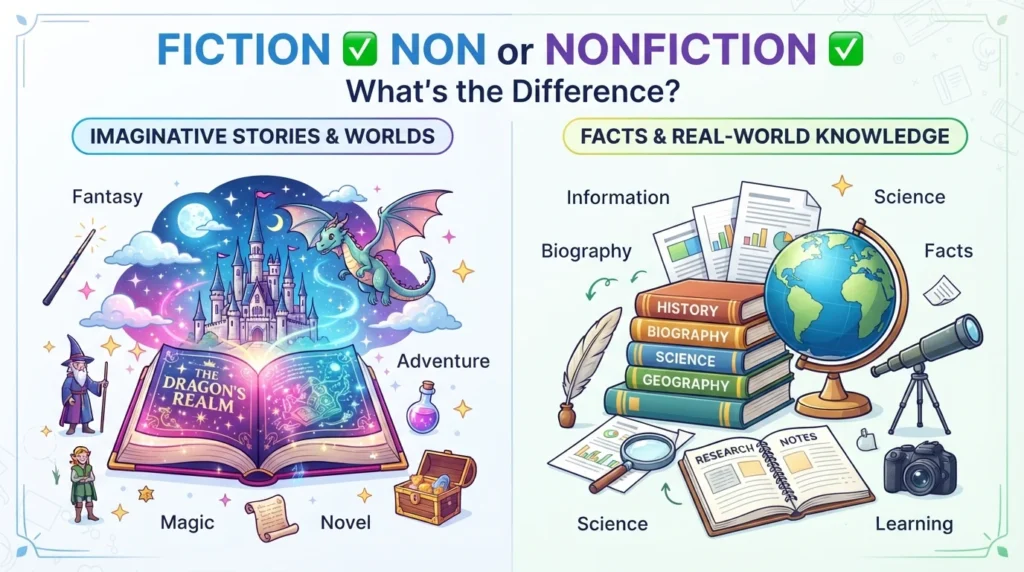

Quick Ans: Fiction refers to stories created from the author’s imagination, while nonfiction is based on real people, real events, and factual information. Both are correct, but they serve different purposes.
Many readers wonder about the difference between fiction or nonfiction. While these terms are commonly used in bookstores, libraries, schools, and online bookshops, they often confuse new readers and writers.
Understanding the distinction is important because it helps you choose the right type of book for learning, entertainment, or research. Whether you’re shopping for books, writing an assignment, or improving your English vocabulary, knowing when to use fiction and nonfiction will make your communication more accurate.
In this complete guide, you’ll learn the meaning of fiction and nonfiction, their key differences, examples, common mistakes, and an easy way to remember which one to use.
Fiction vs. Nonfiction: Which One Is Correct?
Both fiction and nonfiction are correct English words.
However, they describe two completely different categories of writing.
| Word | Correct? | Meaning |
|---|---|---|
| Fiction | ✅ Yes | Stories created from imagination |
| Nonfiction | ✅ Yes | Writing based on real facts, people, and events |
The choice between fiction and nonfiction depends entirely on what kind of content you’re describing.
What Is Fiction?
Fiction is writing that comes from the author’s imagination. Although a fictional story may include realistic settings or historical inspiration, the characters, dialogue, or events are invented.
The purpose of fiction is usually to entertain, inspire, or tell a compelling story.
Common forms of fiction include:
- Novels
- Short stories
- Fairy tales
- Fantasy books
- Science fiction
- Mystery novels
- Romance novels
- Adventure stories
- Historical fiction
Examples of Fiction
- Harry Potter is a work of fiction.
- The Lord of the Rings is fictional.
- Fairy tales like Cinderella are fiction.
- Detective novels are usually fiction.
- Most superhero stories are fiction.
What Is Nonfiction?
Nonfiction is writing based on facts, real people, true events, and verified information.
Its main purpose is to educate, explain, inform, or document reality.
Common types of nonfiction include:
- Biographies
- Autobiographies
- History books
- Science books
- News articles
- Encyclopedias
- Textbooks
- Travel guides
- Self-help books
- Memoirs
Examples of Nonfiction
- A biography of Albert Einstein is nonfiction.
- A history book about World War II is nonfiction.
- Medical textbooks are nonfiction.
- A cookbook is nonfiction.
- A travel guide about Japan is nonfiction.
The Main Difference Between Fiction and Nonfiction
The biggest difference is simple.
Fiction tells imagined stories.
Nonfiction presents real information.
Think about the author’s goal.
If the goal is storytelling using imagination, it’s fiction.
If the goal is sharing facts or explaining reality, it’s nonfiction.
Fiction vs. Nonfiction Comparison
| Feature | Fiction | Nonfiction |
| Based on imagination | ✅ Yes | ❌ No |
| Based on real facts | ❌ No | ✅ Yes |
| Includes invented characters | ✅ Yes | ❌ Usually No |
| Used for entertainment | ✅ Mostly | Sometimes |
| Used for education | Sometimes | ✅ Mostly |
| Includes true events | Sometimes inspired | ✅ Yes |
When Should You Use the Word Fiction?
Use fiction when talking about stories that are invented rather than real.
Examples
- I enjoy reading fiction before bed.
- She writes historical fiction novels.
- Fantasy books belong to the fiction section.
- The characters are completely fictional.
- Fiction allows writers to use unlimited creativity.
When Should You Use the Word Nonfiction?
Use nonfiction when referring to books or articles that present factual information.
Examples
- I prefer nonfiction books about history.
- This biography is nonfiction.
- Scientists often publish nonfiction books.
- Our teacher assigned a nonfiction reading project.
- The documentary was based on a nonfiction book.
Popular Genres of Fiction
Fiction contains many different genres.
Some of the most popular include:
Fantasy
Stories involving magic, mythical creatures, or imaginary worlds.
Example:
Harry Potter.
Science Fiction
Stories about advanced technology, space travel, or future civilizations.
Example:
Dune.
Mystery
Stories where readers solve crimes or puzzles.
Example:
Sherlock Holmes.
Romance
Stories focused on relationships and love.
Horror
Stories designed to scare or create suspense.
Historical Fiction
Imaginary stories set during real historical periods.
Popular Types of Nonfiction
Nonfiction also includes many categories.
Biography
The life story of another person.
Autobiography
The story of someone’s own life.
Memoir
Personal memories from a specific period.
Self-Help
Books designed to improve personal development.
Educational Books
Books used in schools and universities.
News Reporting
Articles based on verified events.
Common Mistakes People Make
Many learners mistakenly think nonfiction must always be boring.
That’s not true.
Many nonfiction books tell exciting true stories.
Another mistake is believing fiction cannot teach anything.
Good fiction often teaches valuable lessons about courage, friendship, leadership, history, or human nature.
Some books even combine real historical settings with fictional characters.
Easy Trick to Remember the Difference
Here’s an easy memory trick.
Fiction = Fake Story
Both words begin with the letter F.
Think:
Fiction = Fake (imagined) story.
Nonfiction = Not Fake
The prefix non- means “not.”
So:
Nonfiction = Not fiction = Real facts.
This simple trick helps many English learners remember the difference instantly.
Fiction and Nonfiction in Schools
Students usually read both fiction and nonfiction.
Teachers often assign fiction to improve imagination, vocabulary, reading fluency, and literary analysis.
Nonfiction helps students develop research skills, understand real-world topics, and build factual knowledge.
Reading both types creates a balanced education.
Fiction and Nonfiction in Libraries
Libraries organize books into fiction and nonfiction sections.
The fiction section usually contains novels, short stories, fantasy books, mysteries, romance, and science fiction.
The nonfiction section includes history, science, business, religion, biographies, travel, cooking, health, and reference materials.
Knowing the difference makes finding books much easier.
Why Both Fiction and Nonfiction Matter
Neither category is better than the other.
Fiction encourages creativity, empathy, imagination, and emotional understanding.
Nonfiction builds knowledge, critical thinking, research skills, and awareness of the real world.
Most lifelong readers enjoy both depending on their mood and purpose.
Examples in Sentences
Here are some correct examples.
Fiction
- She loves reading fiction every evening.
- My favorite fiction author writes mystery novels.
- This fantasy series is pure fiction.
- The characters are fictional but relatable.
- Fiction allows readers to escape into new worlds.
Nonfiction
- I bought a nonfiction book about climate change.
- His autobiography is nonfiction.
- Our history teacher recommended nonfiction reading.
- The documentary follows a nonfiction bestseller.
- Most school textbooks are nonfiction.
Frequently Asked Questions
Is fiction or nonfiction better?
Neither is better. Fiction entertains and inspires, while nonfiction informs and educates.
Can fiction include real places?
Yes. Fiction may use real places or historical periods, but the main story is imagined.
Is a biography fiction?
No. A biography is nonfiction because it tells the true story of a real person’s life.
Are textbooks fiction or nonfiction?
Textbooks are nonfiction because they present factual information.
Can nonfiction be interesting?
Absolutely. Many biographies, travel books, history books, and science books are highly engaging.
Conclusion
Understanding the difference between fiction or nonfiction is essential for readers, students, writers, and anyone learning English. Fiction is based on imagination and tells invented stories designed to entertain or inspire, while nonfiction focuses on real people, real events, and factual information. Both play an important role in reading and learning. Whenever you’re choosing between fiction and nonfiction, simply remember this easy rule: fiction tells imagined stories, and nonfiction tells true stories based on facts.