
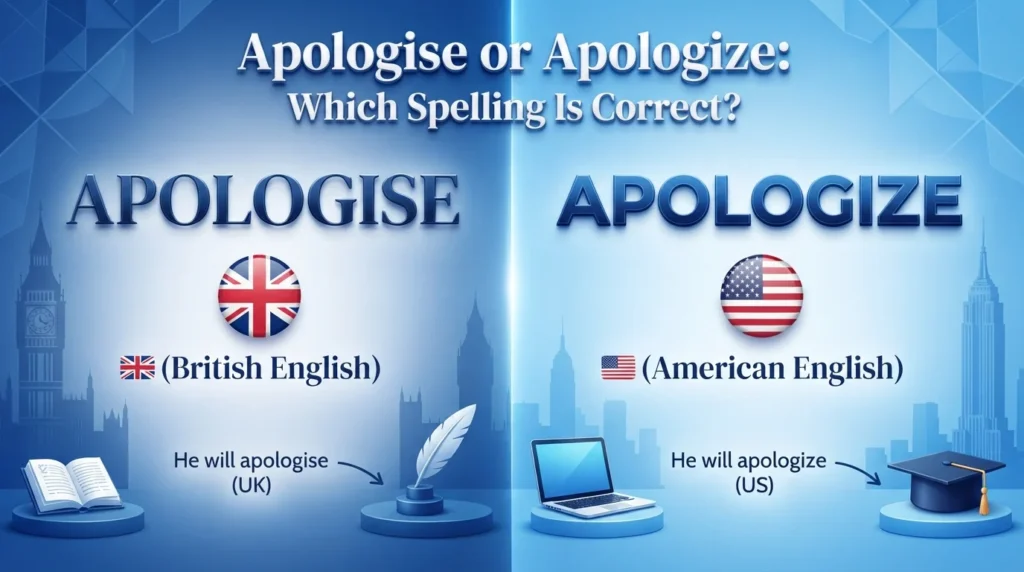

Quick Ans: Both apologise and apologize are correct. The difference is based on the type of English you are using. Apologise is the preferred spelling in British English, while apologize is the standard spelling in American English.
Many English learners become confused when they see both apologise and apologize used online, in books, or in professional writing. At first glance, they appear to be different words, but they actually have the same meaning. The only real difference is the variety of English being used.
In this complete guide, you’ll learn the difference between apologise or apologize, discover when to use each spelling, understand why both versions exist, and see dozens of real-world examples that will help you choose the correct word every time.
Apologise vs. Apologize: Which One Is Correct?
The answer is simple:
Both spellings are correct.
The correct choice depends on whether you are writing in British English or American English.
| Word | Correct? | Used In |
|---|---|---|
| Apologise | ✅ Yes | British English, Australian English, New Zealand English |
| Apologize | ✅ Yes | American English and Canadian English (commonly) |
Neither spelling is grammatically wrong. You simply need to stay consistent throughout your writing.
Word Comparison Box
| British English | American English |
| ✅ Apologise | ✅ Apologize |
What Does “Apologise” Mean?
Apologise means to say sorry for something you have done wrong or to express regret for a mistake, misunderstanding, or inconvenience.
It is the preferred spelling in countries that follow British English, including:
- United Kingdom
- Australia
- New Zealand
- South Africa
- Ireland (commonly)
Examples
- I must apologise for arriving late.
- She wanted to apologise to her teacher.
- Please apologise if I caused any confusion.
- He called to apologise for the mistake.
What Does “Apologize” Mean?
Apologize has exactly the same meaning as apologise.
The only difference is spelling.
It is the standard form used in American English.
Examples
- I want to apologize for my behavior.
- She decided to apologize immediately.
- We sincerely apologize for the inconvenience.
- They apologized after realizing their mistake.
Why Are There Two Different Spellings?
The difference comes from the evolution of English.
British English traditionally uses -ise endings in many verbs.
American English usually prefers -ize endings.
This spelling difference can also be seen in many other words.
| British English | American English |
| Apologise | Apologize |
| Organise | Organize |
| Realise | Realize |
| Recognise | Recognize |
| Optimise | Optimize |
| Civilise | Civilize |
Although the spelling changes, the meaning and pronunciation remain almost identical.
Which Spelling Should You Use?
The best choice depends on your audience.
Use apologise if you are writing for:
- British readers
- UK businesses
- British universities
- Australian audiences
- New Zealand publications
Use apologize if you are writing for:
- American readers
- US companies
- American universities
- International businesses using American English
The most important rule is to stay consistent. Avoid mixing British and American spellings in the same article, report, or document.
Grammar Rule Behind Apologise and Apologize
Both words are verbs.
Their grammatical forms work exactly the same.
Base Form
- apologise
- apologize
Present Participle
- apologising
- apologizing
Past Tense
- apologised
- apologized
Past Participle
- apologised
- apologized
The spelling changes only because of the English variety not because of grammar.
Examples in Everyday Sentences
Here are some examples using apologise.
- I should apologise for interrupting you.
- She came to apologise in person.
- They refused to apologise.
- We sincerely apologise for the delay.
- He finally decided to apologise.
Now look at the American spelling.
- I want to apologize for being late.
- She forgot to apologize.
- We apologize for any inconvenience.
- They immediately apologized.
- He promised to apologize tomorrow.
Both sets of sentences are completely correct.
Common Mistakes People Make
Many learners believe one spelling is wrong.
That is not true.
Here are some common mistakes.
Mistake 1: Thinking Apologise Is Incorrect
❌ Apologise is wrong.
✅ Apologise is correct in British English.
Mistake 2: Thinking Apologize Is Incorrect
❌ Apologize is incorrect.
✅ Apologize is correct in American English.
Mistake 3: Mixing Both Spellings
Incorrect:
We apologise for the delay. Our company apologizes for the inconvenience.
Correct (British):
We apologise for the delay. We apologise for the inconvenience.
Correct (American):
We apologize for the delay. We apologize for the inconvenience.
Choose one spelling style and keep it throughout the document.
Easy Trick to Remember the Difference
A simple memory trick is:
S = UK Style
Z = USA Style
So remember:
- ApologiSSe → Britain
- ApologiZe → America
This small trick makes the difference easy to remember.
Apologise vs. Apologize in Professional Writing
Businesses often choose one spelling based on their location.
For example:
A British company may write:
We sincerely apologise for any inconvenience caused.
An American company may write:
We sincerely apologize for any inconvenience caused.
Both statements are equally professional.
Is One More Correct Than the Other?
No.
Neither spelling is more correct.
Language style guides simply recommend using the spelling that matches the variety of English you are writing.
If your article is written in British English, use apologise.
If your article follows American English, use apologize.
Frequently Asked Questions
Is apologise or apologize correct?
Both are correct. Apologise is British English, while apologize is American English.
Which spelling should I use?
Use the spelling that matches your audience and remain consistent throughout your writing.
Do they have different meanings?
No. They both mean to express regret or say sorry.
Is apologize American English?
Yes. Apologize is the standard spelling in American English.
Is apologise British English?
Yes. Apologise is the preferred spelling in British English.
Which spelling is more common worldwide?
Both are widely accepted, but apologize appears more frequently online because American English has a large global influence.
Can I use both in one article?
No. It is better to choose one style and use it consistently.
Conclusion
When choosing between apologise or apologize, remember that both spellings are correct. The only difference is the variety of English you are using. If you write in British English, use apologise. If you write in American English, use apologize. Neither spelling changes the meaning of the word they both simply mean to say sorry or express regret. By understanding your audience and staying consistent with one spelling style, you can write clearly, professionally, and confidently.