
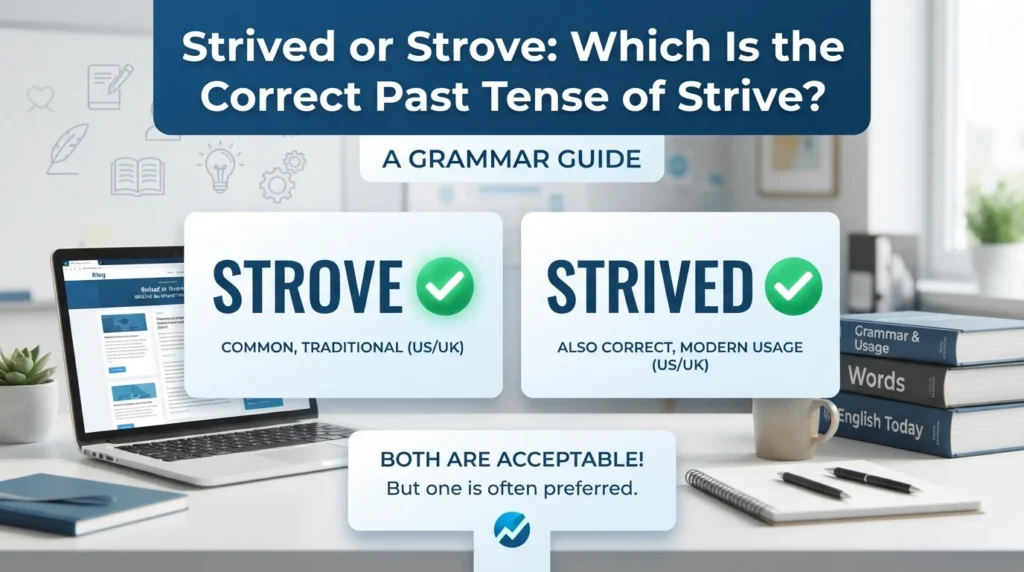

Quick Ans: Both strived and strove are correct, but strove is the traditional and more widely accepted past tense of strive. Strived is also correct and is commonly used in modern English, especially in business, education, and everyday writing.
Many English learners get confused when choosing between strived or strove. Since both words are accepted in English, it’s natural to wonder which one sounds more correct and when each should be used.
The confusion exists because strive has two accepted past tense forms. While strove has been used for centuries and is considered the traditional form, strived has become increasingly common in modern English. Today, both forms appear in dictionaries and are grammatically correct.
In this article, you’ll learn the difference between strived and strove, discover when each word should be used, see real examples, understand the grammar rule behind them, and learn an easy trick to remember the correct form.
Strived vs. Strove: Which One Is Correct?
The short answer is that both are correct.
However, they are used slightly differently depending on style and context.
| Word | Correct? | Usage |
| Strove | ✅ Yes | Traditional and most common simple past tense of strive |
| Strived | ✅ Yes | Modern alternative, especially common in business and everyday writing |
Most grammar experts recommend using strove in formal writing because it has been the standard past tense for hundreds of years. However, strived is no longer considered incorrect and appears in many respected dictionaries and publications.
If you’re writing an academic paper, professional article, or formal document, strove is usually the safer choice. If you’re writing conversational English, blog posts, or workplace content, strived is perfectly acceptable.
What Does “Strive” Mean?
Before comparing strived and strove, it’s important to understand the base verb strive.
Strive means:
- To make a great effort to achieve something
- To work hard toward a goal
- To struggle in order to succeed
- To continuously try to improve
Examples of Strive
- We strive for excellence every day.
- Students should strive to improve their skills.
- The company continues to strive for customer satisfaction.
- She always strives to become a better leader.
Why Are There Two Past Tense Forms?
Unlike most English verbs, strive has developed two accepted past tense forms over time.
Originally, English speakers used strove, following the pattern of many irregular verbs.
For example:
- Drive → Drove
- Ride → Rode
- Strive → Strove
Later, many speakers began using strived, treating strive like a regular verb by simply adding -ed.
Because both forms became common and widely understood, modern dictionaries now accept both.
This is why you’ll often see both strove and strived in books, articles, and professional writing.
When Should You Use “Strove”?
Strove is the traditional simple past tense of strive.
It is generally preferred in:
- Academic writing
- Literature
- Formal essays
- Professional publications
- Historical writing
Examples of Strove
- She strove to become the best doctor in her city.
- They strove for peace during difficult times.
- Our team strove to meet every deadline.
- He strove to improve his communication skills.
- The organization strove to help every family in need.
- Scientists strove to find a cure for the disease.
- The athletes strove for Olympic success.
- Every employee strove to exceed expectations.
In these examples, strove sounds natural, polished, and formal.
When Should You Use “Strived”?
Strived is also grammatically correct.
Although it was once considered less common, it has become increasingly popular in modern English, especially in business communication and everyday writing.
Many organizations, companies, and speakers use strived because it sounds consistent with regular English verbs.
Examples of Strived
- Our company strived to provide excellent customer service.
- She strived to improve every year.
- They strived to finish the project early.
- We strived for continuous improvement.
- The teacher strived to help every student succeed.
- He strived to become more confident.
- The team strived to achieve better results.
- They strived to build stronger relationships with customers.
Although these sentences are completely correct, some editors still prefer strove in highly formal writing.
Strived vs. Strove: What’s the Difference?
The biggest difference is not grammar—it’s style.
Both words describe the same action and have the same meaning.
The difference is mainly in preference.
| Feature | Strove | Strived |
| Grammatically correct | ✅ Yes | ✅ Yes |
| Traditional form | ✅ Yes | ❌ No |
| Modern usage | ✅ Yes | ✅ Yes |
| Formal writing | ⭐ Preferred | Acceptable |
| Business writing | Common | Very Common |
| Everyday English | Common | Common |
If you’re unsure which one to use, strove is usually the safer choice because it has broader acceptance in formal English.
Common Mistakes People Make
Many learners think only one word is correct.
That isn’t true.
Mistake 1
❌ Only strove is correct.
✅ Both strove and strived are accepted.
Mistake 2
❌ Strived is always wrong.
✅ Strived is recognized by major dictionaries and is widely used today.
Mistake 3
❌ Mixing different tenses in the same sentence.
Incorrect:
Yesterday we strove and today we striveed for success.
Correct:
Yesterday we strove for success.
or
Yesterday we strived for success.
Easy Trick to Remember the Difference
A simple memory trick can help you decide.
Think of these irregular verbs:
- Drive → Drove
- Ride → Rode
- Strive → Strove
This reminds you that strove is the traditional past tense.
If you’re writing casually or for business communication, remember that strived is also accepted.
So:
Formal writing → Strove
Modern everyday writing → Strived or Strove
Example Sentences Using Both Words
Here are more examples showing both forms correctly.
Using Strove
- She strove to become a successful entrepreneur.
- They strove for fairness in every decision.
- The players strove to win the championship.
- We strove to complete the work on time.
- He strove to inspire others.
Using Strived
- Our organization strived to improve customer satisfaction.
- The students strived to earn better grades.
- She strived for personal growth every year.
- We strived to meet our goals despite challenges.
- They strived to build a better future.
Both groups of sentences are grammatically correct.
Which Form Do Dictionaries Prefer?
Most modern dictionaries, including respected English references, recognize both forms.
However:
- Strove is often listed first because it is the historical and traditional past tense.
- Strived is also listed as an accepted alternative.
This means you don’t have to worry about being grammatically incorrect when using either word.
Instead, choose the one that best matches your writing style and audience.
Frequently Asked Questions
Is it strived or strove?
Both are correct. However, strove is the traditional and more widely preferred past tense of strive.
Is strived a real word?
Yes. Strived is a real English word and is accepted by major dictionaries.
Which sounds more formal?
Strove generally sounds more formal and is often preferred in academic and professional writing.
Can I use strived in business writing?
Yes. Many businesses and organizations regularly use strived in reports, websites, and company communications.
Which one should English learners use?
If you’re unsure, use strove because it is the more traditional form and is accepted in every context.
Conclusion
Choosing between strived or strove doesn’t have to be difficult. Both words are grammatically correct and express the past tense of strive. Strove is the traditional form and remains the preferred choice in formal and academic writing, while strived has become increasingly common in modern English, particularly in business and everyday communication. If you want the safest option that works in nearly every situation, choose strove. If your audience is more conversational or professional in a modern sense, strived is also a perfectly acceptable choice.